Every tree on this list arrived with somebody. Monkeypod only reached Hawaii in the 1840s, and the two thickest of them on the island's register stand behind a shopkeeper's store and in the front yard of a missionary house. The men of a governor of Kauai planted a banyan for him in the 1880s that now measures close to twenty metres round. A plantation owner emptied his leftover nursery stock along a mile of road and made a tunnel out of it. There is an African baobab behind a church in Koloa.
0 of 6 visited in Kauai
Rain Tree (Samanea saman) · 100 years · Old Koloa Town
The man who planted this tree ran the shop in front of it. Howard Yamamoto's family took over the Koloa general store in the early 1920s, and he put a monkeypod in the ground on the Waikomo Stream side of the building, back when the water was still called Koloa Stream. The trunk now measures just under seven metres round, and the county register, which lists it as an exceptional tree, rates its condition as good.
The store it shades was built in 1898 and rebuilt in 1983, so the tree has already outlived one version of the building it was planted behind. It is the shade in the yard where Old Koloa Town does its business, and it has been that since the shop was still a shop.
Its age is the one thing the sources argue about. The store's own history dates the planting to the early 1920s, which makes the tree about a hundred years old. A tourist photography site says 130 and confuses it with a famous monkeypod on Oahu, which is a different tree on a different island. We have gone with the store, on the grounds that the store was there.
Baobab (Adansonia sp.) · Old Koloa Town
A baobab is not what anybody expects to find behind a church in Hawaii. This one stands near the southeast corner of the yard at Koloa Missionary Church, and it sits on the county's register of exceptional trees, which records its condition as excellent and then stops. No girth, no assessment date, no planting record. The register does not even fix the species: it lists the tree as Adansonia, the baobab genus, without saying which baobab it is.
You will not mistake it for anything else. The genus carries an enormous swollen trunk and a crown of thin branches that look like roots held up in the air, which is worth the short walk over from the rest of Old Koloa Town on its own.
The most recent independent confirmation we could find is from 2016, when the Outdoor Circle featured it in a series on favourite trees. That is a long gap for a tree we are sending people to, and the pin marks the church rather than the trunk, because the register's coordinate is a grid point rather than a position. If you have stood in front of it lately, or you know which baobab it is or who put it there, tell us.
Indian Banyan (Ficus benghalensis) · 140 years · Niumalu
Twenty metres round is not a normal measurement for a tree. This banyan comes to 19.87 at the county's assessment, the largest figure recorded against any Kauai entry in the exceptional trees register, and it gets there the way banyans do: by dropping aerial roots that thicken into extra trunks until one tree becomes a grove of itself. Height 64 feet, condition excellent.
It was planted for a politician. The men of Paul P. Kanoa, governor of Kauai from 1882 to 1886, put it in on his own land in his honour, which makes the tree about 140 years old and the oldest on this list anybody can actually date. The property later passed to the Achi family, and in 1990, at their request, Kauai County declared it exceptional. The island's newspaper looked in on it again this year and reported that it still flourishes.
It stands roughly 84 feet east of Hulemanu Road, on the way down to the Menehune Fishpond, and that sentence is as precise as the record gets. The register describes rather than plots, so our pin marks the road and not the trunk. In practice that is enough. Look for the largest thing in sight.
Indian Laurel Fig (Ficus microcarpa) · 130 years · Nawiliwili
The road this tree was planted beside no longer exists. George N. Wilcox of Grove Farm put it in in 1895 on a curve of the Papalinahoa Road, which came down off Kuhiau Ridge to Nawiliwili. The tree stayed and the road went. What grew up around it instead is the Banyan Harbor Resort, so it now spends its days on the grounds of a working condo complex rather than in a park. The drive in is open and the tree is impossible to miss, but go knowing that this is somebody's address.
By the local paper's account it covers about two acres and has put down more than a thousand aerial roots. Its height is genuinely disputed and nobody has reconciled the figures: the county register recorded 38 feet, the newspaper says about 110. The trunk measurement they agree on is 6.58 metres.
Kauai County declared it an exceptional tree in 1976, after the cultural guardian Sarah Kailikea argued its case. The same newspaper column that told its story in 2013 went back to it this year and found it still flourishing. That makes 130 years, in the course of which its road vanished and a resort was built around it.
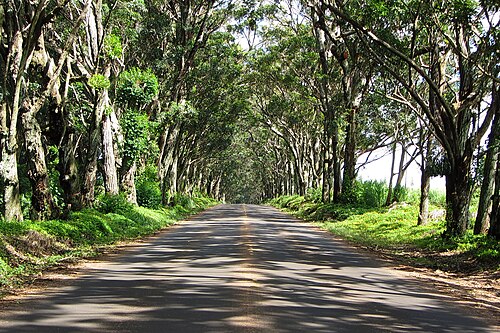
Swamp Mahogany (Eucalyptus robusta) · 115 years · Between Lawai/Kaumualii Highway and Koloa
In 1992 Hurricane Iniki took every leaf off this mile of road and left a corridor of bare poles. Residents said it would grow back. Within a few years it had, and the canopy over Maluhia Road today is those same trees rather than a replanting.
There are more than 500 of them, swamp mahogany eucalyptus, standing along both sides of the road that runs from Knudsen Gap up toward Koloa and closing overhead for about three quarters of a mile. Kauai County has recognised the tunnel since 1976, as one thing rather than as 500 things, which is also how anybody driving through it experiences the place.
Who planted it is not settled. The version you will hear most often credits Walter Duncan McBryde, said to have run leftover nursery stock from his Kukuiolono estate down the lane around 1911. A competing local account credits the Knudsen family, planting to firm up a marshy track and break the wind coming across it. Nobody has produced a document that closes the argument, so both are worth knowing.
It is the gateway to the south shore, which means it is a working road. The shoulder is narrow. Most people take it slowly and look up.
Photo: Bob Linsdell (CC BY 3.0)
Rain Tree (Samanea saman) · Waimea
Local tradition says this monkeypod is 200 years old and arrived as a gift from an Indian prince, the first of its kind planted on the Garden Isle. The arithmetic does not hold. Monkeypod is generally recorded as reaching Hawaii around 1847, which is 179 years ago, so a 200-year-old specimen would predate its own species' arrival by two decades. It is a fine story about the tree and a poor fact about its age, which is why the age field here is empty.
What is measured is the trunk: 8.53 metres round, the largest monkeypod figure on Kauai in the exceptional trees register, holding up a crown that covers the entire front yard of the Gulick-Rowell House.
The house is the reason the address matters. Reverend Peter Johnson Gulick began building it in 1829 and Reverend George Rowell finished it by 1846, and the restoration project now working on it calls it the oldest house on Kauai. It is closed while that work goes on. The tree is in full view from Huakai Road, and the pin marks where to stand. Wood from one pruned limb has already been made into tables at Kokee Lodge.
Nobody has dated it. If you know who put it in, tell us.