Mexico City lost both of its famous old trees. The giant ahuehuete of Chapultepec dried up in 1969, and the tree Cortes is said to have wept under in 1520 is a ruin the city's own website calls one. So this page is about the survivors, and in 2025 the city finally named them: twelve Arboles Patrimoniales, declared in the official gazette with their trunks measured. Nine of them are here, and the trunks are the point. The one in Xochimilco measures more than eighteen metres around.
0 of 9 visited in Mexico City
Montezuma Cypress (Taxodium mucronatum) · 700 years · Barrio de Santa Catarina, Azcapotzalco
The first tree Mexico City ever declared natural heritage stands behind a primary school. In June 2025 the head of government came to Barrio de Santa Catarina in Azcapotzalco, gave this ahuehuete the name El Viejo del Agua and made it the opening entry in a register of protected trees that did not exist the week before. The timing was deliberate: 2025 marked seven centuries since the founding of Tenochtitlan, and the city put the tree's age at 700 years to match. Take that figure carefully. Every outlet repeated it and none of them published how it was reached, with no ring count and no growth-rate calculation on record, so the honest range is somewhere between five and seven hundred years. The trunk is not in doubt. The city's own measurement is 13.8 metres of circumference, under a crown that reaches about 27 metres. Ahuehuete is Nahuatl for old one of the water, which is a species name rather than a claim about this specimen: Taxodium mucronatum grows where the water table is high, and Mexico City is built over a drained lake. What is certain is the company it keeps. It stands beside the parish church of Santa Catarina Martir, in the barrio that argued for its protection and got it before any other tree in the city.
Indian Laurel Fig (Ficus microcarpa) · 35-115 years · Tlacoquemecatl del Valle, Benito Juarez
A property developer wanted this tree gone, and the street would not have it. The laurel fig on the corner of Miguel Laurent and Fresas was in the way of a building project in Tlacoquemecatl del Valle, and instead of losing it the neighbours took the argument to the borough of Benito Juarez and to the city's environment department. In June 2025 the tree was declared protected, and the neighbours had already given it a name: Laureano. How old it is depends on which article you read. El Universal has published both 35 years and more than a hundred, calling it centenario in the second piece, and nobody has resolved the gap. We are not going to pick one for you. What can be measured has been: 2.8 metres of trunk circumference, 23 metres tall, and a crown close to 20 metres across, which for a street tree on a residential corner is a considerable amount of shade to be standing under. That crown is the point. It is why people who walk under it every day noticed when it was threatened, and why a fig that may not even be a century old now carries the same legal protection as ahuehuetes said to be seven hundred. Protection here followed attachment, not age.
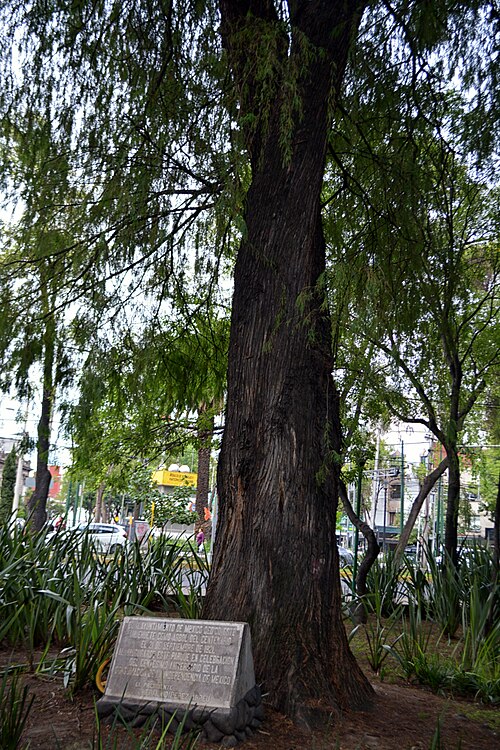
Montezuma Cypress (Taxodium mucronatum) · 105 years · Roma Norte, Cuauhtemoc
This tree has a birthday, which on this page is rare. It went into the ground on 21 September 1921, the day Parque Espana was inaugurated for the centenary of Mexican independence, and it has been growing in the same spot in Roma Norte ever since. Almost every other protected tree in Mexico City is dated by legend, by estimate or not at all. This one has a date somebody wrote down. A century of city has happened around it. The Roma was still a young neighbourhood of new houses when the park opened; the 1985 earthquake brought several of them down within a few streets of here; the district emptied and refilled and became the part of town everyone now has an opinion about. The ahuehuete has been the constant. When Excelsior went to the park for its hundredth birthday in 2021, the tree was described as full of life and among the tallest standing there. The city's own measurements make it 28 metres tall with a trunk just over 5 metres around, which for a tree with a documented start is a useful reference point: this is what a century of growth looks like in this soil, in a species whose older relatives elsewhere in the city run to three and four times that girth.
Photo: ProtoplasmaKid (CC BY-SA 4.0)
Montezuma Cypress (Taxodium mucronatum) · Guerrero, Cuauhtemoc
Mexico City had protected no trees by name at all until 2025, and this was one of the first two it named. The ahuehuete in the Jardin de San Fernando went into the register at the opening of the programme, alongside a tree in Azcapotzalco, in a decree that recorded it at about 25 metres tall with a trunk 158 centimetres across. The environment department's own field sheet, from a separate visit, gives a thicker trunk and a height nearer 28 metres, with a circumference of 5.5 metres and a crown 22 metres wide. Two measuring passes, two sets of numbers, both official, and the difference tells you roughly how much precision to expect from any figure on a tree this size. It stands in a small public garden in Colonia Guerrero, off Avenida Hidalgo, a few minutes' walk from Metro Hidalgo and free to walk into. Do not confuse it with the Panteon de San Fernando next door, the historic cemetery where Benito Juarez is buried, which is a separate site with its own entrance. Nobody has put an age to this tree. There is no planting date in any source we can find and no measured estimate, so it goes on the map undated. If you have seen a figure in print, or an old photograph of this square, send it over.
Montezuma Cypress (Taxodium mucronatum) · Tacuba, Miguel Hidalgo
The famous tree of Tacuba is a ruin, and this is the one still growing. A few streets from here, in Popotla, stands what remains of the Arbol de la Noche Triste, the ahuehuete under which Hernan Cortes is said to have wept during his retreat from Tenochtitlan in 1520. The city's own venue page for the site describes the remains as exactly that, remains. There is nothing left to walk to. Meanwhile, on a pavement corner where Marina Nacional meets Golfo de Bengala, a living ahuehuete has quietly reached a circumference of just over 10 metres. Ten metres of trunk on a street corner, with a crown 18 metres wide and 22 metres of height above it, and until June 2025 it carried no protection of any kind. It was declared an Arbol Patrimonial that month, in the same decree as the ahuehuete in Parque Espana. Nobody has dated it. The city's file records the trunk, the crown and the height and leaves the age column blank, and a girth alone is not an age without a growth rate for this species in this soil. If you know of a source that puts a number on it, we would like to see it. What can be said without hedging is that in a district known for a dead tree, this is the large old one that survived.
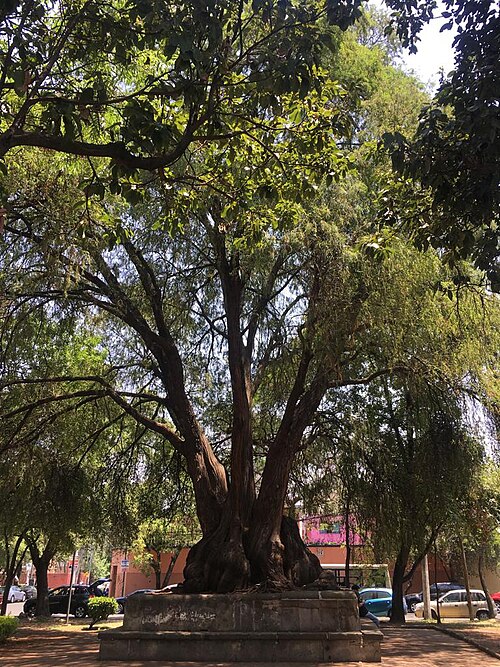
Montezuma Cypress (Taxodium mucronatum) · San Diego Churubusco, Coyoacan
This ahuehuete may or may not have been standing when the United States army took the convent behind it. The Battle of Churubusco was fought here on 20 August 1847, and the building the Mexican garrison defended is now the Museo Nacional de las Intervenciones, a museum of every foreign invasion the country has faced, on the site of one of them. Whether the tree saw any of it is genuinely unknown. No age has been recorded for it by the city or anyone else, and we would rather leave the field empty than invent a number that suits the setting. Tell us if you find one. What was measured is odd enough on its own. The city's file lists two trunks under this single entry, 154 and 161 centimetres across, with circumferences of 4.8 and 5.1 metres, which means either one tree forked low into two great stems or two trees standing close enough that the surveyor registered them as one. Both are worth the walk, and they are not the same thing, so if you get there before we do, say which it is. It reaches 20 metres under a crown 16 metres wide, in the public park that wraps the old convent walls. Metro General Anaya is under ten minutes away on foot and the park costs nothing.
Photo: Marianafloresocampo (CC BY-SA 4.0)
Montezuma Cypress (Taxodium mucronatum) · Barrio de Santa Catarina, Coyoacan
The river this tree is named after is not there any more. Callejon del Rio in Coyoacan follows the old course of the Rio Magdalena, one of the last rivers in Mexico City to run in the open, and the ahuehuete now stands on the median strip left behind, 5.65 metres around and 26 metres tall. Ahuehuetes are water trees. This one is left holding the line of a watercourse that has been culverted underneath it, which is as good a summary of what happened to this city's hydrology as any plaque could manage. It was declared an Arbol Patrimonial in 2025 in a pair with the ahuehuete at San Diego Churubusco. One caution about the name: the press called it the Rio Magdalena ahuehuete, the city's register lists it by its street address on Callejon del Rio in Barrio Santa Catarina, and no single document states outright that the two refer to the same trunk, though the address puts it on that river's line. No age has been recorded. This is one of the two trees on this page that make a real walk: the fresno on Avenida Francisco Sosa is about 700 metres away through the same barrio, with Coyoacan's historic centre and the Viveros a short distance further on.
Shamel Ash (Fraxinus uhdei) · Barrio de Santa Catarina, Coyoacan
Its crown is as wide as the tree is tall: 26 metres across, 26.5 metres high, on a pavement outside a house on Avenida Francisco Sosa. That is a lot of tree to fit on one of the most photographed colonial streets in Mexico City, and it took until 2025 for anyone to protect it. The fresno at number 202 was the twelfth and final tree in the city's first batch of declared Arboles Patrimoniales, and the only ash among a list otherwise dominated by ahuehuetes. The trunk measures 6.1 metres around, which for a shamel ash is exceptional; the species is planted everywhere in this city and almost never left standing long enough to reach that. Francisco Sosa runs from the Jardin Centenario out towards San Angel, past walled houses that were country estates when Coyoacan was a village outside the capital, and the tree has the scale of that older street rather than the modern one. Nobody has dated it. There is no planting record in the city's file or in the press coverage of its protection, so the age stays blank until somebody produces one. Walk on and the Rio Magdalena ahuehuete is about 700 metres away in the same barrio, which makes these two the one genuine pair on this page.
A day trip away
Barrio de San Juan, 14 km south-east
Montezuma Cypress (Taxodium mucronatum) · 500 years · Barrio de San Juan, Xochimilco
Eighteen and a half metres around. That is the circumference the city's environment department recorded for this ahuehuete when it wrote the tree into the new register of heritage trees in 2025, and it makes El Sabino the thickest of the twelve trees Mexico City has so far declared. Local tradition, set down by the chronicler Rodolfo Cordero Lopez, holds that Cuauhtemoc planted it in 1521 in thanks to the Xochimilca people. Nobody has ever tested that. No ring count or growth study has been published, so the round 500 years is a story the barrio tells rather than a number anyone has measured. What is documented is harder to read. In September 2018 the tree broke apart in high winds, a year after specialists from the Universidad de Chapingo had warned that it was not being properly maintained. What stands in the plazuela today is the surviving part, recorded at 24.5 metres tall and formally protected seven years after that night. The city has form here. El Sargento, the giant ahuehuete of Chapultepec that generations of Mexicans were taken to see, dried out in 1969 and is a relic now. This one is not. It stands in a small plaza in Barrio San Juan with the neighbourhood around it, which is roughly how it has survived everything else.