The most photographed tree at the Alamo arrived on a mule cart in 1912 and did not watch the 1836 battle, whatever the postcards suggest. A few streets away a bald cypress on the River Walk is said to be the one a marksman fired from on the night Ben Milam was killed. Four verified trees, two of them genuinely old and two of them state champions that got their size on speed rather than centuries.
0 of 4 visited in San Antonio
Bald Cypress (Taxodium distichum) · 200 years · Downtown / River Walk
By local tradition, the shot that killed Ben Milam came out of this tree. On the night of 7 December 1835, during the Siege of Bexar, a marksman under General Cos is said to have fired from the branches of this bald cypress as the Texian commander crossed the courtyard of the Veramendi Palace to confer with another officer. Milam died there. The palace came down around 1910. The cypress is still standing, 762 centimetres round and about 27 metres tall, and put at over two hundred years old, which means it was certainly already here that night.
Whether a rifleman was ever actually up there is not settled and probably never will be; the story is older than anyone alive to check it. What is not in doubt is that this trunk was on this bank while San Antonio changed hands, and that it has stood through everything the city did to the river afterwards, including turning it into a walkway lined with restaurants.
Today it grows behind a downtown hotel on the busiest stretch of the River Walk, and the barges narrating the river's history pass underneath it all day long. The crews who look after the walk call it Geronimo. It is free to see from the path or from the water. Our pin marks a stretch of the east bank rather than the trunk, so look for the biggest cypress between the Commerce Street and Houston Street bridges.
Southern Live Oak (Quercus virginiana) · 155-160 years · Downtown / Alamo Plaza
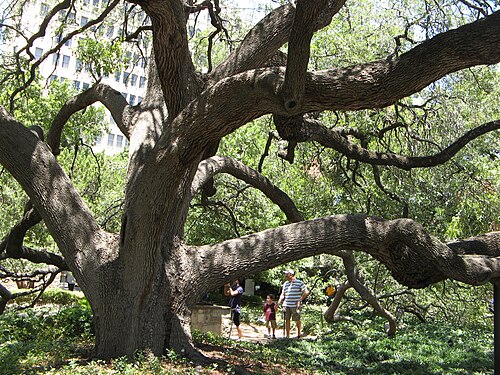
The most photographed tree at the Alamo arrived on a mule cart. It did not watch the 1836 battle, and it was not even growing here: in 1912 or 1913 the nurseryman Walter Whall dug up a live oak already around forty years old from a ranch outside town and hauled it whole to the Convento Courtyard, said to be the first transplant of its size anyone in San Antonio had attempted. It survived the move, it launched Whall a business shifting trees, and it has stood beside the old well for well over a century since. Add the head start and it comes to roughly 155 to 160 years.
Locals just call it the Big Tree, and the name is about spread rather than height. It is 389 centimetres round and only about twelve metres tall, with a crown reaching some 27 metres across, more than twice its own height. Live oak wood is heavy enough that the tree's own limbs sag under themselves, so the branches are cabled and pruned to keep them off the limestone of the barracks wall.
The Alamo is in the middle of a 400 million dollar rebuild of its plaza, running five years, and the tree is explicitly excluded from the works. Grounds and courtyards are free to walk into. Only the exhibits inside need a ticket.
Photo: olekinderhook (CC BY 3.0)
Mexican Sycamore (Platanus mexicana) · 35-45 years · Trinity University / Monte Vista
This is the biggest Mexican sycamore in Texas and it is about forty years old. The city forester puts its planting in the mid 1980s, which rules out any romance about ancient wood; what it has instead is speed. Mexican sycamore can put on several feet a year, and this one had reached 328 centimetres of girth by the time the Texas Big Tree Registry taped it in November 2021, taking the state championship for the species and scoring the registry's top grade for condition.
The bark is the reason to walk over. It sheds in irregular plates, leaving a mottled camouflage pattern that gives way to a trunk close to bone white, which is why people on the Trinity University campus call it the ghost tree. The leaves are large, felted silver underneath, and they flip in wind. A second, slightly smaller Mexican sycamore grows beside it, both of them fed by the drainage creek that runs through the disc golf course.
So it earns its place on size and strangeness rather than on years, and it is worth saying so plainly rather than dressing a young tree up as an old one. The ground is open campus, no gate and no fee, about 4.5 kilometres north of downtown, with a VIA Route 8 stop on Stadium Drive. Our pin marks the course rather than the trunk. Look for the whitest tree on it.
Texas Mountain Laurel (Dermatophyllum secundiflorum, syn. Sophora secundiflora) · Alamo Heights / Broadway
Texas mountain laurel is a shrub. This one is nearly ten metres tall, which is exactly why it holds the state champion title for the species: 9.8 metres of height and a crown just over ten metres across, on a plant most Texans know as a dense evergreen bush beside a car park. Its trunk is 152 centimetres round. San Antonio's own development services department names it as the state champion in its planning material, and the newspaper that had it surveyed agrees.
In March it flowers in heavy drooping purple clusters that smell of grape soda, unmistakably and from some distance, which is the one week of the year you can find this tree by nose. Afterwards it sets hard red seeds inside woody pods, the mescal beans that give the species its other name and that are toxic enough to leave alone.
It grows beside the Lourdes Grotto on the Incarnate Word grounds, a devotional site people have been walking up to for generations; the gate there is decorative rather than locked. Local tradition puts the tree at around a hundred years old, and the paper that reported that figure says plainly it is folklore rather than record, so take it as a story people tell. Nobody has established an age.
Come on foot. Driving onto campus can mean a visitor parking pass; walking in does not.