Six of these eight stand in City Park, which holds more registered live oaks than any other place on earth, and the three oldest sit on a strip between City Park Avenue and Bayou Metairie that never flooded, not even in 2005. The bayou spent centuries dropping silt and raised that ground a metre above the rest of the park, which is why the city's oldest oaks are the ones on the high ground. Two are reckoned between seven and nine hundred years old and one stands on wooden crutches. The other two are uptown by the zoo.
0 of 8 visited in New Orleans
Southern Live Oak (Quercus virginiana) · 700-800 years · City Park
The branches are too heavy for the tree now, so they rest on wooden crutches. That is the first thing you notice and the whole story in one image: a crown about forty six metres across on a trunk of eight metres, held up because nobody is willing to cut it back.
City Park reckons it at seven to eight hundred years, which puts its first century somewhere around the time the Choctaw were the only people here and five hundred years before the French arrived. It lost a major limb in 1981, which is why there is a cement patch as well as the props.
The reason it is still standing is geological rather than lucky. The Old Grove sits on the strip between City Park Avenue and Bayou Metairie, and the bayou spent centuries overflowing and dropping silt, which raised this ground about a metre above the rest of the park. When the levees failed in 2005 and most of City Park went under, the Old Grove stayed dry.
There is a plaque at the foot of the trunk. It is a considerable understatement.
Southern Live Oak (Quercus virginiana) · 500-900 years · City Park
Victor Anseman was a florist who retired and then gave the last fifteen years of his life to a park. In 1891 he pulled together the business and political people of the city into the City Park Improvement Association, which is the reason there is a park here at all rather than a subdivision. He died in 1904 and they named this oak after him.
It is a good choice of monument. The tree is given the same range as the McDonogh Oak, five hundred to nine hundred years, and some accounts make it the older of the two. Neither has been cored, so the order between them is a matter of who is doing the estimating.
It stands at the western end of the same high strip of ground, just inside the entrance that also carries his name. The pin here marks the entrance rather than the trunk, because the grove holds hundreds of old oaks and pretending to know which metre is the one would be a promise this page cannot keep. Walk in from City Park Avenue opposite North Alexander and look for the biggest thing standing.
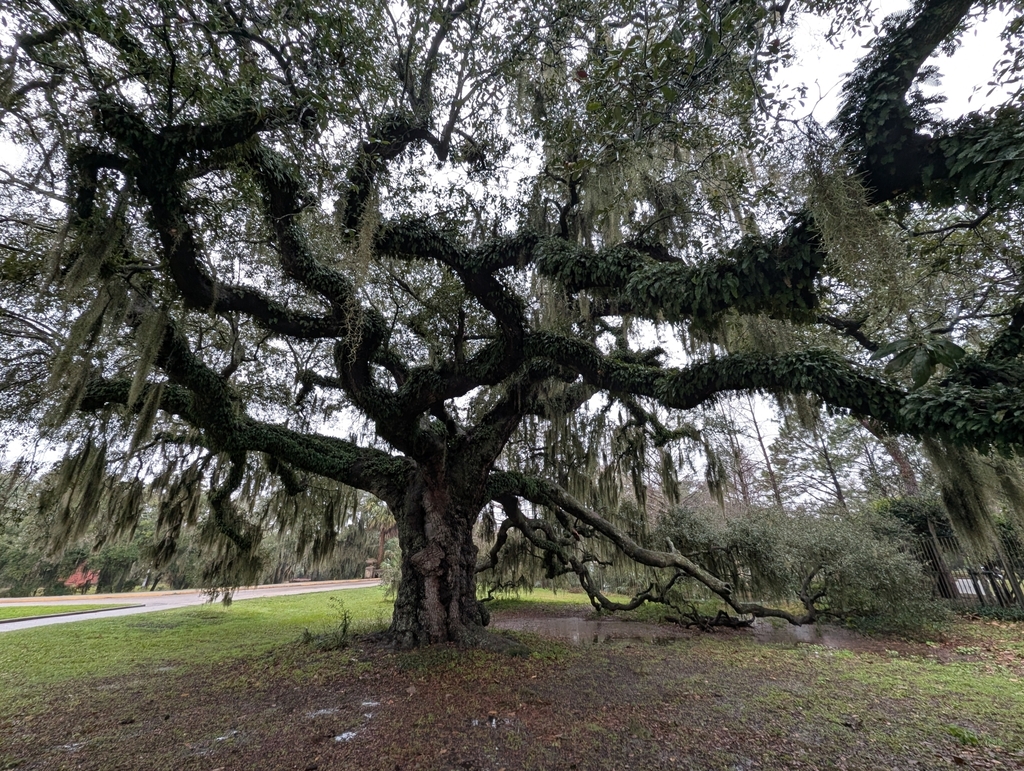
Southern Live Oak (Quercus virginiana) · 300 years · City Park
Between 1834 and 1844 there were stretches when scarcely a day passed without a duel being fought under these trees. Creole New Orleans settled its arguments here with swords and pistols, over insults, politics, cards and women, and the oaks were the address everyone understood without being told.
There were two. A hurricane took one in 1949 and the other is still standing, roughly three hundred years old, twenty one metres tall on a trunk seven and a half metres round.
What makes it worth the walk now is the contrast rather than the gore. The tree stands where Dueling Oaks Drive meets Dreyfous Drive, which puts it a few steps from the Besthoff Sculpture Garden and the art museum. So the spot where men shot each other over remarks at dinner is now the quietest corner of the park, full of people looking at bronze.
The pin marks the junction rather than the trunk. You will not need it: there is only one oak there with a story attached.
Photo: Ken-ichi Ueda (CC BY)
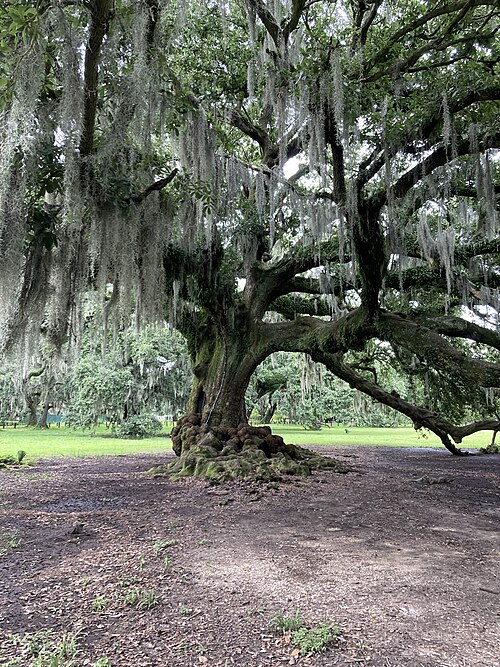
Southern Live Oak (Quercus virginiana) · 285 years · Uptown
Eleven metres round, eighteen tall, and a crown reaching close to fifty metres across, which means the limbs left the trunk, ran horizontally as far as they could, and then came back down to the grass. That is why this is the most climbed and most photographed tree in Louisiana: it invites you up without asking you to be able to climb.
The sign by it gives a planting date of around 1740. A better story says Etienne de Bore, the first mayor of New Orleans and the man who worked out how to granulate sugar commercially, planted it in 1771 as a wedding present for his wife. That version is tradition rather than record, and it has the wrong decade, but it has stuck hard enough that the tree carries his name as often as its other one.
In 1934 it became one of the forty three founding members of the Live Oak Society, an organisation whose members are all trees and whose only human is a secretary who keeps the roll.
It stands outside the zoo fence, so you do not need a ticket. The giraffes are on the other side.
Southern Live Oak (Quercus virginiana) · City Park
The name is the reason most people come and it is worth stating plainly: sixteen men took their own lives under this tree over about twelve years, from the 1890s into the 1900s, when this corner of the park was a quiet distance from the city. The newspapers named it and the name stuck.
What you stand in front of is one of three named survivors of the forest that covered this ground before New Orleans existed, the others being the McDonogh Oak and the Anseman Oak a few hundred metres south. One low branch does the thing live oaks do when nobody prunes them. It leaves the trunk, bends the whole way down to the grass, frames the walkway and rises again on the far side. Two giant limbs came off in the 1980s and one of them still lies underneath.
Nobody publishes an age for this one. The accounts that group it with the McDonogh and the Anseman put those two somewhere between seven and nine hundred years, and we have found no measurement of this trunk at all, so the honest answer is that it is old and undated. If you know a girth figure, or a survey that covers it, tell us and it goes on the page.
Southern Live Oak (Quercus virginiana) · 125 years · City Park
Seven sets of wind chimes hang in this oak, the longest of them over four metres, and they are tuned so that the wind cannot play a wrong note. The scale is pentatonic, the five notes behind West African music, early jazz and gospel, which in this city is a deliberate choice rather than a musical convenience. They are painted black to disappear into the shadow of the branches, so most people hear the tree a while before they find it.
The chimes are Jim Hart's, hung as part of the Big Lake project that rebuilt this corner of the park after 2005. The oak itself is reckoned at about 125 years, which makes it the youngest tree we map in New Orleans by four centuries. It earns the walk the way a live oak does: a low wide crown reaching out over the grass on the lake's east side, with enough shade under it for an afternoon.
A plaque at the foot asks the wind to bring you a melody, a smile and a sense of peace and nature. Nobody has published a girth for it, so if you carry a tape measure, we would like the number.
Southern Live Oak (Quercus virginiana) · Audubon Park / Audubon Zoo
Martha Washington had a husband and a rival, and both were oaks. In 1934, when the Louisiana Garden Club Federation founded the Live Oak Society and inducted its first 43 members, three trees on the old de Bore sugarcane plantation joined together: George Washington, Martha Washington, and the tree now known as the Tree of Life, already published on this page as the Etienne de Bore Oak. George and Martha stood on either side of the plantation house, framing the view of it the way a married couple frames a photograph. George is gone now, marked deceased in the Society's own register. Martha is not, and today stands inside the zoo that grew up around the old plantation ground, in the rhino habitat.
To join the Society in 1934 a tree needed a trunk at least eight feet round, so Martha was already a substantial tree nine decades ago. The Society's own measurement puts her at 28 feet round today, a couple of feet more than the figure recorded when George Douglass first registered her. Nobody has published an age, and a live oak this size does not hurry toward one.
She keeps her Society rank too: current fourth vice president, an honour the Live Oak Society hands out to its most senior members rather than to anyone with a vote.
Southern Live Oak (Quercus virginiana) · City Park
Every December this oak wears blue. Draped in dripping LED lights for Celebration in the Oaks, City Park's holiday lighting event, it is one of the more theatrical trees on a list that runs mostly to war and duels.
It carries the name of Enrique Alferez, the sculptor whose WPA-era fountains and figures are scattered through City Park, though the tree itself stands in the Botanical Garden rather than at the newer sculpture garden that also bears his name. It is one of 26 oaks the park singled out for a historic walking tour, drawn from roughly 250 Live Oak Society members growing across the grounds, and when the park re-measured its tour trees between 1983 and 1999, this was the one that had grown the most. Its trunk measured just over 16 feet round in 1983; the Live Oak Society's current figure puts it at over 17.
Nobody has published its age, which for a tree in a park this thoroughly documented is itself a small honest gap. What is on record is upkeep: City Park describes it as getting regular watering and feeding at that spot, the kind of attention that keeps a showpiece a showpiece.