Ten trees, and three of them are groves, because that is how Austin's oldest survived. A live oak downtown lived through a deliberate poisoning in 1989. A block away is the grove the city was auctioned beneath in 1839. Four more stand on the university's original forty acres. A state co-champion oak grew up wild on Waller Creek. Sunset Valley, a town inside Austin, holds the national champion Bigelow oak. Two are worth the drive: a bald cypress written about in 1716, and a grove where a settler was killed fighting behind a trunk.
0 of 10 visited in Austin
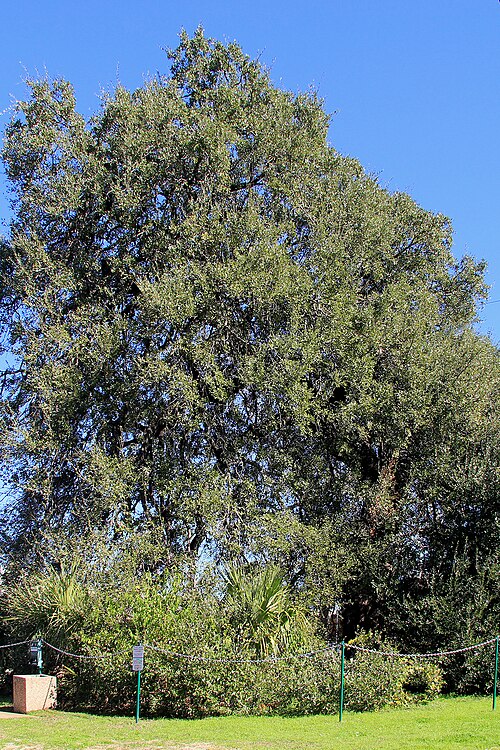
Texas Live Oak (Quercus fusiformis) · 500 years · West Line Historic District
In 1989 a man poured enough Velpar herbicide around the roots of this tree to kill roughly a hundred trees. Austin reacted the way few cities react to an assault on a plant. Children taped notes to the trunk, arborists rigged a screen to shade it through the summer, and crews dug out the poisoned soil and fed what was left. Two thirds of the tree died anyway and more than half the crown had to come off. The rest of it held on, and in 1997 it set acorns again.
What survived is a Texas live oak of around five hundred years, now permanently one sided. Local tribes are said to have called it the father of the forest, and tradition puts Stephen F. Austin under it signing his first boundary agreement with them, though that part is story rather than record. What is measured is the spread: before the poisoning its branches reached thirty nine metres across.
It has its own small park, which is the tell. A city does not buy a block of land in the middle of downtown for a tree it thinks is ordinary.
Photo: Larry D. Moore (CC BY 4.0)
Oak (Quercus sp.) · 190 years · Downtown
In August 1839 the lots of a city that did not yet exist were sold in the shade of these trees. Judge Edwin Waller had staked out the grid that spring and held back the best ground for the capitol. The rest went under the hammer here: two hundred and seventeen lots, three hundred thousand dollars, which covered the public buildings of the new Texas capital. The grove is the reason this square exists.
Then the twentieth century happened to it. For decades the square was a parking lot with asphalt run right up to the trunks, which is close to the worst thing you can do to a live oak, and the trees came through anyway. The city rebuilt the square in 2017 and they now stand in open ground again.
Aim for the southwest corner. The square is a single block and the grove is unmistakable once you are inside it.
One thing nobody has settled is which live oak these are. Central Texas has two that look much the same, and the sources that tell the auction story do not name the species. If you know, tell us.
Texas Live Oak (Quercus fusiformis) · 250-300 years · University of Texas
Three live oaks stand on the rise at the north end of the original forty acres, and they were there before the university was. When the University of Texas opened in 1883 they were already old, the survivors of a larger grove. The story told on campus is that the rest came down during the Civil War, cut to raise a fortification when word arrived that Union troops had reached Galveston, and that these three were left.
They nearly went in 1923 instead, when the site was picked for the Biology building. William Battle, a professor of Classics chairing the faculty building committee, argued them out of the plan. They carry his name rather than the war's, which seems like the right outcome.
The university puts the group at two hundred and fifty to three hundred years and reckons the largest predates the Civil War outright, making them among the oldest living things on campus. A plaque at the foot tells the whole thing in fewer words than this.
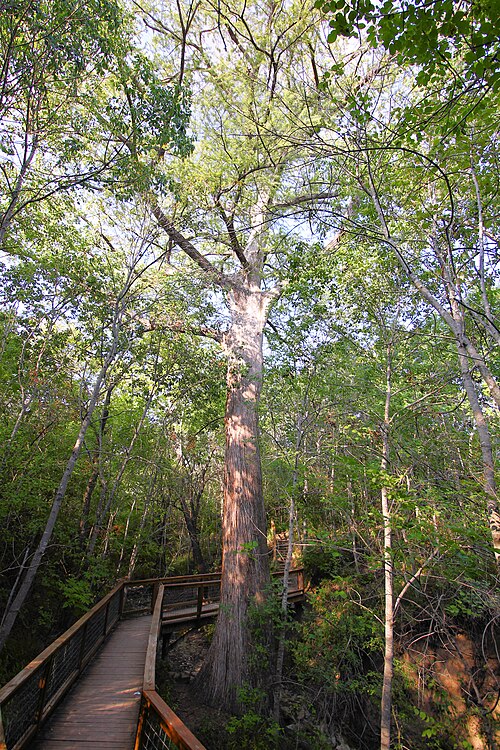
Bald Cypress (Taxodium distichum) · 500-600 years · Southeast Austin
Father Antonio Olivares, the Franciscan who later founded San Antonio, wrote about this cypress in 1716. It was old then. Texas Parks and Wildlife calls it the oldest bald cypress on public land in the state and dates it past five hundred years, with some accounts reaching five hundred and fifty.
It stands where Onion Creek runs through the park, thirty one metres tall on a trunk just under five metres round, big enough that it now houses other things: nesting birds, ball moss, vines working up the bark. Bald cypress is a conifer that drops its needles, so the tree is bare through winter and turns rust orange before it goes, which is the week to come if you want the colour.
Onion Creek has flooded around the trunk in 1869, in 2013 and again in 2015. Each time the water went down and the tree was where it had been. Take the Rock Shelter Trail northeast from the main parking area; it is signposted, and there is no mistaking it when you arrive.
Photo: Larry D. Moore (CC BY 4.0)
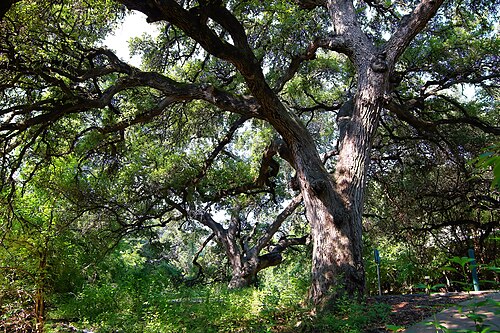
Oak (Quercus sp.) · 190 years · Shoal Creek
In the spring of 1842 Gideon White was out looking for livestock when riders caught him in the open. He got a tree between himself and them and fought from behind it, killing at least one before they killed him. The bullet holes and arrow marks stayed visible in the bark for decades afterwards.
Four years later his daughter Louisa married Edward Seiders, an Austin grocer, and for a while the couple lived in her father's cabin by the spring. The spring took the family name and so did the grove. The Seiders then did something that reads oddly now and worked completely: they built bath houses, picnic tables and a dance pavilion along the creek to get Austin to come out and use the place. Austin came, and has not really stopped.
Four big live oaks stand together in the middle of the greenbelt, reachable on paved path from either end. The Texas Forest Service notes they were already large when the city was being laid out in the 1830s, which puts them past two centuries and probably well past.
Photo: Larry D. Moore (CC BY 4.0)
Himalayan Cedar (Cedrus deodara) · 130 years · University of Texas at Austin campus (The Drag)
When George W. Littlefield planted a cedar beside his house in 1893, the story goes, he did not trust Texas dirt with it. The cattle baron, later a regent of the University of Texas, had the young deodar brought from the western Himalayas and, by the account the university's alumni magazine has repeated ever since, had the planting hole backfilled with Himalayan soil as well.
Whether the soil made the difference or not, the tree took. More than 130 years later it stands on the lawn of Littlefield House at 24th Street and Whitis Avenue, 335 centimetres round and close to 18 metres tall at the Texas Big Tree Registry's last measurement in 2021. It is often called the only one of its kind in Austin, and it is one of the most photographed trees on the Forty Acres.
It has watched the campus fill in around it. The house passed to the university and onto the National Register; the open ground around it became quads, towers and the traffic of the Drag one block west.
The ranking is where the sources part ways. The university's news office called it the state's number two while quoting a forester who credited it with the largest girth of its kind in Texas; the facilities department, in 2023, called it the second largest deodar in the state. Somewhere in the top two, then, which is plenty for a tree that arrived with its own soil.
Durand Oak (Quercus sinuata var. sinuata) · Downtown / Waller Creek Greenbelt
Texas's co-champion Durand oak was not planted by anybody. It grew up wild on the bank of Waller Creek, a few minutes' walk from Congress Avenue, and downtown Austin arrived later.
The evidence for that is in a herbarium drawer. The University of Texas holds specimens of this species collected along Waller Creek in 1901, 1933 and 1945, so the oaks on this stretch belong to a native population rather than a park planting. The species goes by a blunter local name too, bastard oak, which undersells it considerably.
The Texas Forest Service certified this one as a state co-champion in January 2014, and somebody nailed a numbered metal tag, 809, to the trunk. The measurements drift a little between visits: a naturalist who wrote it up in December 2018 recorded 419 centimetres round, 44 feet tall and a crown 56 feet across, while the state registry's 2021 figures give 429 centimetres and 45 feet. Three years of growth would cover the gap. On that December visit, the ground beneath it was littered with thousands of acorns.
It stands in Sir Swante Palm Neighborhood Park, a small green strip on the greenbelt trail, and it is not alone there: at least four other large Durand oaks share the park, and a sign along the trail names the species.
Nobody has dated it, and a wild tree comes with no planting record to date it from. If you know more, tell us.
Texas Live Oak (Quercus fusiformis) · 260 years · South Congress / Dawson
In 1872, the story goes, a priest chose where to build a university by standing under a tree. Edward Sorin, who had already founded Notre Dame in Indiana, found this limestone hilltop south of Austin almost bare, with one big oak on it, known then as the Umbrella or the Lone Tree. The school he started here became St. Edward's University, and the oak has carried his name since at least 1976, when it first turned up in the student paper.
It has had a rough century and a half. In 1903 fire destroyed part of the Main Building beside it. In 1922 twin tornadoes crossed the hill, one of them rated EF4, and the tree stayed up. For decades after that it stood with a parking lot beneath its limbs, breathing exhaust, until the lot was taken out.
The numbers are a little unsettled. In 2022, when it won Austin's Tree of the Year in the large-tree category against 36 other Central Texas trees, the university put it at 250 years on its arborist's word. In 2026 the student paper reported about 260, confirmed by tomography scans, with a trunk 17 feet round, about 5.2 metres, and a height of 56 feet. Either way, it was already about a century old when Sorin came up the hill.
The university holds its Ring Ceremony under it, which is a fair return for picking the site.
Pecan (Carya illinoinensis) · Zilker / Barton Springs
Austin's Tree of the Year for 2011 is a pecan that people mostly know from lying underneath it. The Mother Pecan stands in Zilker Park near Barton Springs Pool, and the two accounts written about it describe the same thing from different angles: an outdoor yoga spot in one, a place to lean a bicycle and sit in the shade of a communal pecan in the other.
The award came from the Austin Tree of the Year Awards, which judged it the best large tree in the city that year. Margret Hoffman, the former council member Austin knew as the Tree Lady, came to the ceremony.
Finding it takes a little looking, and that is worth saying plainly. The awards record puts it at 802 Azie Morton Road, another account at 2201 Barton Springs Road, and the two are about 400 metres apart by road. Both describe the stretch of park around the pool, so our pin marks that area rather than the trunk. If you have stood under it and can tell us where, or send a photograph, we will move the pin.
Do not confuse it with the other famous Zilker pecan. That one stood near the great lawn, dated only from the 1970s, and fell in the Memorial Day floods of 2015; a transplanted live oak took its place.
Nobody has published an age for the Mother Pecan either. If you know it, tell us.
Bigelow Oak (Quercus sinuata var. breviloba) · Sunset Valley (enclave inside Austin)
The national champion Bigelow oak stands in a city that sits entirely inside another city. Sunset Valley is an incorporated enclave with Austin on every side, and the tree grows on its conservation land beside Williamson Creek.
Set the yardstick before the numbers. The Bigelow oak, also called white shin oak, is a small-tree oak, so this is not a giant by the standards of oaks in general. It is a giant by the standards of its own kind. Nominated to the Texas Big Tree Registry in February 1999 and remeasured in June 2024, it came in at 315 centimetres round, 13.4 metres tall and about 13 metres across the crown, which makes it the state and national champion for its variety.
The town knows what it has. Sunset Valley's public works department lists a champion Bigelow oak among the things the city is home to, though it uses an older botanical name, Quercus durandii, where the registry files the tree as a variety of Quercus sinuata. Shin oak names are a tangle, and the two records do not use the same label.
It is not alone. An iNaturalist observer walking the creek in 2016 noted several large shin oaks along it, so the champion is the biggest of a group rather than the only one.
Nobody has recorded its age, and nothing we hold gives a basis to estimate one. If you know when this tree took root, tell us.