Kagoshima keeps its own list. Since 1974 the city has designated preserved trees one at a time, measured each at 1.5 metres and put a signboard at its foot, so the ages here come from a municipal register rather than from folklore. Number one is a camphor at Kagoshima Shrine. Number eight is a subtropical fig on the flank of an active volcano that the sign dates at a thousand years. Above the harbour, Shiroyama was fenced off for most of the Edo period and never cleared. An hour north stands the largest tree in Japan.
0 of 16 visited in Kagoshima
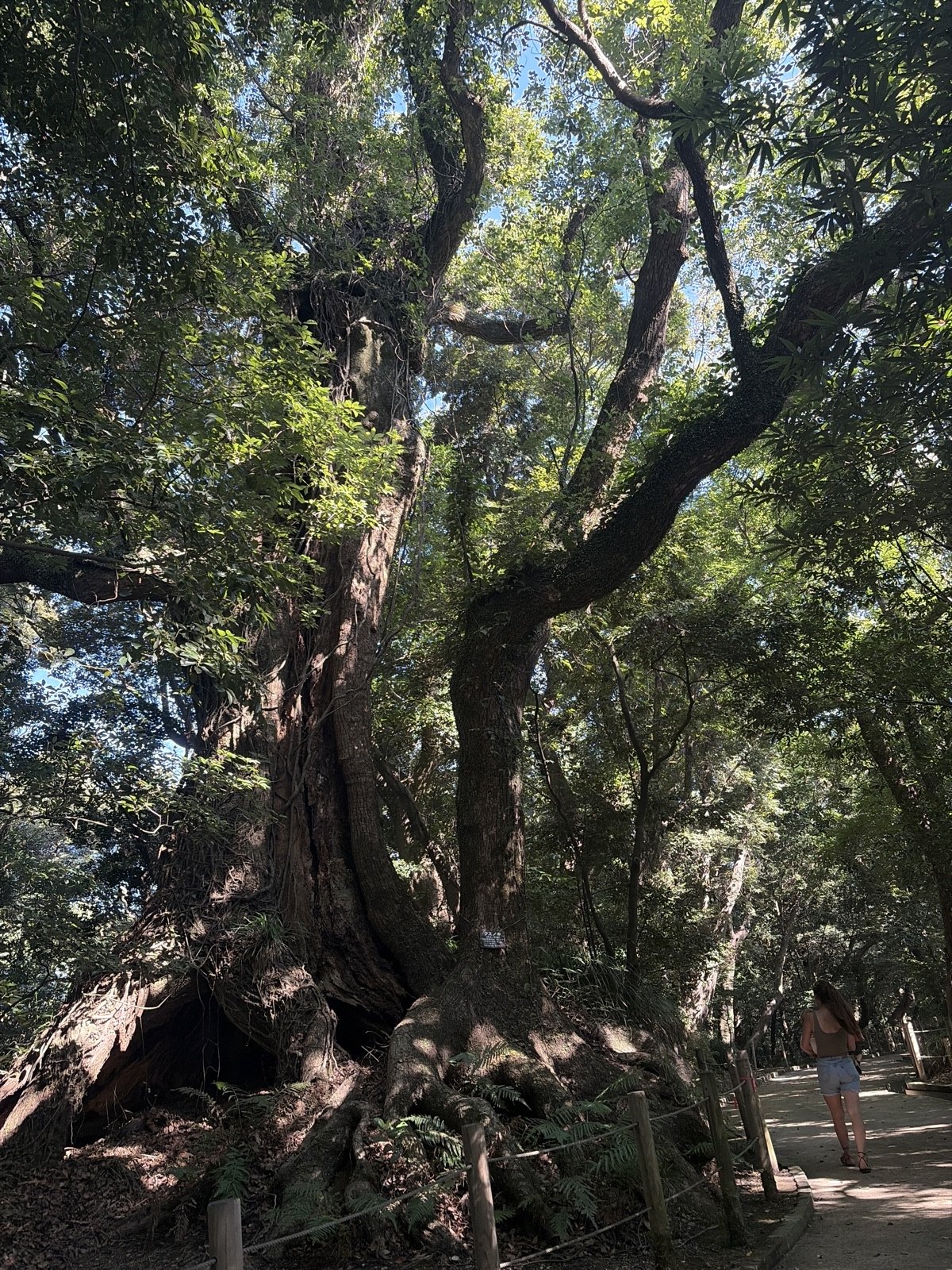
Camphor Tree (Cinnamomum camphora) · 300 years · Shiroyama
There is old forest 300 metres from Kagoshima's city hall because a lord gave up on a castle. A local clan built a fortress on this hill in the medieval period, which is where the name Shiroyama, castle hill, comes from. When the Shimazu took Kagoshima they built the flat, tower-less Tsurumaru castle at its northeastern foot instead, abandoned the hill fort within a generation, and closed the slope. Two and a half centuries of nobody going in produced what a 1974 academic survey counted as more than 510 species of higher plant on a hill 107 metres high, several of them recorded in Japan here for the first time. The biggest camphor anyone has measured in that forest stands beside the walking path. The Environment Agency's giant-tree survey gives it 12.9 metres around and 23 metres tall, at 300 years or more. Treat the girth carefully: it was taken at 1.3 metres, which on this tree is still root, and the trunk proper is a good deal narrower. Shiroyama is also where the Satsuma Rebellion ended. Saigo Takamori and a few dozen surviving men held caves on this hillside and came down into the government guns on the morning of 24 September 1877. The whole hill was made a National Natural Monument and a National Historic Site on the same day in 1931.
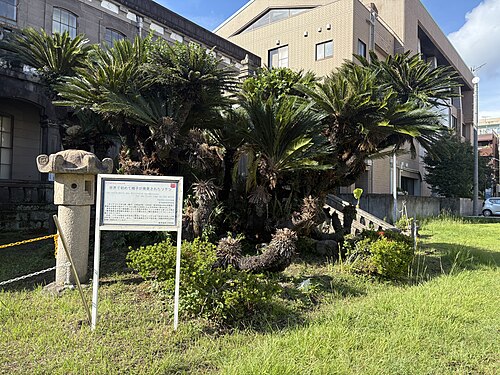
Sago Palm (Cycas revoluta) · 400 years · Shiroyama-cho
In 1896 a botanist in Tokyo looked into a cycad ovule and saw something swim. Until that afternoon, motile sperm belonged to ferns and mosses; seed plants were supposed to have given them up. Ikeno Seiichiro's finding put a swimming sperm cell inside a gymnosperm and moved the line between the two groups, and a few weeks earlier at the same university Hirase Sakugoro had found the same thing in a ginkgo. The plant Ikeno worked from is this one, according to the signboard the Kagoshima Prefectural Museum has set beside it, and an offshoot was later sent to Tokyo and planted at the Koishikawa Botanical Garden. It is not much like a tree. Cycas revoluta is a cycad, a lineage older than any flowering plant, and this one is a low thicket of stiff ferny crowns on a knot of trunks about 5.9 metres tall, put at roughly 400 years old. Kagoshima Prefecture designated it a Natural Monument in 2008 under its full formal title, the cycad in which sperm was discovered for the first time in the world, which is long even by the standards of Japanese heritage names. It sits in the open in Terukuni Park, a two-minute walk from the shrine, with nothing to mark it out but the board.
Photo: あじさか (CC BY-SA 4.0)
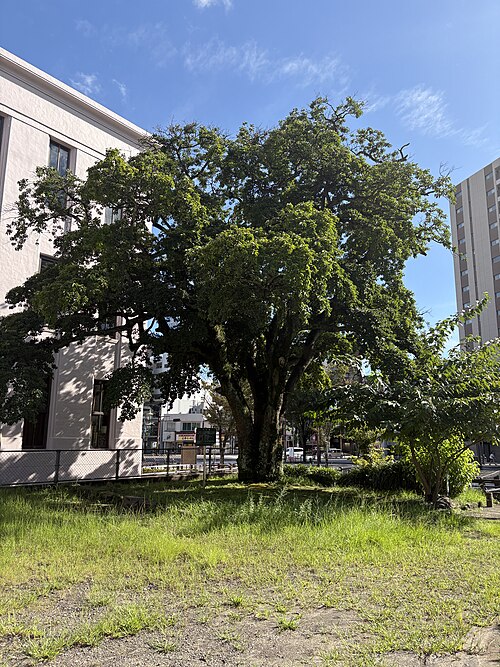
Kurogane Holly (Ilex rotunda) · 180 years · Shiroyama-cho
Four national highways die at the crossroads this tree stands over. Route 3 comes down the west coast of Kyushu, Route 10 comes down the east coast, and both of them, with Routes 225 and 226, end at the intersection south of Terukuni Shrine. The holly is at the park's southern corner, the closest tree to that junction. Kurogane holly grows all over southern Japan as a street and garden tree and very rarely gets to this size: 4.85 metres around at 1.5 metres, 13.5 metres tall, about 180 years old by the city's estimate. It is multi-stemmed rather than single-trunked, so the girth is the whole cluster, but the crown it carries is broad and even and reads as one tree from any distance. Kagoshima made it preserved tree number 6 on 20 March 1974, in the first batch the city ever designated. The park is effectively the front garden of the Kagoshima Prefectural Museum, and the shrine beside it enshrines Shimazu Nariakira, the lord who put a reverberatory furnace and a glassworks into Satsuma in the 1850s and sat for the oldest surviving photograph taken by a Japanese photographer, then died at 49 with the works half built. Female hollies of this species carry dense red fruit through the winter, which is most of why anyone plants them.
Photo: あじさか (CC BY-SA 4.0)
Camphor Tree (Cinnamomum camphora) · 600 years · Somuta
Kagoshima's preserved-tree register opens with this camphor. On 20 March 1974 the city designated its first trees under a new ordinance, and number 1 went to the one standing in the middle of the courtyard at Kagoshima Shrine in Somuta. The register gives 7.30 metres around at 1.5 metres, 24.5 metres tall and about 600 years. The Environment Agency measured the same tree at 6.8 metres and 26 metres and put it at 300 years or more, so the older figure is the city's estimate rather than a settled date, and the gap between the two is the honest width of what anyone knows. The shrine carries a second name, Ujise, and a third that only locals use, Uttesa, which is Ujise-sama said in Satsuma dialect. Ujise is thought to describe swirling water, either the eddies at Kanze out in Kinko Bay where the shrine is said to have stood before, or the fast shallows of the Kotsuki River that once ran below this ground. Neither reading is settled. The camphor stands alone at the centre of the grounds, with vines climbing well up the trunk and no sign that it minds. If you know how old it actually is, or anyone has cored it, tell us.
Ogatama Magnolia (Magnolia compressa) · 130 years · Kamitatsuo-cho
The tree whose name means spirit-summoning stands beside two thousand graves. Nanshu Cemetery holds the dead of the Satsuma Rebellion, Saigo Takamori among them, buried on this slope after the fighting ended in September 1877, and the shrine that enshrines him was built next to it later. The ogatama in its grounds is preserved tree number 2, from the city's first designation in March 1974: 3.82 metres around, 13.5 metres tall, about 130 years old. Ogatamanoki is one of the trees Shinto actually uses. Its branches are offered at altars, and the name is usually read as a worn-down form of ogitama, to call a spirit down. It is an evergreen magnolia, dark and dense and completely unremarkable for most of the year. Then in late winter it opens hundreds of small cream flowers whose scent almost everyone identifies, correctly and unhelpfully, as banana. The graves below it run in ranks by battle and by home village. From the top of them you look straight across the bay at Sakurajima, which has been dropping ash on this hillside for the whole 130 years and considerably longer.
Camphor Tree (Cinnamomum camphora) · 180 years · Kasuga-cho
Of the 38 trees Kagoshima protects, only two are taller than this one. The camphor in the grounds of Kasuga Shrine runs to 25.5 metres, which puts it third on the city's register behind a ginkgo out at Koyamada and a sweetgum in a school yard at Kiire. It is not especially thick for a camphor, 4.18 metres around, and that combination is the whole character of the tree: it has gone up rather than out, a tall column of trunk in a small walled shrine a few streets back from the harbour, with the crown starting well above the roofs around it. The city made it preserved tree number 24 in March 1976 and estimates it at about 180 years, which would put its start somewhere in the last decades of Satsuma rule. Camphor dominates the city's register, eleven of the 38 trees, and almost all of those eleven stand in a shrine courtyard or a school yard. That is not a fact about camphors. It is a fact about which ground in a port town that burned in 1945 was never cleared for something else.
Sea Fig (Ficus superba) · 180 years · Shimizu-cho
Kagoshima is about as far north as this tree can live. Akou, Ficus superba, is a subtropical strangler fig whose range runs up from Taiwan and the Ryukyus and stops around here, which is why four of the city's 38 preserved trees are akou and why almost nobody north of Kyushu has heard of one. It behaves like a fig from further south: it germinates in a crack or on another tree, sends roots down over whatever it started on, and ends up sitting on a fused mat of its own root rather than a trunk. This one is 4.90 metres around, 15.5 metres tall and about 180 years old, preserved tree number 7 from the city's first designation in 1974. It stands in Tagayama Park, on the bluff at the northern end of the harbour, looking straight out across the ferry lane to Sakurajima. Akou drops all of its leaves at once, briefly, usually in spring, and then refoliates within a few weeks, so there is a short window each year when this tree looks dead and is not.
Kurogane Holly (Ilex rotunda) · 130 years · Gionnosu
This holly is 15 metres tall on a trunk 2.4 metres round, which for the species is close to the limit, and it stands on ground that was under water when it started. Gionnosu is reclaimed land at the mouth of the Inari River. The city made the tree preserved number 35 in March 1981 and puts it at about 130 years. What sits beside it now is Kagoshima's collection of stone bridges. Five arched stone bridges were thrown across the Kotsuki River about 150 years ago by Iwanaga Sangoro, a master mason brought in from Higo, as part of rebuilding the castle town after the domain got its finances in order. The flood of 1993 destroyed two of them. The surviving three were taken apart and re-erected here at Gionnosu, where Iwanaga himself had worked, the prefecture moving Nishida bridge into a memorial park that opened in April 2000 and the city moving Korai and Tamae bridges into this one. So a holly that has stood here since roughly the 1890s now has three nineteenth century stone arches for neighbours, all of them younger residents than it is, and none of them crossing anything.
Sea Fig (Ficus superba) · 1,000 years · Yuno, Sakurajima
The oldest tree in Kagoshima grows on the side of a volcano that has erupted continuously for most of the last century. The signboard beneath it, put there by the city, gives about 1,000 years, which is roughly three times the next oldest figure on the municipal register and rests on nothing anyone has published a method for. Take it as an official estimate. What is measured is the size: 7.40 metres around by the city's reckoning, 6.5 by the Environment Ministry's, the difference almost certainly because two stems fuse about a metre above the ground and the ministry recorded only the thicker one. From any distance it is one tree with one crown. It stands on a lane one street below Route 224, in the hamlet of Yuno on the southern coast of Sakurajima, on a stone revetment above the little port of Yunomotsuki, and a footpath runs down from it to the water. If the age is anywhere near right, this fig was already standing through the Bunmei eruption of the 1470s, the An'ei eruption of 1779, and the Taisho eruption of 1914, which poured enough lava into the strait on the far side of the island to weld Sakurajima to the mainland for good.
Japanese Black Pine (Pinus thunbergii) · Gionnosu
Kagoshima protects 38 trees by name and not one of them is a pine. That is strange in a port city on a volcanic bay, where the black pine is the tree the whole coast is planted with. This one stands on the lawn at Gionnosu, on the old battery embankment beside the relocated stone bridges, and it is held up. A dozen wooden props carry limbs that run almost horizontally out from a short trunk, in the shape a garden pine only takes after decades of being trained into it. Somebody thought it was worth the trouble. When a surveyor mapped the trees of this park in June 2025, every other one went down as an avenue tree and this one alone was marked a landmark. Past that there is nothing. It is on no register, no Japanese page names it, and we have found no age, no girth and no planting date. The ground under it is older than the lawn suggests: the park opened in April 2000, but it was laid out on the Gionnosu battery built under Shimazu Nariakira, so a coastal pine standing here could be considerably older than the park around it. If you have stood in front of it, tell us what the board says.
Ryukyu Pine (Pinus luchuensis) · Yoshino-cho
Its name says it was the mark the Ryukyu ships steered by. Ryukyusen no mejirushi matsu stands on the coast road north of Gionnosu, facing out across Kinko Bay, and the name is a claim about four centuries of shipping. Satsuma took the Ryukyu kingdom in 1609 and ran its trade with China through this bay for the next two and a half centuries, so ships coming up from Okinawa made their landfall along this shore, and a conspicuous tree at the water's edge is exactly what a pilot steers on. The species is the strange part. It is recorded as Pinus luchuensis, the Ryukyu pine, whose natural range is Okinawa and the Amami islands, several hundred kilometres south of here. Whether that is coincidence, or whether somebody put a southern pine here on purpose as a mark for southern ships, we cannot tell you. Everything beyond the species and the position comes from the name itself. It appears on no Japanese page we can find, in no register, and in no history we have read: the only record of it is a survey note left on the map in June 2025. Nobody has dated it either. If you know the story behind the name, or there is a board at the foot of it, we would like to hear.
Ginkgo (Ginkgo biloba) · 130 years · Kamitatsuo-cho
Kagoshima's preservation register holds two trees at Nanshu Shrine, and the ginkgo is the taller by ten metres. Registered in 1974 as preserved tree number 16, it stands 24 metres over the graves of the men who fought and died in the 1877 Satsuma Rebellion, a girth of just under three metres and an age the city puts at about 130 years, roughly what it also recorded for the ogatama magnolia sharing these grounds.
Ginkgos are famously slow to die. Individuals in China and Japan have stood for well over a thousand years, so on that scale this one has barely started. What it has already done is weather Sakurajima's ash, which drifts across this hillside on most days and settles on every leaf the volcano can reach.
Nobody appears to have re-measured either tree since that original 1974 survey, so the figures on the register are older than most of the visitors reading them. Its one dramatic month is November, when the whole crown turns a single even gold over a cemetery that otherwise asks for quiet.
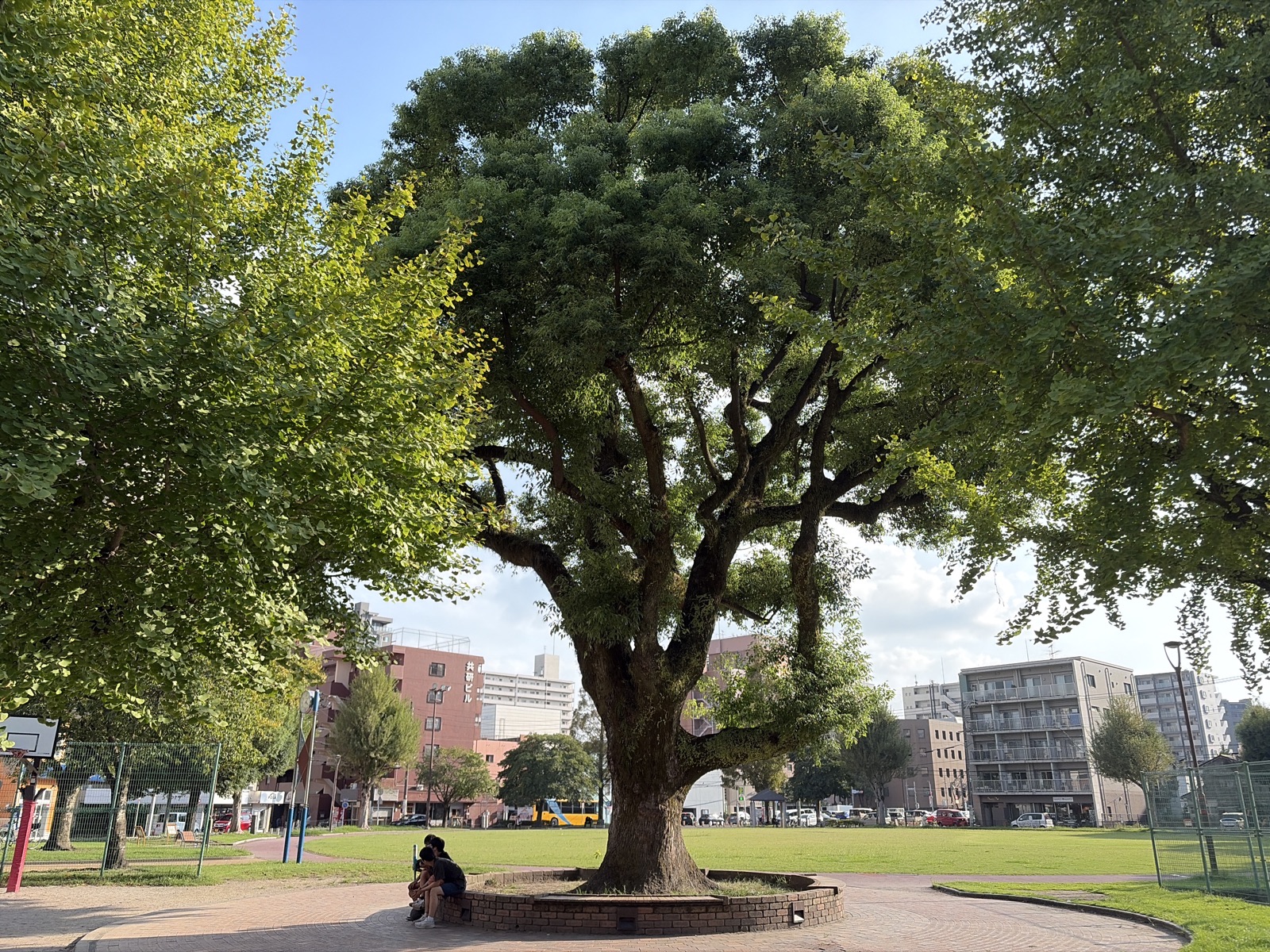
Camphor Tree (Cinnamomum camphora) · Chuo-cho
Saigo Takamori once lived on this exact patch of ground. Short of money, he sold his house in Kajiya-cho and moved here, and when Sakamoto Ryoma passed through Kagoshima he is said to have stayed as Saigo's guest. A stone marker in the park, Saigo Nanshu's Former Residence, still says so.
None of that history belongs to the tree. By 1911 the plot had become a girls' vocational school, the predecessor of today's Kagoshima Girls' High School, and only in 1951 did the city turn it into Kyoken Park, a sports ground squeezed into the blocks a few minutes from Kagoshima-Chuo Station. When the whole park was rebuilt between 2001 and 2004, the city named this camphor and a row of ginkgos along its new brick promenade as the park's symbol trees, the two things kept standing on purpose while the tennis courts and playground went in around them.
Nobody has measured it since. A visitor's own reckoning put it at about four metres round, wide enough to shade a good stretch of the basketball court beside it, growing alone in a circular brick planter where people sit out the afternoon. The layers underneath it, a Meiji-era school and a rebel general's house, are real and undated. The tree just happens to be standing on top of both.
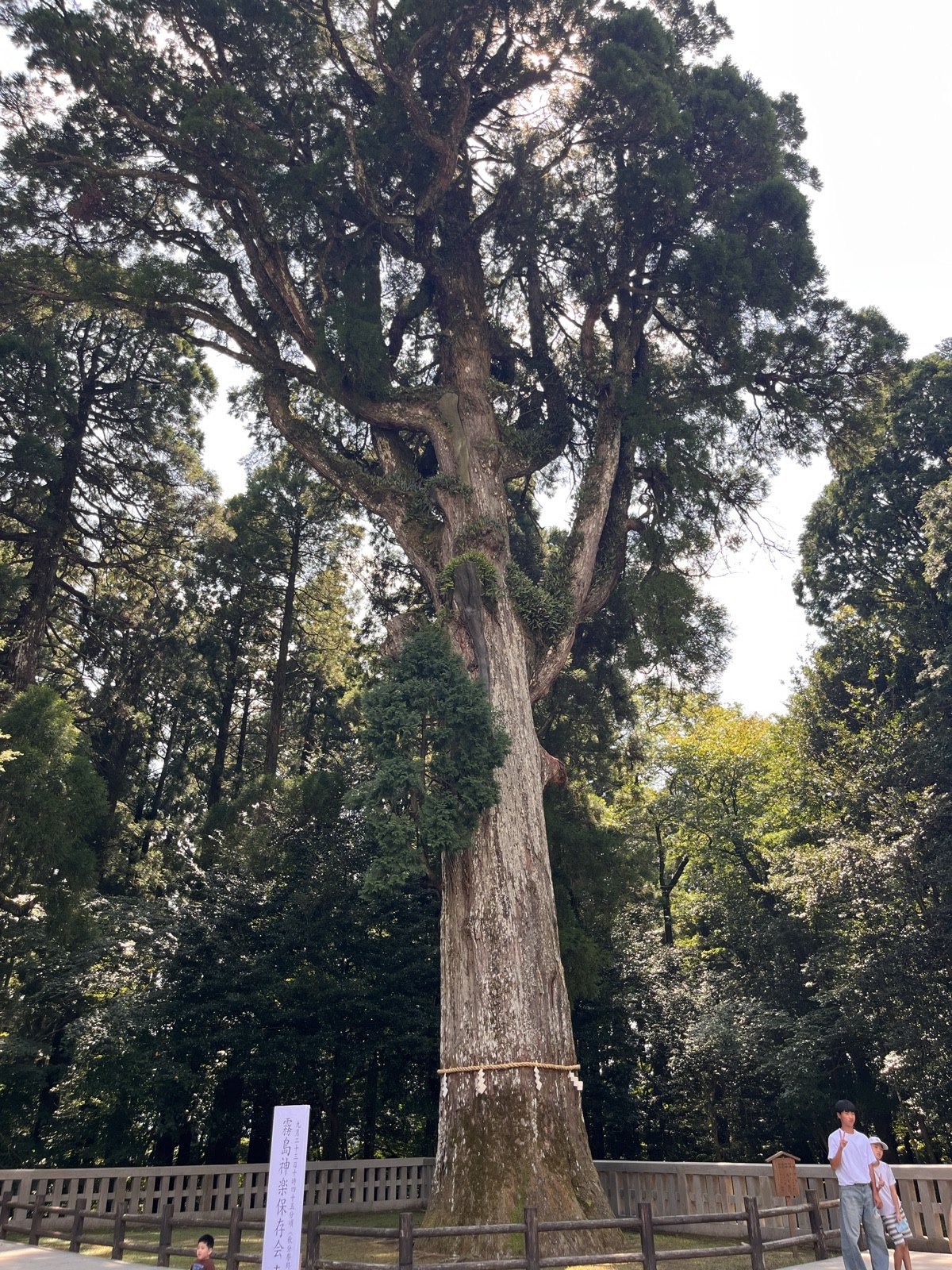
Japanese Cedar (Cryptomeria japonica) · 800 years · Kirishima (day trip from Kagoshima)
Every cedar in southern Kyushu is said to descend from this one. Kirishima Jingu calls its sacred tree the Kirishima-sugi, or Kirishima measa, the ancestor of the region's cedars, and that claim is tradition rather than anything a laboratory has tested.
The size is easier to check. The shrine's tourist association gives it 38.2 metres of height, 6.8 metres round the trunk and an age of about 800 years. Nobody publishes how those figures were taken, so read the age as the shrine's estimate rather than a count of rings.
If the estimate holds, the cedar was here before the shrine was. Kirishima Jingu was re-established on its present site in 1484, and the shrine's own guide says this tree was already standing when it arrived. It has watched more than five centuries of worshippers walk the approach since.
Eight hundred years is long enough to start leaning. By the early 2010s the trunk had tilted about ten degrees and the tree was in visible decline, and restoration work was carried out on it in April 2013. In October 2026 its crown was full and green.
It stands inside a low wooden fence in the front courtyard, a straw rope hung with paper streamers tied round the foot of the trunk and ferns growing on the bark. It is a day trip from Kagoshima: the train to Kirishima-Jingu station, then about fifteen minutes on the bus.
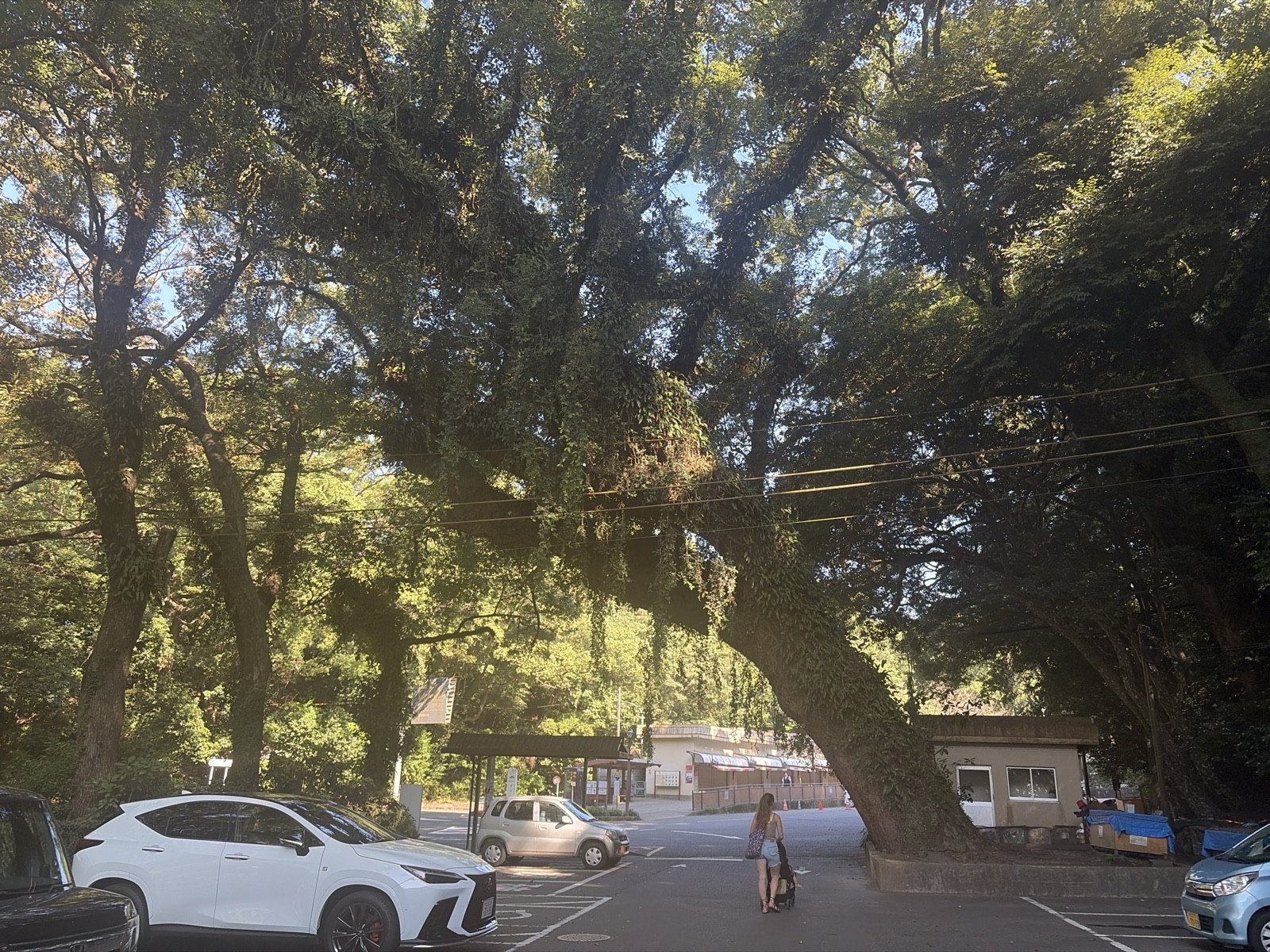
Camphor Tree (Cinnamomum camphora) · Shiroyama
Its main limb leaves the trunk at a slant and keeps going, out across the road, until it hangs over the cars parked on the other side. Almost everything else about this camphor is an open question.
Kagoshima keeps a register of 38 preserved trees, each measured and given a signboard at its foot. This one is not on it. It stands at the edge of a car park below Shiroyama, the hill above the city that has been a national natural monument and historic site since 1931, about 250 metres from the Camphor of Shiroyama on the forest path. None of the writing about Shiroyama that we found names it.
What one visit shows: a massive trunk rising out of a raised concrete bed beside a small building, a crown that was full and green in October 2026, and ferns growing along the leaning limb. The species is read from the leaves, the bark and the shape of the tree rather than from any record, and nobody has published a name, a girth, a height or an age for it.
That makes it a tree you can help put on the record. If you are standing under it, a tape round the trunk at chest height would give it its first measurement. If there is a plaque at the base, or a name the neighbourhood uses for it, or you know when it was planted, tell us and this page will carry it.
A day trip away
Kamo, 18 km north
Camphor Tree (Cinnamomum camphora) · 900 years · Kamo, Aira
This is the largest tree in Japan, and it was already being worshipped when the shrine beside it was founded in 1123. That founding record is the hard part of its age: the lord of Kamo brought the Hachiman deity here from Usa and set up the shrine, and the camphor is written down as a sacred tree at the time, which makes it at least 900 years old without anyone having to guess. The shrine's own figure is about 1,600. The measurements are not in dispute. The trunk is 24.22 metres around at chest height and 33.57 metres around at the roots, the tree is 30 metres tall, and the Environment Agency's 1988 national survey of giant trees ranked it first in the country, ahead of the camphor at Kinomiya Shrine in Atami by 32 centimetres. Inside, the trunk is hollow for about 4.5 metres across, roughly the floor of an eight-mat room. It was made a Special Natural Monument in 1952, the highest grade Japan awards, held by only seven things in this prefecture including Yakushima's cedar forest. Legend gives it a different origin: Wake no Kiyomaro, exiled to Osumi in the eighth century, is said to have pushed his staff into the ground here.