Miyazaki holds four trees the Japanese state has designated National Natural Monuments. They are not in the centre. The city swallowed three neighbouring towns in 2006 and 2010, so its boundary now runs 40 kilometres from a ginkgo on the old Satsuma highway to a fig on the Nichinan coast. Beside them stand camphors at Ikime, Eda and Sumiyoshi and the largest bald cypress in Japan. All but the ginkgo grow in shrine precincts, several of them founded more than a thousand years ago and never cleared since.
0 of 8 visited in Miyazaki
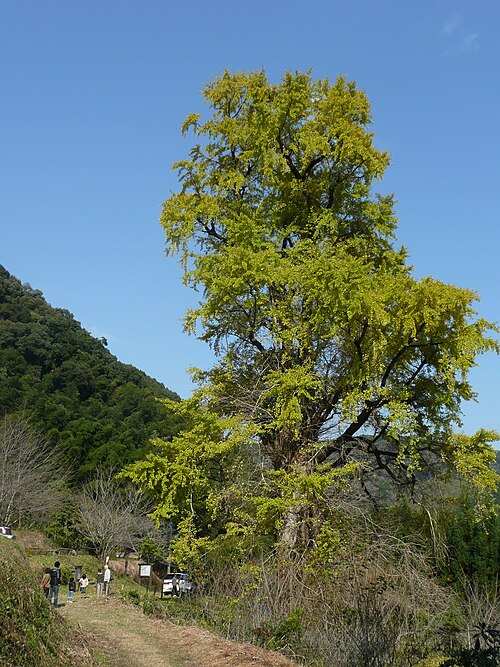
Ginkgo (Ginkgo biloba) · 800 years · Sarukawa, Takaoka
The Satsuma lords passed this tree on their way to Edo. The old Takaoka road ran close by it, a good way east of the modern route, and it was the road the Shimazu used for the sankin-kotai, the enforced march to the shogun's capital and back that every daimyo made. Sarukawa was the checkpoint on it, the gate between Satsuma and the outside. The ginkgo stands 400 metres off the present highway at the foot of a hill, in the loop of an old meander of the Oyodo river, and because nothing tall grows near it you see the crown long before you arrive. It is 11.2 metres round and 30 metres tall by the Environment Agency's survey, and it has been a National Natural Monument since December 1935. The signboard says 800 years and attributes the planting to Shimazu Tadahisa, the clan's founder, who died in 1227. That is where the number comes from: it is the legend converted into arithmetic, not a measurement, and the giant-tree database that records the tree says in plain words that it looks younger. It is a female tree, straight-trunked with few heavy limbs, and it goes gold in the last week of November.
Camphor Tree (Cinnamomum camphora) · 900 years · Kiyotake
People sheltered inside this tree during the war. The trunk has a mouth in it, and behind the opening the hollow runs to something like the floor of a seven or eight mat room; Kodansha's survey of Japan's natural monuments records that it was used as a makeshift air-raid shelter, and whether that would have helped against strafing or a bomb was never tested, because the attack did not come. The camphor stands at the foot of the hill beside Funabiki Shrine, which its signboard dates to 1087, and the 900-year age given for the tree is that founding date carried across on the assumption the two began together. It is a large assumption and it is the only basis there is. What is measured is the size, and it is not in dispute: 13.2 metres round and 35 metres tall in the Environment Agency's survey, which puts it among the largest camphors in the country. The shrine enshrines Emperor Chuai, Empress Jingu and their son Ojin, the Hachiman deities, and the tree is known locally as the Hachiman camphor because of it. It has been a National Natural Monument since June 1951. Epiphytes have thickened on it noticeably over the last few decades.
Camphor Tree (Cinnamomum camphora) · Ose-cho
Japan designated sixteen trees here at once. The camphors in the precinct of the Hachiman shrine at Uryuno were made a National Natural Monument as a group in June 1951, not one specimen but the whole stand, and three of the sixteen are outstanding. The largest is set at an angle behind the main hall, 9.6 metres round and 25 metres tall, and it is the one fewest people reach, because the gate on that side is usually shut and in high summer the grass comes up. The second stands to the right of the second torii and is worth the visit for its roots alone, a spreading platform of them you look up at from below. The third is on the left at the entrance and throws its heavy limbs out in every direction without much discipline. Nobody has published an age for any of them. The shrine's signboard says the Hachiman deity was invited here in 737, which would make the precinct nearly thirteen centuries old, and the plain reading is that the shrine is older than its trees rather than the reverse. What is unusual, for a national monument, is that you can put your hand on them. Nothing is fenced.
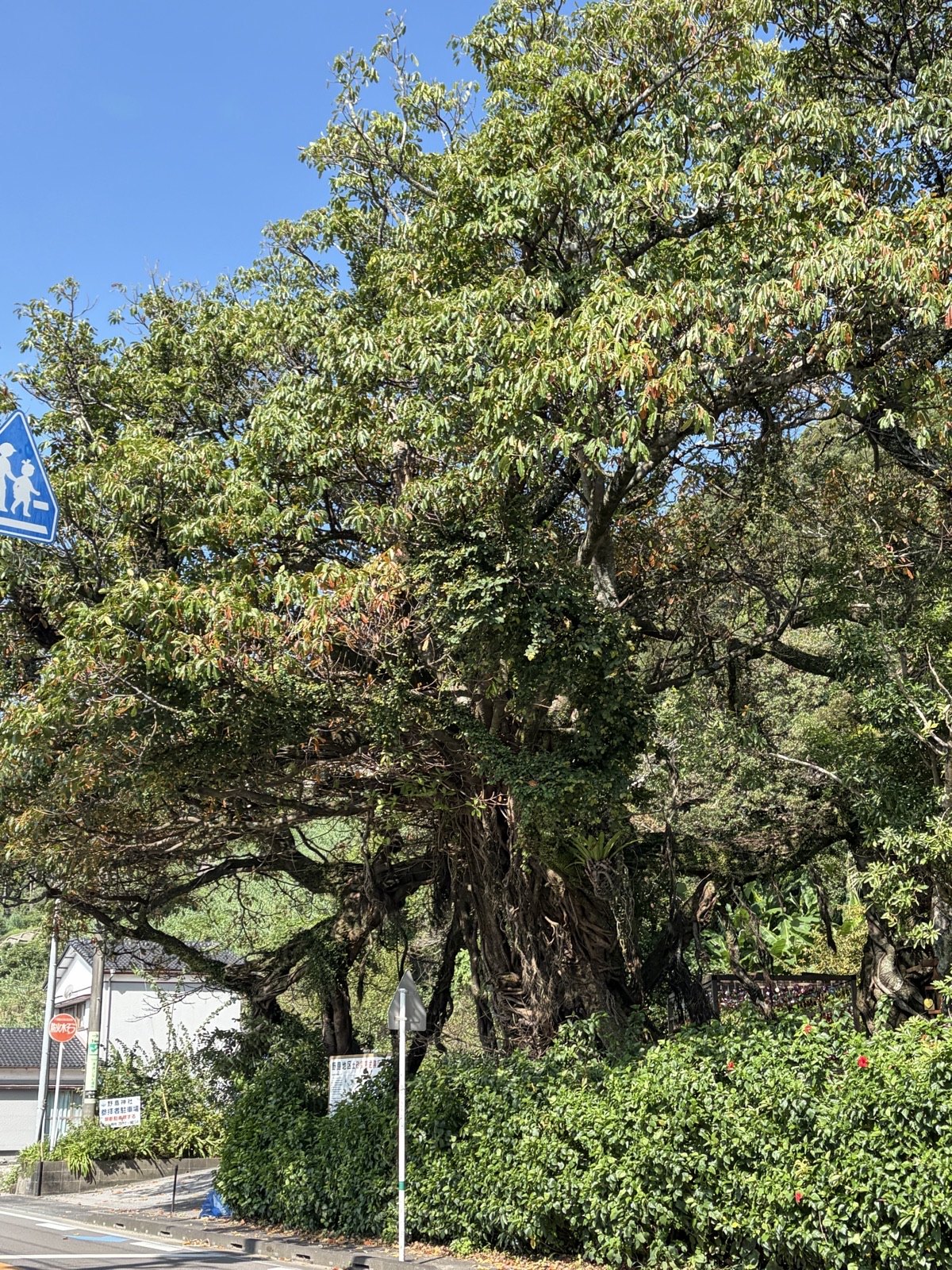
Sea Fig (Ficus superba) · 200-300 years · Uchiumi
Only one tree in this precinct is the national monument, and almost everybody gets it wrong. Nojima Shrine sits on the Nichinan coast road with akou figs all through it, roots poured over the walls and the rock, and the effect on arriving is unlike any other shrine grove in Japan, which is exactly why visitors assume the whole stand is protected. It is not. The designation, made in October 1941, covers the single tree standing to the right of the main hall: 6.9 metres round, 15 metres tall, put at 200 to 300 years by the Environment Agency. The explanatory diagram posted in the precinct says so correctly. Akou is a subtropical strangler fig at the northern edge of its range here, and Japan has only five national designations of the species, of which three protect a site rather than a tree; this is one of the two individuals. It is worth saying that the other figs around it are not filler. Standing in that precinct without them would be a much smaller experience, and the designated tree looks the wildest of a wild group rather than a specimen apart from them.
Bald Cypress (Taxodium distichum) · 130 years · Jingu
This is the largest bald cypress in Japan, and it is a stranger here. Taxodium distichum grows wild in the swamps of the American southeast and did not exist in this country until somebody carried it in, so every one in Japan was planted by a person, and the Environment Ministry's giant-tree database holds 27 of them under two different Japanese names. This one is number 1. It stands 24 metres tall with a trunk 5 metres round, near the entrance to the main approach at Miyazaki Shrine, on the left as you go in. It is a conifer that drops its needles, which is unusual enough in Japan to confuse people, and in its native swamps it grows knees, woody knobs that come up out of the ground around the trunk. The age is soft and the page will not pretend otherwise: a signboard from the prefecture's hundred-giant-trees project put it at 100 when it went up in 1992, which carried forward makes it about 130 now. The shrine it stands in is dedicated to Emperor Jimmu, who by the chronicles set out from this province to found the state, and it is a large quiet wood in the middle of a city.
Camphor Tree (Cinnamomum camphora) · Ikime
In 1870 the government ordered this tree cut down and the parishioners bought it back with rice. The new Meiji administration's Miyazaki office sent down an order that the camphor at Ikime Shrine was to be felled, presumably for timber, and the people who used the shrine petitioned against it on the grounds that they were afraid of what the god would make of it. The felling was waived in exchange for three koku and eight to of brown rice, something over five hundred kilograms. Then they cut the whole episode into a stone and set it under the tree, where it still stands, which suggests they wanted the transaction remembered rather than the tree simply saved. It is 8.7 metres round and 24 metres tall, to the right of the hall as you face it, with a ginkgo in front and an ogatama on the left; the camphor and the ogatama are both Miyazaki City Natural Monuments, designated in March 1973. Ikime was once written with characters meaning living eye, and the shrine has long been petitioned for eye complaints. No age has been published for the tree. If you know one, tell us.
Camphor Tree (Cinnamomum camphora) · Shimanouchi
The address says Shimanouchi and everything else here says Sumiyoshi. The district was called that once, and the name survives in the station, the schools, the post office and the bank, so the shrine is universally the Sumiyoshi Hachiman even though the ward it sits in has been renamed around it. Two big camphors stand in the precinct. The one near the torii is the smaller, 5.8 metres round in the Environment Ministry's database. The other, 8.2 metres, is to the left of the worship hall on a low mound, and it divides into two trunks at about 1.8 metres, which means the girth figure flatters it slightly; the mass below the fork is the impressive part rather than the number. Branches on the hall side have been taken off, so the crown is longer and narrower than it wants to be, and the rest of the heavy limbs are still there, which is more than most camphors this size in a working precinct keep. Nobody has recorded an age for it. The tree looks in good health, which is worth saying about an eight-metre camphor standing between a middle school and a nursery.
Camphor Tree (Cinnamomum camphora) · 100-200 years · Awakigahara
By the chronicles, three of the most important gods in Japan were born a few hundred metres from this tree. Eda Shrine enshrines Izanagi and Izanami, and the ground it stands on is one of the places identified as Awakigahara, where Izanagi washed himself clean after fleeing the land of the dead. The story goes that when he washed his left eye Amaterasu came out of it, from his right eye Tsukuyomi, and from his nose Susanoo. There is still a purification pond in the woods behind the hall. The camphor is on the main approach, on the right as you face the worship hall, 5.3 metres round and 15 metres tall, and the Environment Agency puts it at 100 to 200 years, which for a camphor is young. Soil has washed away from its base and left the top of the roots exposed, and one of them carries a rounded knob that has been rubbed smooth and shiny by hands over the years. There is no signboard explaining why people touch it. Trees are petitioned for breast milk in Japan and the shrine's old local name means honoured mother, so a guess is available, and it stays a guess.