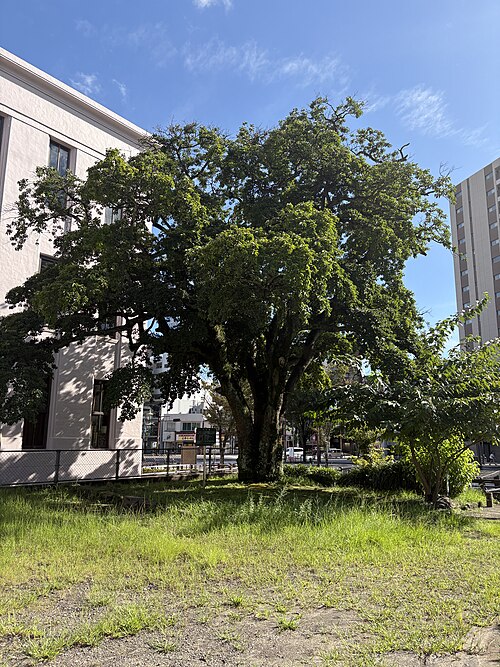
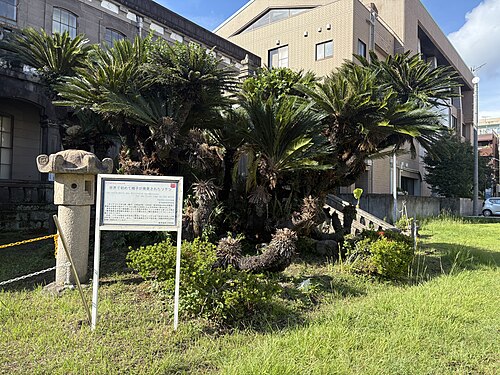
Saigo Takamori once lived on this exact patch of ground. Short of money, he sold his house in Kajiya-cho and moved here, and when Sakamoto Ryoma passed through Kagoshima he is said to have stayed as Saigo's guest. A stone marker in the park, Saigo Nanshu's Former Residence, still says so. None of that history belongs to the tree. By 1911 the plot had become a girls' vocational school, the predecessor of today's Kagoshima Girls' High School, and only in 1951 did the city turn it into Kyoken Park, a sports ground squeezed into the blocks a few minutes from Kagoshima-Chuo Station. When the whole park was rebuilt between 2001 and 2004, the city named this camphor and a row of ginkgos along its new brick promenade as the park's symbol trees, the two things kept standing on purpose while the tennis courts and playground went in around them. Nobody has measured it since. A visitor's own reckoning put it at about four metres round, wide enough to shade a good stretch of the basketball court beside it, growing alone in a circular brick planter where people sit out the afternoon. The layers underneath it, a Meiji-era school and a rebel general's house, are real and undated. The tree just happens to be standing on top of both.
Kyoken Park (Kyoken Koen), Chuo-cho 14, Kagoshima 890-0053 You can recognise it by its own circular brick planter at the park's centre, the only tree here fenced off like that. It stands between the basketball court and the open lawn, a few minutes from Kagoshima-Chuo Station.
Free, public neighbourhood park, open around the clock
About a 4-minute walk from Kagoshima-Chuo Station