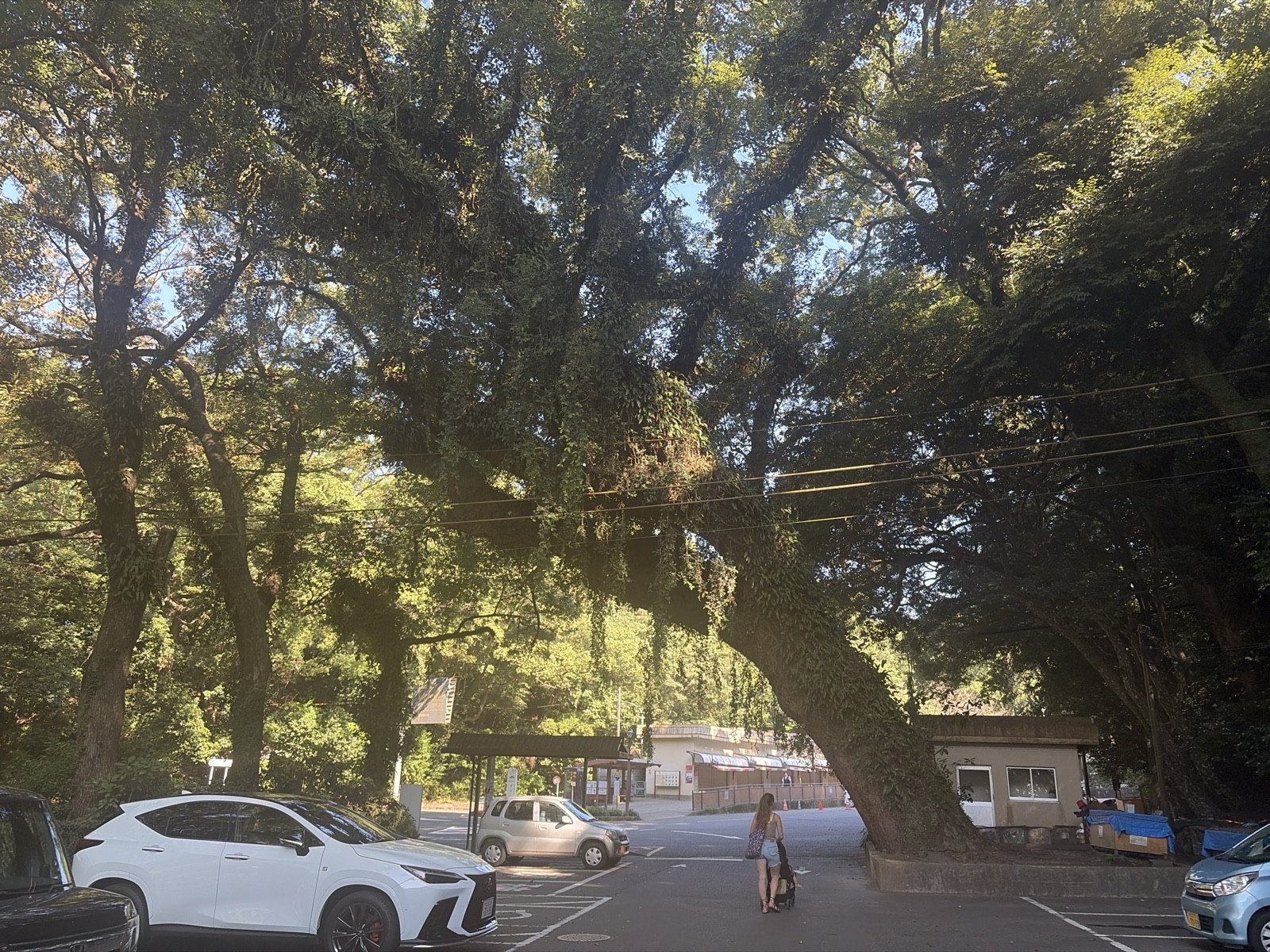
There is old forest 300 metres from Kagoshima's city hall because a lord gave up on a castle. A local clan built a fortress on this hill in the medieval period, which is where the name Shiroyama, castle hill, comes from. When the Shimazu took Kagoshima they built the flat, tower-less Tsurumaru castle at its northeastern foot instead, abandoned the hill fort within a generation, and closed the slope. Two and a half centuries of nobody going in produced what a 1974 academic survey counted as more than 510 species of higher plant on a hill 107 metres high, several of them recorded in Japan here for the first time. The biggest camphor anyone has measured in that forest stands beside the walking path. The Environment Agency's giant-tree survey gives it 12.9 metres around and 23 metres tall, at 300 years or more. Treat the girth carefully: it was taken at 1.3 metres, which on this tree is still root, and the trunk proper is a good deal narrower. Shiroyama is also where the Satsuma Rebellion ended. Saigo Takamori and a few dozen surviving men held caves on this hillside and came down into the government guns on the morning of 24 September 1877. The whole hill was made a National Natural Monument and a National Historic Site on the same day in 1931.
The line is our estimate of how much there is to see, not a measurement. Typical for this species where this tree stands; exact weeks shift with the year.
Shiroyama Park walking trail, Shiroyama-cho, Kagoshima 892-0853You can recognise it by the base, 12.9 metres round at chest height where the tree is still root, with the trunk proper narrower above it. It stands beside the walking path in Shiroyama Park.
Free, public hillside park, walking trails open at all times
Kagoshima City View bus to Shiroyama, or about 20 minutes uphill on foot from Tenmonkan
Sources
Where the facts on this page come from.