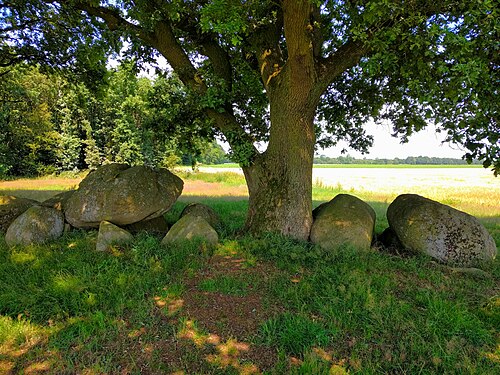
There is only one long grave in the Netherlands and this oak is standing next to it. Hunebed D43 is a langgraf: instead of a single chamber under a round mound, it has a covering mound forty metres long with two separate burial chambers set into it, the whole thing ringed by a kerb of stones. Fifty two of them survive, and the ring has been restored so that it reads almost completely. Nothing else of this form exists in the country. The oak went in some four and a half thousand years later, between 1860 and 1870. What makes this pair better than the tomb alone is scale. A forty metre mound is hard to see as a shape; from a distance it is a rise in the ground. A big oak beside it gives you something to measure against, and the length of the thing suddenly registers. Oaks and burial sites go together across northern Europe, and not by chance: burial mounds were left unploughed for centuries, so they became the one place in a farmed landscape where a tree could reach two hundred years. Walk the full length of the kerb. It takes longer than you expect.
In fruit
September to October: acorns drop, and a good mast year buries the ground in them
The line is our estimate of how much there is to see, not a measurement. Typical for this species where this tree stands; exact weeks shift with the year.
Beside hunebed D43, Emmeres and OdoornerstraatThe large oak standing alongside the ring of 52 kerb stones.
Free. Open ground at the hunebed, reachable at any time.
About 2 km northeast of Emmen centre, along the Odoornerstraat.
Sources
Where the facts on this page come from.
- In the official register: Landelijk Register Monumentale Bomen (Bomenstichting), no. 1682312
- monumentalebomen.nl
- services-eu1.arcgis.com