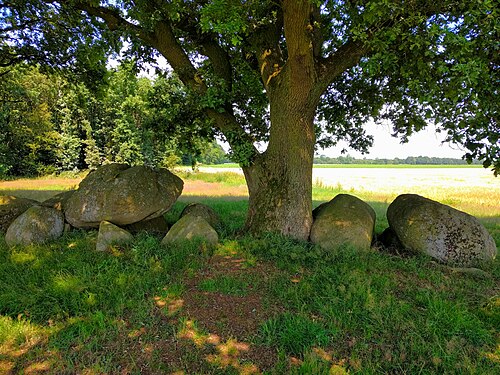
The oldest part of Emmen is a street, and this is the tree on it. Emmen began as an esdorp on the southeastern shoulder of the Hondsrug, the long sand ridge that runs across Drenthe. An esdorp is a village organised around a shared arable field, the es, built up over centuries with sods and manure until the soil was deep enough to farm on ground that was otherwise heath. The Noordeind was where it started, lined with the characteristic Drenthe farmhouses, most of which have gone. The lime stayed, planted, the register suggests, around 1790. A village lime in this part of the country was never ornamental. It was the meeting point: shade in summer, a place to stand and settle things, sometimes the spot where local justice was spoken, and always the thing you gave directions by. That is why so many of them are older than the houses. Nobody removes the tree everyone arranges to meet at. Go in July, when it flowers. Lime blossom on a still evening is heavy and sweet and carries the length of a village street, and it is one of the few sensory experiences here that has not changed since 1790.
In bloom
July, when the blossom carries down the whole street
The line is our estimate of how much there is to see, not a measurement. Typical for this species where this tree stands; exact weeks shift with the year.
Noordeind, opposite number 9A very heavy old lime standing alone on the street, opposite number 9.
Free. Stands on the public street opposite number 9.
About 1.5 km north of Emmen centre, on the Noordeind.
Sources
Where the facts on this page come from.
- In the official register: Landelijk Register Monumentale Bomen (Bomenstichting), no. 1682311
- monumentalebomen.nl
- services-eu1.arcgis.com