This list ranks the best afternoon, not the single best tree: cities where several ancient trees stand close enough for one honest walk rather than a taxi between highlights. Every distance and time below comes from the same walk planner every city page already uses, real streets allowed for, not straight lines, and it is a flat-ground number: a hillside city can cost more effort than the kilometres alone suggest, noted plainly where that applies. Order runs easiest first. Lisbon and Sintra are presented as one paired trip, a short train ride apart, so eleven cities carry ten rankings. Every fact here is drawn from this project's own verified research, nothing polled or scored by an algorithm.
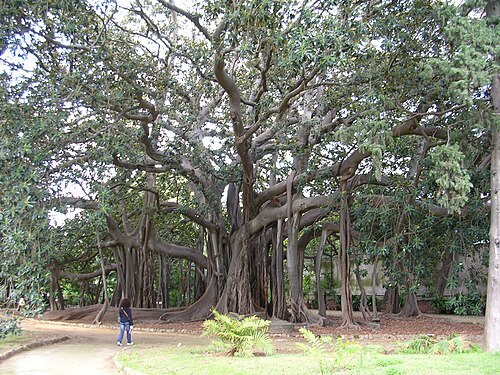
Moreton Bay Fig (Ficus macrophylla) · approximately 181 years · Kalsa
Start under the biggest canopy on this list: 3,000 square metres of fig, built from 44 aerial roots that thickened into trunks since 1845, reportedly Europe's widest tree crown. Walking the connected cluster around it, an offspring fig in Piazza Marina, a royal palm avenue and a dragon tree at two nearby villas, comes to about 5.5 km and a little over an hour on foot, flat, free everywhere except the botanical garden itself. The easiest trip on this list.
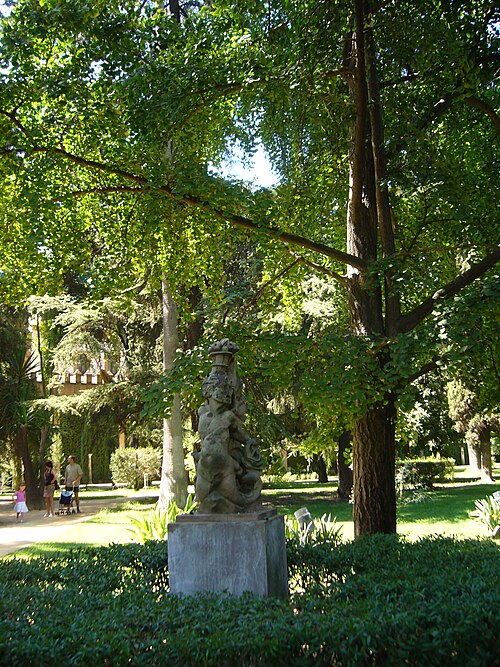
Ginkgo (Ginkgo biloba) · 116 years · Santa Cruz, Casco Antiguo
Nine of Seville's ten trees chain into one loop, about 4.3 km and under an hour, flat the whole way. It threads from these Real Alcázar ginkgos, survivors of a 1910 shipment from a royal garden near Segovia that turn uniformly gold every December, through the orange-tree courtyard of the Patio de los Naranjos and out along the shaded Alameda de Hércules. Free throughout except the Alcázar's own entry fee.
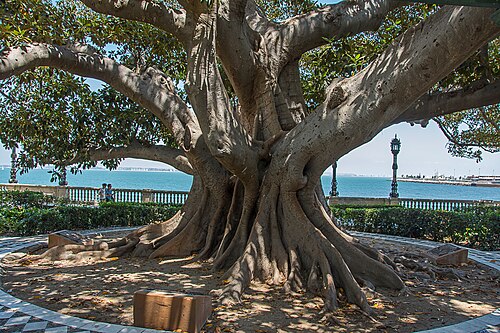
Moreton Bay Fig (Ficus macrophylla) · approximately 123 years · San Carlos
All five of Cadiz's trees fit into one short seafront walk, about 1 km and roughly a quarter of an hour, the shortest and flattest trip here. It starts with this Alameda fig, grown from a sapling missionary nuns carried from India in 1903, and continues into Parque Genovés for a disputed-age dragon tree, an Argentine ombú and a pohutukawa reported as the oldest of its kind documented in Europe. No entry fee anywhere on the route.
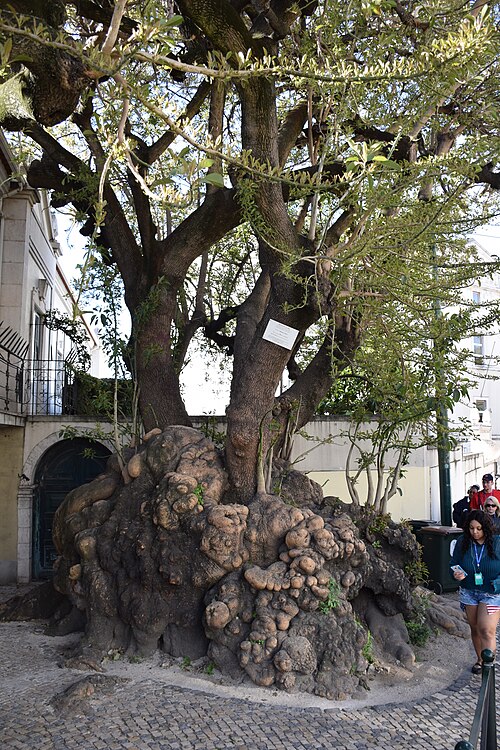
Five of Lisbon's trees cluster into a walk of about 3.5 km, under an hour, running from this ombú's seventeen-metre trunk against the old Limoeiro prison wall down through the Alfama toward Príncipe Real's cypress, the Giant Rubber Tree escaped from a broken Mouraria pot, and Jardim de São Bento's tipu. Pairs naturally with Sintra below, a forty-minute train away, for a two-day version of this trip.
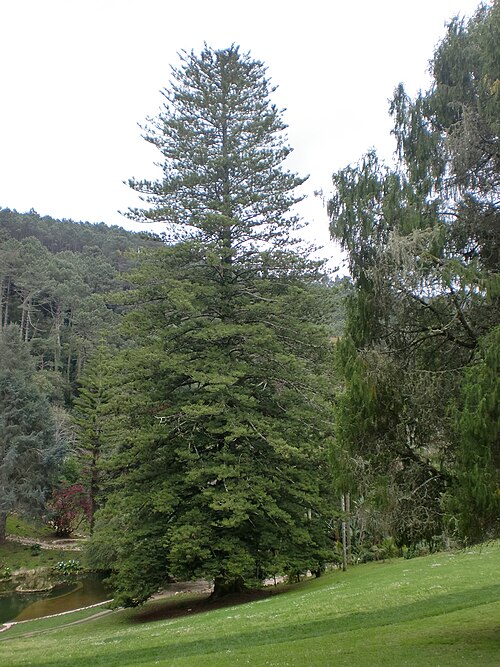
Norfolk Island Pine (Araucaria heterophylla) · approximately 160 to 180 years · Galamares
Sintra's own five trees connect into a longer walk, about 5.7 km and well over an hour, and the hilly Serra de Sintra terrain between the palace grounds costs more than that flat number shows. It runs past this 50-metre Norfolk Island pine planted by a Victorian textile magnate, a western red cedar that has spent a century and a half walking across the Pena grounds one rooting branch at a time, and a roadside cork oak over 300 years old. Pairs with Lisbon above.
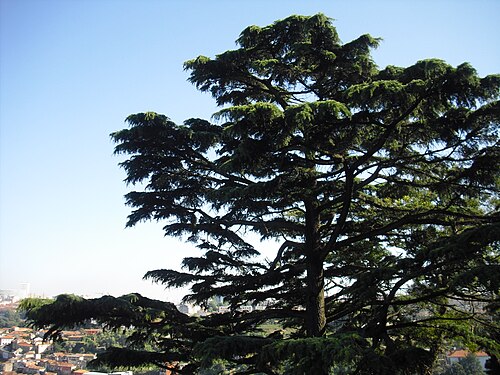
Himalayan Cedar (Cedrus deodara) · unknown · Massarelos
Every one of Porto's ten trees fits into a single walk, about 2.6 km in roughly half an hour, the best tree-to-effort ratio on this list. Most cluster around the Jardins do Palácio de Cristal, where this Himalayan cedar's crown clears the rooftops for a view over the Douro, before continuing to Casa Tait's magnolia and camellias and Quinta da Macieirinha's plane. Free throughout, flat, and short enough to fit before lunch.
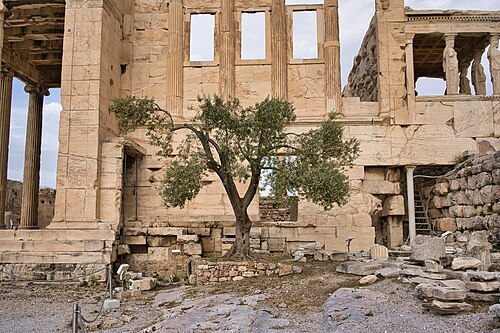
Olive (Olea europaea) · 70-110 years (current wood); mythologised lineage to 480 BC · Acropolis
Five of Athens's ten trees connect into a walk of about 3.8 km, under an hour of flat ground, but budget extra for the climb up Filopappou Hill at the far end. It opens at this olive beside the Erechtheion, kept alive by cuttings since a predecessor Herodotus says burned with the Acropolis in 480 BC, then threads through the First Cemetery's cypresses and the National Garden's holm oak. Acropolis entry needs the standard ticket; the rest is free.
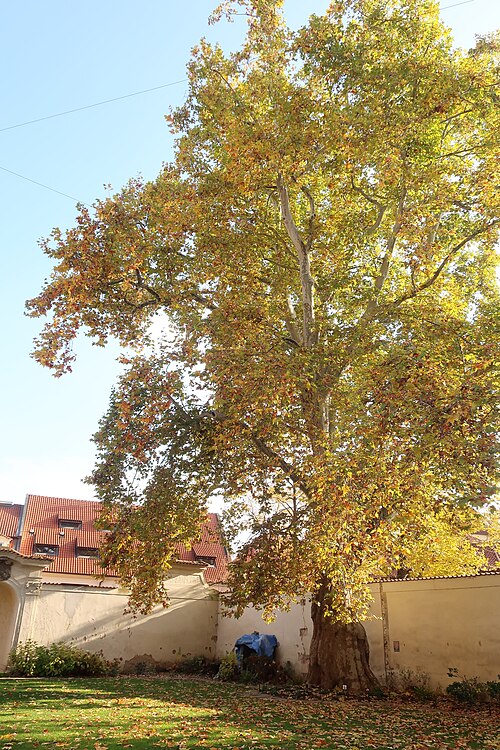
London Plane (Platanus x acerifolia) · estimated 200-300 years · Mala Strana
Seven of Prague's ten trees join into a walk of about 4.6 km, just over an hour, opening on the hillside gardens near Strahov before dropping down to the river. It passes Neruda's Pear Tree and three separate plane trees at Kampa, Kinsky Garden and Karlovo namesti before reaching this plane, Prague's thickest protected tree at 7.5 metres round, shading the Lennon Wall without most visitors ever looking up to notice it.
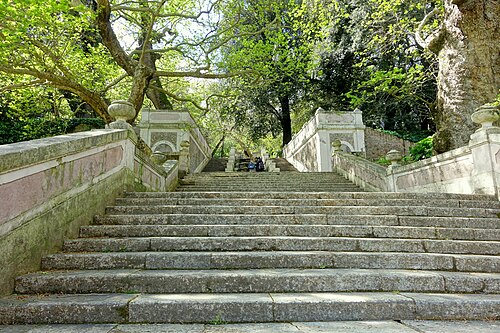
Oriental Plane (Platanus orientalis) · 350 years · Trastevere, at the foot of the Gianicolo
Seven of Rome's ten trees connect into a walk of about 5.2 km, just over an hour, and it is genuinely hilly: the route climbs the Gianicolo to reach the Cedar of the Garibaldi Mausoleum, so budget more effort than the flat distance implies. It runs from Villa Celimontana's undocumented cedar and pine through the Capitoline's fitolacca to these two 300-year-old planes framing the botanical garden's eighteenth-century fountain staircase, finishing at Villa Sciarra's ginkgo.
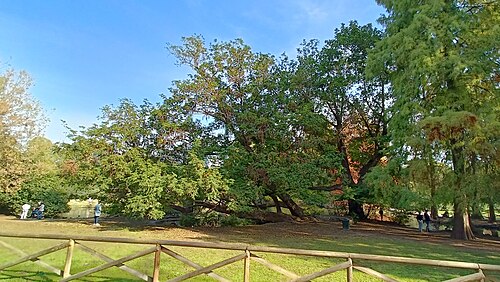
Caucasian Wingnut (Pterocarya fraxinifolia) · age undocumented · Sempione
Seven of Milan's ten trees chain into a walk of about 5 km, a little over an hour, flat throughout in a city famous for having no hills to climb. It starts at this Caucasian walnut leaning almost horizontally over a Parco Sempione pond near the Sforzesco Castle, then crosses to Via Madonnina's paulownia, the Orto Botanico di Brera's ginkgo, and Giardini Montanelli's hackberry and catalpa.
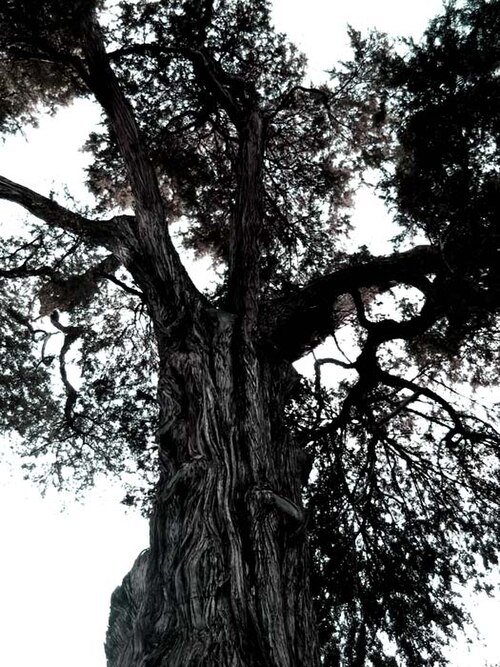
Mexican Cypress (Cupressus lusitanica) · approximately 440 years · Antequeruela
All ten of Granada's trees connect as one continuous walk by distance, about 5.2 km and just over an hour, but the number understates the effort: most of these ten grow within or below the hilltop Alhambra and Generalife grounds, so expect a real climb the flat kilometres don't show. It opens at this cypress a 16th century mystic reputedly planted with his own staff, then rises past Generalife's sequoias, the Alhambra forest's horse chestnuts and the Archbishop's Palace palms.