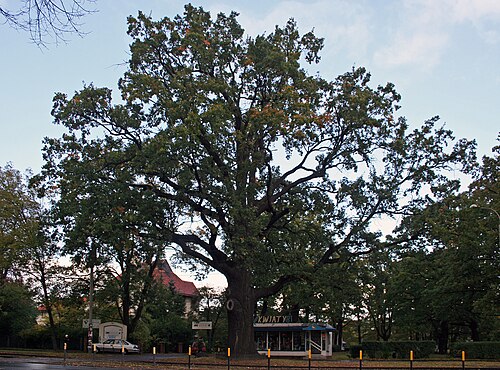
Lightning found this oak and it is still in leaf. The strike left it in poor structural condition, which is the surveyors' phrase and not a euphemism, and it went on growing: 554 centimetres round and 26 metres tall, the tallest of the four oaks on this page. It stands inside Park Szczytnicki near the narrowing of the park pond, a few minutes from the Hala Stulecia, Max Berg's concrete dome of 1913 that went on the UNESCO list in 2006 and drew the world's architects to this corner of the city. Unlike the other three, this tree was not protected in the 1953 batch. Its designation came on 2 April 1976, decision 26/76, twenty-three years later. It carries the name of Jan Stanko, the fifteenth-century physician and naturalist who compiled one of the earliest catalogues of Central European plants and animals, which is a fair patron for a tree in a park built as a botanical showpiece. No age estimate for it exists in any source found: the register that protects it records a species, a position and a date, and has no column for age or girth anywhere in it, so the girth and height here come from a dedicated survey of the island's monument trees.
In fruit
September to October: acorns drop, and a good mast year buries the ground in them
The line is our estimate of how much there is to see, not a measurement. Typical for this species where this tree stands; exact weeks shift with the year.
Park Szczytnicki, near the narrowing of the park pond, WroclawYou can recognise it by its tall crown, damaged by a past lightning strike, still holding leaves. It stands in Park Szczytnicki, near the narrowing of the park pond, a few minutes from Hala Stulecia.
Free, inside the public Park Szczytnicki, open at all times
Tram stops around Hala Stulecia (Centennial Hall) / Park Szczytnicki, a short walk
Sources
Where the facts on this page come from.
- GDOS CRFOP register: http://crfop.gdos.gov.pl/CRFOP/widok/viewpomnikprzyrody.jsf?fop=PL.ZIPOP.1393.PP.0264011.2287
- przyrodniczo.pl