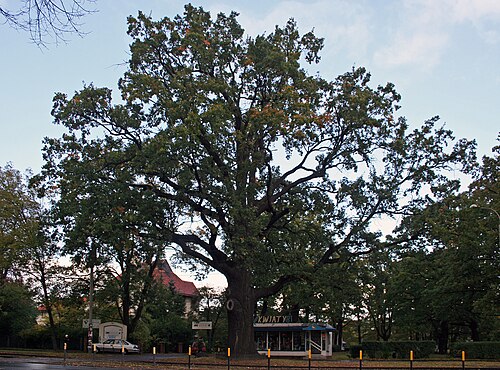
In 1865 the mayor of Breslau bought a piece of riverbank so that this oak would not be cut down. Artur Hobrecht made the purchase on the city's behalf and the tree carried his name for the next eighty years, the Hobrecht-Eiche, until Breslau became Wroclaw in 1945 and the new Polish city renamed it for Jan Dzierzon, the Silesian priest and beekeeper who worked out that drones hatch from unfertilised eggs. It has been a protected natural monument since 16 February 1953, decision 5/53, one of three on this page designated on the same day. A dedicated survey of the monument trees of Wielka Wyspa puts it at 652 centimetres round and 22 metres tall, which is within half a centimetre of the girth recorded for Dziadek, a kilometre away. Poland's national register has no column for either figure, so the measurements come from that survey rather than from the state. The same survey is blunt about its condition: the interior is substantially decayed, the trunk is hollow and the structure is poor. The tree is alive and comes into leaf, standing on the open boulevard along the Oder canal between the Zwierzyniecki and Szczytnicki bridges, where anyone can walk up to it at any hour.
In fruit
September to October: acorns drop, and a good mast year buries the ground in them
The line is our estimate of how much there is to see, not a measurement. Typical for this species where this tree stands; exact weeks shift with the year.
Bulwar on the Odra Canal embankment, ul. Bartla, WroclawYou can recognise it by its hollow, thick trunk on the open riverside boulevard. It stands beside the Oder canal, between the Zwierzyniecki and Szczytnicki bridges.
Free, on the public riverside boulevard/embankment along the Oder canal, open at all times
Tram stops serving Most Zwierzyniecki, about 10 minutes' walk along the river path
Sources
Where the facts on this page come from.
- GDOS CRFOP register: http://crfop.gdos.gov.pl/CRFOP/widok/viewpomnikprzyrody.jsf?fop=PL.ZIPOP.1393.PP.0264011.2307
- przyrodniczo.pl