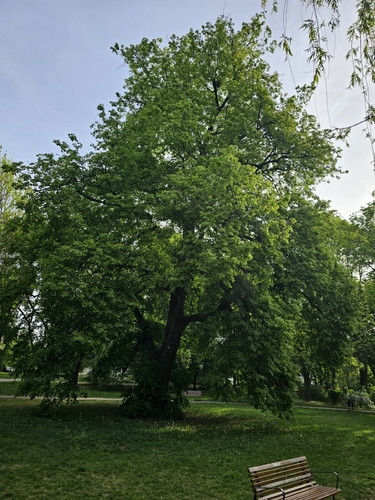
Five pedunculate oaks stand together near Palac Szustra, the neoclassical villa at the heart of Park Morskie Oko, registered as one natural monument in 1978. Princess Izabela Lubomirska commissioned the palace and its grounds in the 1770s, designed by the architects Szymon Boguslaw Zug and Efraim Szreger; the estate passed to Anna Potocka in 1820, and in 1845 the banker Franciszek Szuster bought it and opened the lower part of the grounds to the public as a promenade, which is where the district gets its name. The palace burned during the 1944 Warsaw Uprising and was rebuilt after the war. Warsaw's own environmental department lists a pedunculate oak next to the palace among the park's protected natural monuments, though the register gives no age or measurements for any of the five, only their 1978 designation date. Park Morskie Oko, also called Park Promenada-Morskie Oko, is one of Mokotow's most visited green spaces, its ponds and paths busy on any warm weekend, and the oaks stand a short walk from the palace steps, easy to overlook next to a building with so much of its own history on display. Nobody has measured them yet: if you know how old they are, this is the page to tell us on.
In fruit
September to October: acorns drop, and a good mast year buries the ground in them
The line is our estimate of how much there is to see, not a measurement. Typical for this species where this tree stands; exact weeks shift with the year.
Park Promenada-Morskie Oko, beside Palac Szustra, off ul. Pulawska, Mokotow, WarszawaYou can recognise them as five pedunculate oaks standing together, registered as a single natural monument. They stand near Palac Szustra in Park Promenada-Morskie Oko.
Free, the park is open daily to the public at no charge
Tram or bus to Dolna/Pulawska, short walk into the park
Sources
Where the facts on this page come from.
- In the official register: Centralny Rejestr Form Ochrony Przyrody (CRFOP, GDOS), no. PL.ZIPOP.1393.PP.1465011.2969
- pl.wikipedia.org
- zabytek.pl