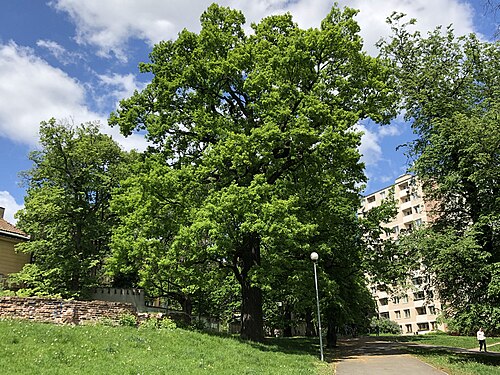
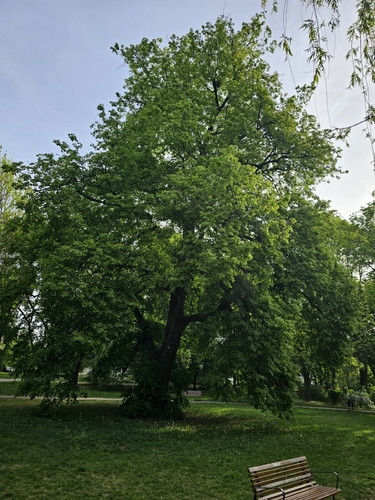
Warsaw's register gives this oak a date five years older than its five famous neighbours. The Szustra Oaks, a group of five pedunculate oaks registered together in 1978, stand right beside Palac Szustra in Park Morskie Oko. This one, thirty metres further east, was designated on its own in 1973, which makes it the earliest protected tree found in the whole park, and yet it has no name of its own beyond a line in a register. Why it was split out from a group registration nobody has explained. It may simply have been protected first, alone, before somebody later decided the palace's other five oaks deserved the same status as a set. Whatever the reason, the city treats it as a genuinely separate monument, with its own designation number rather than a line inside the Szustra group's listing. Nobody has measured its girth or estimated its age, only recorded that it stands and that it is protected. A photograph taken in 2022 shows it in leaf at the stated spot, thirty metres from the palace, the most recent confirmation this pass could find that the earliest-registered tree in Park Morskie Oko is still there. If you know its age or have stood beside it, tell us: the reader is the one most likely to fill in what the register left out.
In fruit
September to October: acorns drop, and a good mast year buries the ground in them
The line is our estimate of how much there is to see, not a measurement. Typical for this species where this tree stands; exact weeks shift with the year.
Park Promenada-Morskie Oko, roughly 30 metres east of Palac Szustra, MokotowYou can recognise it as the one oak registered separately from the five named Szustra Oaks nearby, thirty metres east of the palace. It stands in Park Promenada-Morskie Oko.
Free, the park (Park Promenada-Morskie Oko / Park Morskie Oko) is open daily to the public at no charge.
Tram or bus to Dolna/Pulawska, short walk into the park; about 90m from the Szustra Oaks (war_009).
Sources
Where the facts on this page come from.