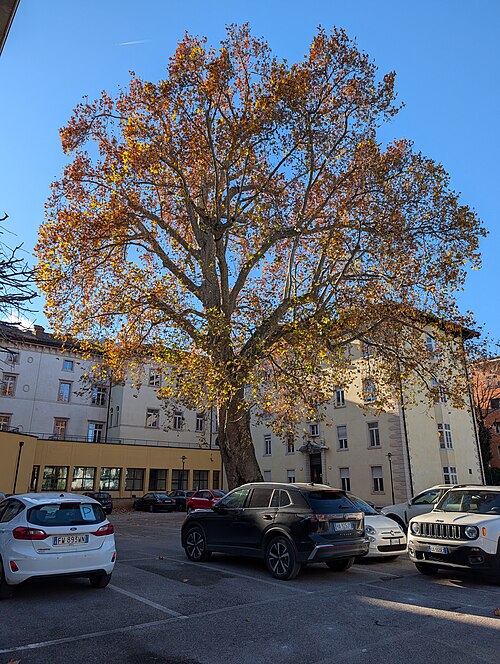
A black poplar with a trunk of 570 centimetres is a rarer thing than it sounds. Populus nigra is one of Europe's most threatened native trees, not because anyone cuts them down but because nearly every poplar planted along a European road or river for two centuries has been a hybrid with an American species, and the native form has been bred out of its own landscape. It is also fast, soft and short-lived by the standards of this map. Most do not last long enough to be measured at nearly six metres round. This one made Trento's list of eighteen monumental trees in 2024, named in the national coverage as the black poplar of Largo Pigarelli. What that coverage does not give is an age, and neither does anything else we found. The register's girth is the only measurement on record, with no second reading to check it against, so the number stands uncorroborated and the tree is flagged for it. The garden is small and municipal, listed in the comune's own directory of parks, a few minutes on foot from the station in a stretch of the centre where several monumental trees stand within a short walk of one another. Free, no gate, no hours. Poplars move in wind more than any tree of their size, which is the thing to stand under it for.
The line is our estimate of how much there is to see, not a measurement. Typical for this species where this tree stands; exact weeks shift with the year.
Giardino di Largo Pigarelli, 38122 Trento TN, ItalyYou can recognise it by its trunk, 5.70 metres round, an unusually large size for a native black poplar, and by how much it moves in the wind. It stands in the Giardino di Largo Pigarelli.
Free, public garden (Comune di Trento, listed in its official park/garden directory)
roughly 10 min on foot from Trento station
Sources
Where the facts on this page come from.
- In the official register: Elenco degli alberi monumentali d'Italia (MASAF), no. 13/L378/TN/22
- MASAF national monumental trees register, sheet 13/L378/TN/22
- comune.trento.it garden directory entry for Giardino largo Pigarelli
- 2024 local press (ANSA, il Dolomiti) coverage of Trento's 18 monumental trees, which names a black poplar at Largo Pigarelli among them
- MASAF, Elenco degli alberi monumentali d'Italia (Italy's national register of monumental trees), no. 13/L378/TN/22