This is not a palm at all, whatever its common name says.
Sago Palm
Cycas revoluta
A sago palm is not a palm at all. We map 6 of them, in 6 cities.
Cycas revoluta belongs to the cycads, a lineage that predates flowering plants, largely unchanged since before the dinosaurs, and it grows to match, sometimes a centimetre or two of height a year. Old ones sprawl into colonies of many trunks from one base. Japan names three great cycads. Myokoku-ji's in Sakai is put at over 1,100 years by tradition and Nomanji's at about a thousand, and both carry the same legend: a warlord took the plant to his castle and sent it home after it wept every night for its temple. Ryuge-ji's in Shimizu is one plant with fifty-eight trunks rising from a single base. One beside a museum in Kagoshima carries the name of a discovery: in 1896 a botanist found this species' sperm swimming inside an ovule, the first motile sperm ever seen in a seed plant.
Seville
Osaka
Oda Nobunaga took this plant, and by the story it cried until he gave it back.
Kagoshima
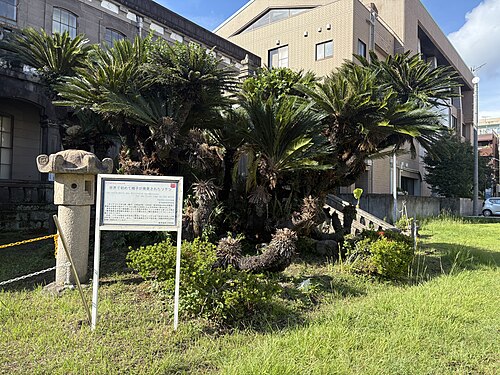
In 1896 a botanist in Tokyo looked into a cycad ovule and saw something swim.
Photo: あじさか (CC BY-SA 4.0)
Kawazu
Four thick branches run along the ground from this cycad's base like the arms of something reaching rather than growing, described in Japanese sources as looking like a giant snake writhing.
Shimizu
From the temple path this looks like a thicket of small palms.
Yoshida
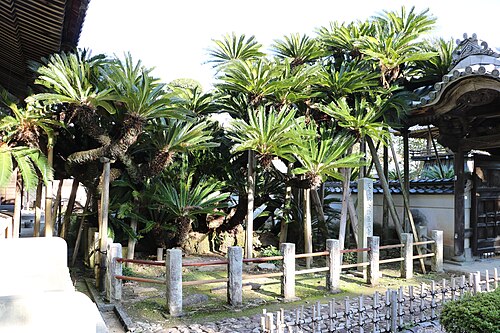
When Tokugawa Ieyasu had this cycad dug up and moved to his castle at Sumpu, the story goes, it wept every night for its old temple until he gave up and had it replanted where it started.
Photo: さかおり (CC BY-SA 4.0)
Explore by city: Seville · Osaka · Kagoshima · Kawazu · Leiden · Brussels · Brisbane · Munich · every city · or browse all species.