Yoshida maps one tree: the Nomanji Cycad, a multi-stemmed sago palm at Nomanji Temple wrapped in Heian-period legend, said to have been planted around the year 1000 by the diviner Abe no Seimei. It is counted among Japan's Three Great Cycads and has held National Natural Monument status since 1924, one of the earliest tree designations under the country's original heritage law.
0 of 1 visited in Yoshida
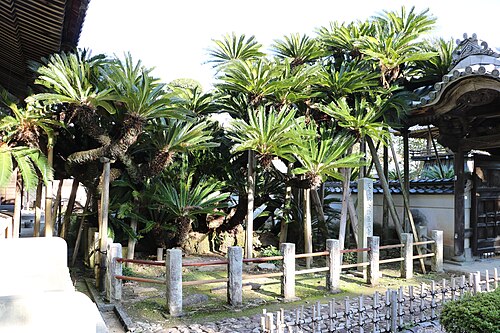
Sago Palm (Cycas revoluta) · 1,000 years · Kataoka, Yoshida
When Tokugawa Ieyasu had this cycad dug up and moved to his castle at Sumpu, the story goes, it wept every night for its old temple until he gave up and had it replanted where it started. That legend, along with one crediting its planting around the year 1000 to Abe no Seimei, the Heian-era diviner famous for sealing a serpent spirit beneath its roots, is why this plant carries more folklore than most trees twice its official age.
It is not really one trunk. What stands at Nomanji Temple today is a clump of roughly ninety branching stems rising from one base, the largest of which measures about 2.5 metres round on its own, with the whole clump's base running to roughly 3.3 metres. It stands only about 6 metres tall, low and dense rather than towering, which is normal for Cycas revoluta, a sago palm rather than a conifer or broadleaf.
Japan named it a National Natural Monument in 1924, one of the earliest tree designations under the country's original 1919 heritage law, and it is counted among the Three Great Cycads of Japan alongside specimens in Osaka and Shimizu. It also appears on the folklore list known as the Seven Wonders of Enshu. The temple opens its grounds daily from 9 to 5, with parking on site, for a plant that supposedly once refused to grow anywhere else.
Photo: さかおり (CC BY-SA 4.0)