A daimyo oak this size is unusual enough to be the whole point.
Daimyo Oak
Quercus dentata
Kashiwa, the daimyo oak, is a slow tree of poor ground and cold slopes that rarely puts on real bulk, which makes every specimen here worth the detour on size alone. We map 3 of them, in 3 cities.
Its broad leaves are the reason most people in Japan know the species without knowing they do: they wrap the rice cakes eaten at Children's Day, chosen because the old leaves cling on through winter and let go only when new buds push them off, read as a family line that never breaks. Sapporo's stands on the path to Hokkaido Shrine's worship hall, probably the largest of several big kashiwa on those grounds. Hiroshima's carries the same three-century age band as the giant cedar it grows beside. The oldest and strangest is Shogen-in's Sakasa Gashiwa in Shiwa, its trunk splitting into four limbs at ground level that run outward before turning up, so the branches read as roots that changed their minds; the only daimyo oak under national protection in Japan.
Hiroshima
Sapporo
This shrine was founded before it had a place to stand.
Shiwa
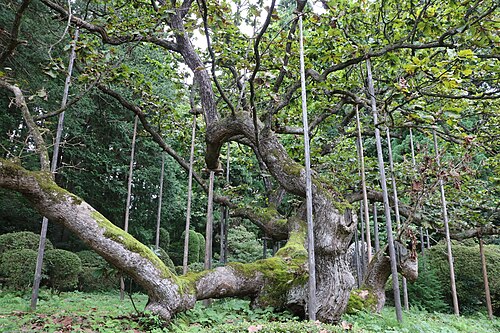
This oak looks as though someone planted it upside down.
Photo: さかおり (CC BY-SA 4.0)
Explore by city: Hiroshima · Sapporo · Prague · Brussels · Seville · Munich · Porto · Brisbane · every city · or browse all species.