Sapporo was laid out on open plain in 1869, so almost nothing here is old by Japanese standards and the trees split into two kinds. There is what was already growing: a hill on the western edge never cleared and now a National Natural Monument, and a willow in a park that stood before the city did. And there is what the settlers brought, planted along new streets or shipped in for a botanical garden. No shrine here is older than the town. Every old tree in Sapporo is a survivor of the plain or an immigrant.
0 of 6 visited in Sapporo
Katsura (Cercidiphyllum japonicum) · Maruyama
There is uncut forest 3.7 kilometres from Sapporo station. Maruyama is a 225 metre cone standing on its own at the western edge of the grid, and while everyone knows the park and the zoo at its foot, the hill itself is covered in natural woodland that Japan designated a National Natural Monument in March 1921 under the name Maruyama Primeval Forest. Katsura is the species that gets big in it, particularly on the north side, and this one is 12.2 metres round and 27 metres tall. Follow the path from the Daishido, the gate to the eighty-eight station pilgrimage circuit, up beside what looks like an irrigation channel and is the Maruyama river, and the tree is on the bank; the way the roots gather into the trunk is the thing to look at. Two honest caveats come with it. The Environment Ministry's database lists several katsura here at 12.0, 11.5, 9.5 and 8.4 metres, all of them clusters of stems rather than single trunks, and which record belongs to which tree is not resolvable from the data. The ministry also files this one under a different address and owner, which if correct would put it just outside the protected forest. It is a magnificent tree standing on a boundary in two senses.
Katsura (Cercidiphyllum japonicum) · 750 years · Koganeyu
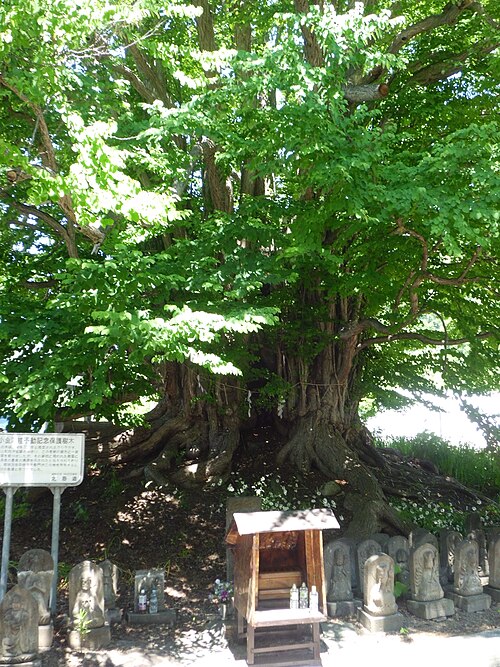
The hot spring came up under this tree, and the tree became the god. Koganeyu sits on the right bank of the Toyohira river on the road up to Jozankei, and its own account says the spring welled out from beneath the katsura. The name given to the tree is not Fudo's katsura but Katsura Fudo, the katsura as Fudo Myoo rather than a tree belonging to him, which is a distinction somebody thought about. There is a torii in front of it and a straw rope round the trunk. It is 11.4 metres round and 20 metres tall, with heavy surface roots, and Hokkaido has listed it as a commemorative protected tree. The 750 years on the board is a tradition and should be read as one. Even the discovery of the spring is disputed: the signboard reads as though the wandering ascetic Jozan found it, as he found Jozankei in 1866, while the hot spring's own website says settlers from Kumamoto came across it around 1883. It is worth noting that the people with the commercial interest tell the duller and more plausible story. The tree stands in the car park by the entrance.
Photo: 禁樹なずな (CC BY-SA 4.0)
Ezo Willow (Salix rorida) · 200-300 years · Nakajima
If the estimate is right, this willow was here before Sapporo was. The Environment Ministry puts it at 200 to 300 years, and the city was laid out from 1869, so on the low end it was already a mature tree on open plain when the surveyors ran their first lines. It stands near the Minami 14-jo bridge over the Kamokamo river at the southern end of Nakajima Park, close enough to the road that the source warns drivers not to stare. It has lost its top, so it is shorter than it was, and it is still the biggest tree in a park of 24 hectares. The two authorities disagree about what it is. The park office calls it an Ezo willow, Salix rorida; the Environment Ministry's database files it as a white willow, Salix jessoensis. Nobody has settled it and the page will not pretend to. Nakajima Park is next to Susukino, Sapporo's drinking quarter, and holds a tea house designed by Kobori Enshu and the Hoheikan, the western-style hotel the Meiji colonisation office built, both national Important Cultural Properties. The willow predates them and stands beside a road full of exhaust, in good health.
Daimyo Oak (Quercus dentata) · Miyagaoka
This shrine was founded before it had a place to stand. In 1869 the Meiji government renamed Ezo as Hokkaido, in order to make it unambiguously part of Japan, and held a ceremony in Tokyo enshrining three deities for the opening of the north. The kami were then carried from Tokyo to Hakodate and on to Sapporo, and it took some moving about before they settled here on the slope facing Maruyama. Emperor Meiji was added as a fourth in 1964. The grounds run to 18 hectares of woodland, and what is striking to anyone arriving from the rest of Japan is that the big trees are kashiwa, the daimyo oak, rather than camphor or cedar. Kashiwa is a northern tree with enormous leaves that go brown and hang on all winter instead of falling, which is why it stands for continuity and why the leaf is used to wrap rice cakes at boys' festival. This one is 4.2 metres round and 24 metres tall, on the path between the third torii and the worship hall, and it is probably the largest here, though the source notes that big kashiwa are scattered all over these grounds and it may have missed one.
Lombardy Poplar (Populus nigra 'Italica') · 100-200 years · Nakajima
Sapporo chose a European street tree for a European-looking town. This poplar stands between the carriageway and the pavement along the edge of Gokoku Shrine, and although it is named after the shrine it belongs to the city, which planted it. It is 5.4 metres round and 27 metres tall, with an Environment Ministry estimate of 100 to 200 years, which would put it among the earliest street planting the colonisation office did. Several more of the same size stand along the same stretch. The choice makes sense in context: the Hoheikan a few hundred metres away in Nakajima Park was built by the same office as a western-style hotel, and a Lombardy poplar is about as western as a tree can look, a narrow green exclamation mark of a thing used all over Europe to line roads. Then the motor car arrived and low branches became an obstruction, so everything reaching toward the road was cut back and the long limbs shortened, and what is left is a tree with a strange, pruned outline. It looks perfectly healthy on it. Lombardy poplars are all male clones, propagated from cuttings since the eighteenth century, so this tree has no seedlings anywhere.
Northern Red Oak (Quercus rubra) · 125 years · Kita 3-jo Nishi
This tree was posted from Massachusetts. The Hokkaido University Botanic Garden, set up on William Clark's recommendation, took delivery of a northern red oak from Harvard's Arnold Arboretum in the middle Meiji period, roughly 130 years ago, and it is now 32 metres tall on a trunk 4.5 metres round and is very probably the largest of its species in Japan. Red oak is North American, so every one in this country arrived the same way, in somebody's luggage or a crate. What makes the garden worth the entry fee is not really the individual trees. It sits 700 metres from Sapporo station in the middle of a city laid out on a grid, and going through the gate is an abrupt change: outside is a wide ordinary street and inside is bright, closed woodland on the original ground, so completely unlike its surroundings that the source describes it as feeling like a jump through space. The oak goes deep red in autumn, which is what the garden's own board points out about it, and it is used here as the garden's representative tree. There is no visitor car park, and the garden shuts out of season.