Cesky Krumlov's protected trees split in two directions. Four cluster eight kilometres out at Zlata Koruna, a Cistercian monastery: three behind its ticket, plus one free lime on the village square nearby, at 600 to 800 years the oldest tree here and older than the monastery itself. The other two stand roadside in opposite hamlets, a bridge oak and a hedge-lime nobody has dated. Nothing stands inside the old town's own walls; every tree here is a trip out from it, on foot, by train or by bike along the Vltava.
0 of 6 visited in Cesky Krumlov
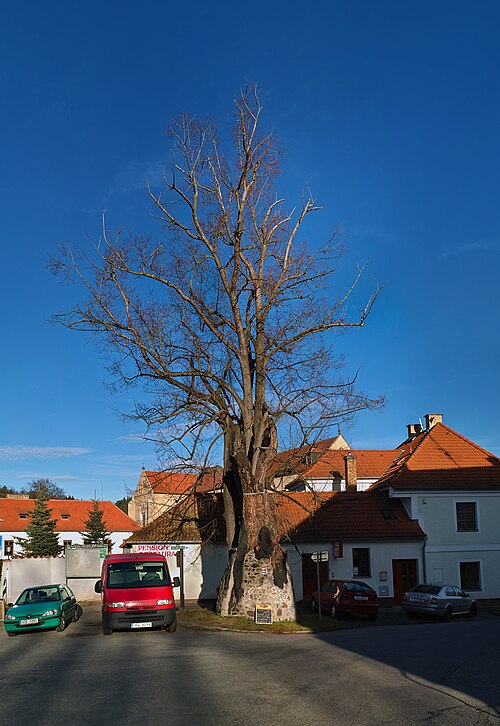
Large-leaved Lime (Tilia platyphyllos) · 700 years · Zlatá Koruna village, near Český Krumlov
Part of this trunk is stonework. Some time in the 19th century masons packed and reinforced the hollowing base of the village lime with masonry, and the upper trunk is held together with metal bands so that it does not split under its own weight. What they were propping up is the oldest tree in Zlatá Koruna and, by the Blanský les landscape administration's reckoning, the oldest in the whole protected area: 7.18 metres round when the ministry's assessors measured it in 1994, 17 to 18 metres tall, and somewhere between 600 and 800 years old.
It did not always stand alone. A 17th-century chronicle describes it as one tree in an avenue of lindens running through the village, and this is the last of that line still standing. It was already several centuries old when the Cistercian abbey across the green was dissolved in 1785, and it has outlasted the monastery as a working institution by another two hundred and forty years.
The best part is the address. It stands on the public green in front of house number 26, about 150 metres outside the monastery gate, which means no ticket, no opening hours and no closed Monday. The state protects it twice over, as a memorial tree since 1990 and a national one since 1994. Walk up and stand under it.
Photo: Xth-Floor (CC BY-SA 3.0)
Large-leaved Lime (Tilia platyphyllos) · 400 years · Zlatá Koruna monastery (Klášter Zlatá Koruna), near Český Krumlov
The leaves curl into hoods. That is a real mutation rather than a trick of the light: this lime grows in the cucullata form of Tilia platyphyllos, whose leaf blades roll up at the edges into small cowls, and the tree's Czech name, Kapucínka, comes from that shape.
The story attached to the name is older and darker than the tree itself. In 1420 Hussite troops took the monastery, and by local tradition the monks were hanged from the lindens of the avenue that then ran through the grounds. The hooded leaves have been read as a memorial of it ever since. The arithmetic does not support the reading. This tree is put at about 400 years old, which starts it roughly two centuries after the Hussites came through, so whatever it stands for it did not see.
What it did see is everything after: the abbey dissolved by imperial decree in 1785, the Schwarzenberg forestry school that briefly took over the buildings, and the long second life of the place as a state monument. It is the tallest of Zlatá Koruna's protected trees and the best known of them, 30 to 31 metres high and five metres round at the measurements taken in the mid 1990s, standing in the main courtyard beside the Chapel of the Guardian Angels. That courtyard is inside the ticket, and the monastery is closed on Mondays.
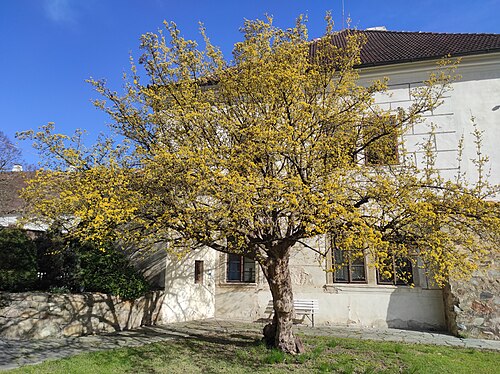
Cornelian Cherry (Cornus mas) · 200 years · Zlatá Koruna monastery (Klášter Zlatá Koruna), near Český Krumlov
A cornelian cherry usually spends its life as a shrub. This one got to be a tree, and the monastery's own note on it says only that it still remembers the Cistercians, which is the Czech way of saying it was already growing here before the abbey was dissolved in 1785. No planting date has ever been written down, so the age stays loose on purpose: over two hundred years, and possibly a good deal more than that.
Its size is the figure to take carefully. The register puts the girth at 130 centimetres, unusually thick for Cornus mas and not confirmed by any second source. A species that tends to grow in clumps is easy to measure across several stems at once, and that may be what happened here.
What it does every year is not in doubt. In late summer the branches load with drínky, scarlet fruit the shape and size of a small olive, sour raw and very good cooked. Czech kitchens still turn them into jam and syrup, and before that the fruit was a folk remedy, which is a reasonable thing to find growing in a monastery garden. It flowers in the other direction too, bare yellow in the last weeks of winter, months before anything around it wakes up.
The tree stands in the garden on the tour route, so reaching it means the monastery ticket and its opening hours.
Photo: Anaj7 (CC BY-SA 4.0)
Black Mulberry (Morus nigra) · 200 years · Zlatá Koruna monastery (Klášter Zlatá Koruna), near Český Krumlov
Zlatá Koruna's last abbot went into silk. Bohumír Bylanský ran the monastery until Joseph II dissolved it in 1785, and among the ventures he set up here was silkworm rearing, which meant planting mulberries to feed the worms. This tree is the last of those mulberries still standing, which puts it somewhere between 220 and 260 years old, counted back from the end of his tenure rather than from any recorded planting day.
Two details are worth holding lightly. Silkworms are normally raised on white mulberry; this is a black one, the species people plant when they are after the fruit. And the register's girth of 450 centimetres is very large for a mulberry trunk. Old black mulberries lean, spread and throw stems from low down, so that tape may have gone round more than one trunk, and no second measurement exists to check it against.
It still fruits. The monastery that planted it was shut down two and a half centuries ago and the silkworms are long gone, and every summer it drops black fruit onto the ground beside the monastery pond, which is where it grows, just inside the entrance gate. Getting to it means the monastery ticket and its opening hours, closed Mondays like the rest of the site.
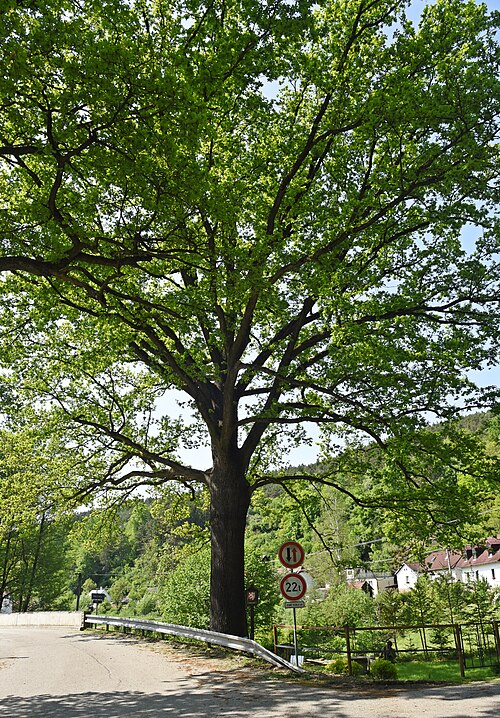
Pedunculate Oak (Quercus robur) · Staré Dobrkovice, on the Kájov road out of Český Krumlov
The crash barrier runs in front of it. This oak stands at the mouth of an old stone bridge over the Polečnice in Staré Dobrkovice, on the left bank, close enough to the carriageway that the district's own record places it behind the road's safety barriers. A second oak stands at the far end of the bridge, so the two of them frame the crossing, though only this one is registered and documented as a protected tree.
It is a heavy tree: 4.15 metres round, a figure the national memorial-tree register and the Czech district list arrive at separately and agree on. The bridge beside it is a protected monument in its own right and was restored in 2021, which is why the stonework looks better cared for than the verge.
The setting is the point. This is the old road west out of Český Krumlov toward Kájov, about 2.5 kilometres from the painted houses of the old town, half an hour on foot down the river valley and a few minutes by bike. There is no gate, no ticket and no opening hour. You stand on the roadside, watch for traffic, and look up.
Nobody has dated it. The register kept its girth and not its years, and if you know how old this oak is, tell us.
Photo: Peter Doležal (CC BY-SA 4.0)
Small-leaved Lime (Tilia cordata) · Drahoslavice, a hamlet on the Přídolí road out of Český Krumlov
The official record fixes this tree's position by the village weighbridge. It grows about ten metres from the váha at the eastern edge of Drahoslavice, a hamlet of a few houses on the road to Přídolí, which is a modest address for a tree of this size. The lime here runs to 32 metres tall and 5.13 metres round, one of the largest small-leaved limes anywhere near Český Krumlov, and the state has protected it since December 1990.
The lime is the Czech national tree, planted at crossroads, chapels and village greens all over Bohemia, and usually planted to mark something: a boundary, a coronation, a peace, a birth. Nobody wrote down what this one marks, if anything. It stands where the settlement ends and the fields start, and the road has been routed past it rather than through it.
By every description on record it stands in the open beside route 1572, with no fence, yard or gate between the tarmac and the trunk, though nobody has walked out to confirm that on the ground. Drahoslavice is about 2.4 kilometres from the old town, roughly half an hour uphill on foot and a few minutes by car or bike.
Its age is not known. No source gives one, so if you have a figure for this lime, or a tape measure, tell us.