Washington Tree
You need a ticket to see this treePaid entry (Sequoia National Park entrance fee); Giant Forest grove.
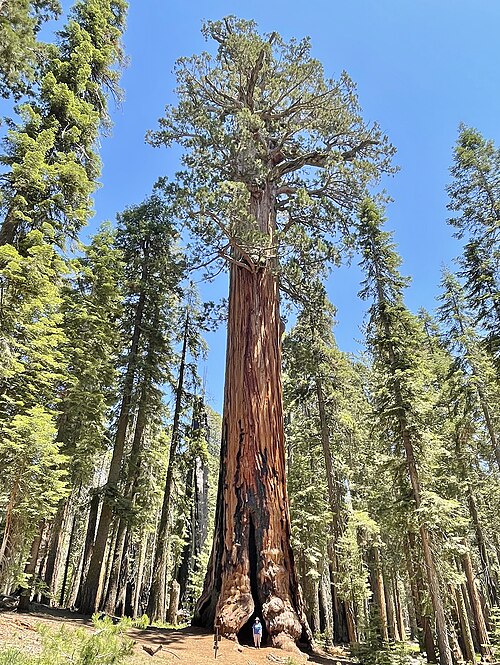
Until 2005 this was the second largest tree known on Earth. Then a winter did what centuries of fire had not. The trouble started with lightning. A strike set the tree burning in September 2003, by one source, or September 2002 by another, and the fire cut back the crown. In January 2005 a heavy load of snow finished the job, collapsing the upper half and leaving what remained of the upper trunk hollow. The Washington Tree went from about 77 metres tall to somewhere between 35 and 37. It had held 49,550 cubic feet of wood. It now holds a little over 30,000, and that figure counts the hollows. Most trees would be a stump after that. This one is not. Both sources report new foliage and small branches growing back on the south side, and it has been put back on the lists of the largest trees, around 55th, from second. A giant sequoia's answer to catastrophe is apparently to keep going at a lower altitude. It stands in the Giant Forest grove near the Franklin Tree, and it is the easier of the two to spot: look for the shortened, broken-topped column with green coming back on one side. Nobody has published an age for it. If you know one, tell us.
From people who stood here
No notes yet
Did you visit the tree? Leave a note for the next visitor.
Getting there
Giant Forest, Sequoia National Park, Tulare County, California
You can recognise it by the broken, hollowed top, cut to about 35 metres by a 2005 snow collapse, with new green growth on the south side. It stands in the Giant Forest near the Franklin Tree.
Sources
Where the facts on this page come from. The story was written with AI from these sources, and readers who know the tree correct it.