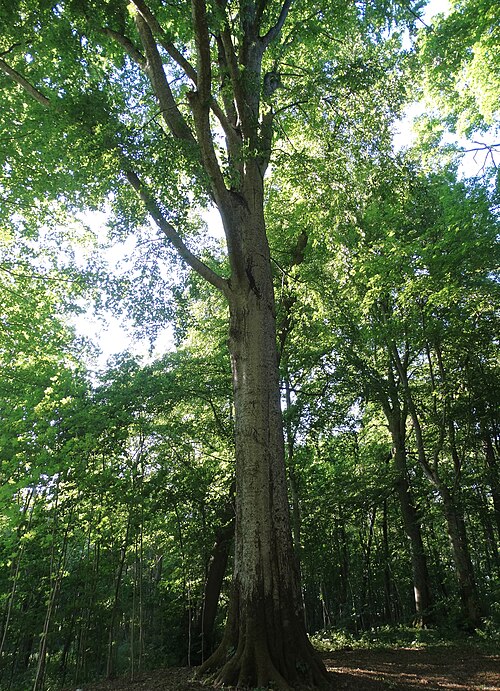
Oaks in this part of Europe usually spread rather than climb. This one is 32.5 metres tall, a height you would expect from a spruce, over a trunk 5.03 metres round. It takes its name from the Šperberiai family, who owned the Priekulė manor and the ground it grows on. Official recognition came late. A survey of the Priekulė district in 2017 turned up five natural heritage objects nobody had on the books, and on 16 April 2018 the environment minister's order No. D1-300 protected this oak among them. Four other trees on this list carry that same order, all of them within a walk of this one, in a town of a few thousand people. It stands on a slope in Vingis Park, roughly 120 metres in from the main gate, sixty metres from the Minija. When the river comes up the ground around the trunk floods, and the park keeps the spot cleared and maintained. Two things nobody has written down. There is no age on record, and the register says only ąžuolas, oak, without naming the species. Pedunculate oak is the overwhelming default in Lithuania and that is our assumption rather than a fact on file. If you know this tree, or you can tell a pedunculate from a sessile oak at a glance, tell us and we will correct the page.
Vingio parkas (Vingis Park), Priekulė, about 120 m northeast of the park's main entrance gate, near the Minija riverbankYou can recognise it by its unusual height for an oak, 32.5 metres, more like a spruce than a spreading oak. It stands on a slope in Vingio parkas, about 120 metres from the main gate.
Free, in a public park (Vingio parkas), beside the main path near the entrance
In Vingio parkas in the small town of Priekulė, about 15 km south of Klaipėda; walkable from the town centre
Sources
Where the facts on this page come from.
- In the official register: Saugomų teritorijų valstybės kadastras (STVK), no. 0310505010283
- lt.wikipedia.org
- ve.lt
- Lietuvos Respublikos saugomų teritorijų valstybės kadastras (STVK), gamtos paveldo objektai, botanical objects, no. 0310505010283