Perth has an old tree that arrived by road. Gija Jumulu, a boab of more than 750 years, was dug out of the Kimberley in 2008 and driven 3200 kilometres south to Kings Park, where it now stands beside a red flowering gum that is the last of a hundred planted in 1929. The other four are where they grew: two enormous figs in the city centre, a third in Fremantle, and a ringbarked jarrah out in Armadale that refused to die.
0 of 6 visited in Perth
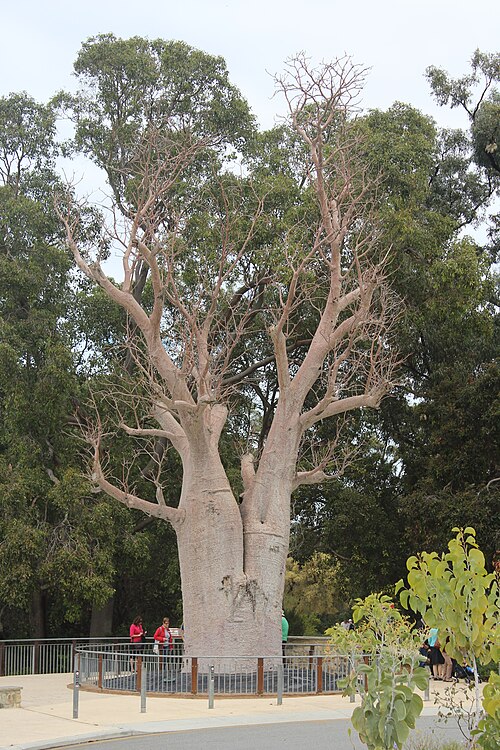
Boab (Adansonia gregorii) · 750 years · Kings Park
This boab did not grow where it stands. It is reckoned to be over 750 years old and it spent almost all of that beside Telegraph Creek near Warmun in the Kimberley, until 2008, when it was lifted out of the ground to clear the way for a road bridge on the Great Northern Highway. Eighteen metres tall and 37 tonnes, it then travelled 3,200 kilometres south on a truck, the longest known road journey by a living tree of that size, and was replanted in Kings Park on 20 July 2008. The Gija people, traditional owners of the country it came from, held a farewell ceremony for it six days before it left and gave it the name Gija Jumulu. Jumulu is their word for boab.
It arrived with superficial damage to its bark and was assessed as healthy in 2016. Boabs are built to absorb that sort of insult. They drop their leaves through the dry-season winter and keep photosynthesising through the bark itself, which is why the bare months show the tree at its best rather than its worst: a swollen grey bottle of a trunk above the Two Rivers Lookout, with nothing to distract from the shape. New growth usually starts again in December.
On the estimates it has another twelve centuries ahead of it, all of which it will now spend 3,200 kilometres from where it started.
Photo: Martinvl (CC BY-SA 4.0)
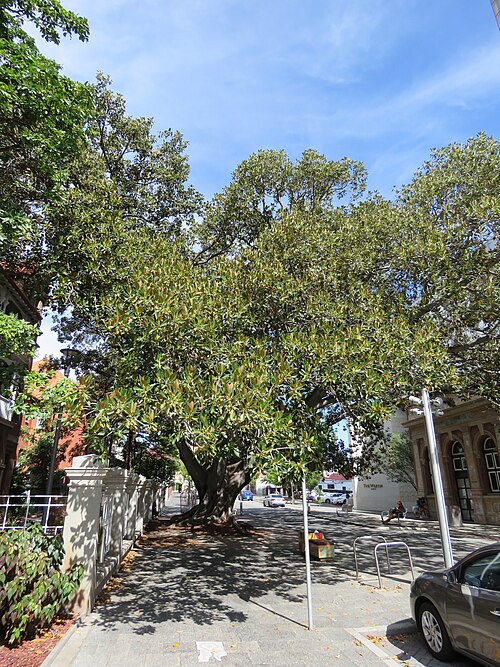
Moreton Bay Fig (Ficus macrophylla) · 130-140 years · Perth CBD
The trunk measures 9.4 metres around, which is a startling thing to meet on a city footpath. The National Trust of Western Australia measured it in November 2018 and recorded three metres of diameter, 36 metres of height and a condition of good. It stands on Murray Street in front of Kirkman House at Royal Perth Hospital, and it has been the spot where staff and visitors arrange to meet each other for as long as anyone there remembers. The state heritage inventory calls it a dominant element in the streetscape and unique in form and character in the city centre, which for a heritage inventory counts as enthusiasm.
Nobody wrote down who planted it, or when. The inventory says early 1900s and stops there. The National Trust register put it at about 130 years when it took its measurements, which makes it somewhere near 138 now, and that figure is an estimate by people who assess figs for a living rather than a planting record. It could be out by a decade in either direction. If you know the date, tell us.
The paperwork behind it is considerable: National Trust classification in 1975, the interim Register of the National Estate in 1978, the state heritage list in 1985. The tree's own argument is simpler. It is enormous, it is in the middle of a working hospital forecourt, and you can walk up and put a hand on it.
Photo: Calistemon (CC BY-SA 4.0)
Port Jackson Fig (Ficus rubiginosa) · 139 years · Perth CBD (West End)
In 1971 an office tower was built around this fig rather than over it. Mt Newman House went up on the site of The Cloisters on St Georges Terrace, and the architects designed the development to keep the tree where it was. The state heritage inventory files the result as a successful attempt to rehabilitate a mature existing tree and integrate it into a major city development, which is bureaucratic language for a decision most Australian cities were not making in 1971. It survived a later redevelopment of the site as well.
Its age is a matter of record rather than of estimate, which is rare. A tenant of The Cloisters planted it as a small tree in 1887, and the heritage inventory and the building's own history agree on that, so the tree is 139 years old this year.
It has grown into the space it was spared. Eighteen metres tall, a trunk 3.9 metres round, a canopy spreading roughly 15 by 18 metres, condition assessed as very good. Port Jackson figs branch low and wide, so it fills the forecourt between the tower and The Cloisters' old brickwork and turns a piece of hard city frontage into shade.
It is a minute's walk off the main run of St Georges Terrace, free, and visible from the street at any hour, and it asks nothing of you but a look upwards.
Red-flowering Gum (Corymbia ficifolia) · 97 years · Kings Park
A hundred scarlet-flowering gums went into Fraser Avenue on 29 September 1929. This is the only one left.
They were planted for Western Australia's centenary by the Centenary Committee, the Kings Park Board and assorted dignitaries, led by A. Lovekin MLA, and every planter was handed an inscribed silver trowel for the occasion. Then patch canker went through the avenue in the 1930s and took most of them, along with much of the original 1898 planting made for Queen Victoria's jubilee. By 1938 the gaps had been filled with lemon-scented gums, which are the tall pale trunks that give Fraser Avenue its look today.
The survivor stands near the main entrance and does not announce itself: 11 metres tall, two metres through the trunk, in excellent condition when the National Trust measured it in 2014. Ninety-seven years old, from a documented planting date rather than a guess.
In high summer it does the thing its species is named for and covers itself in scarlet flower heads, which is when a modest tree becomes the reason people stop walking.
The register places it north-east of the main Fraser Avenue entrance rather than at a fixed point, so our pin is good to the area and not to the trunk. Come in January or February and you will not need the pin.
A day trip away
Fremantle, 14 km south-west
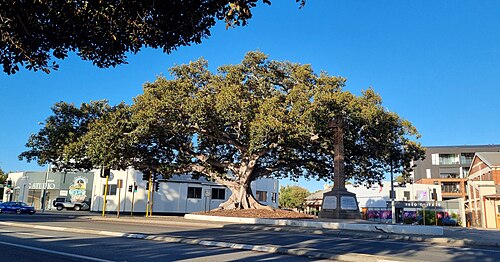
Moreton Bay Fig (Ficus macrophylla) · 136 years · Fremantle
The fig has grown over the monument it shares its corner with. Under the canopy stands the William Marmion Memorial, a Celtic cross unveiled in 1902, now partly hidden by a tree that was already twelve years in the ground when it arrived.
The planting is dated to the afternoon. On 21 October 1890 Governor Sir William Robinson put this Moreton Bay fig in to mark the granting of self-government to the Colony of Western Australia, and both the state heritage record and Fremantle's own local history give the same date, which makes the tree 136 years old and one of the few on this map whose birthday is known. It went in at the corner of Adelaide, Parry and Queen Victoria Streets, the point where everyone entering Fremantle's main streets passed by, and it has held that corner ever since. The corner is now a small park hemmed in by three roads.
It sits on the state Register of Heritage Places, was classified by the National Trust in 1980 and is on the City of Fremantle's heritage list. What nobody has published is a girth figure, and a fig of this age tends to have an interesting one. If you take a tape to it, tell us the number.
Fremantle is roughly half an hour by train from central Perth, and the tree is a 700 metre walk from the station.
Photo: Sam Wilson (CC BY-SA 4.0)
Armadale, 27 km south-east
Jarrah (Eucalyptus marginata) · 400-800 years · Armadale
In 1997 vandals ringbarked this jarrah, a cut that should have finished it. Three quarters of its canopy is dead or gone and earlier lopping had already taken roughly half its height, but it answered the ringbarking with epicormic shoots along its northern side and it is still assessed as stable. Alive, in other words, and visibly not unharmed.
What happened next is the part worth knowing. 1,147 people wrote to the state government asking for the tree to be protected. A conservation order followed on 14 November 1997, a heritage agreement in 2002, and in 2003 it went onto the State Heritage Register, one of only three trees or groups of trees listed in all of Western Australia.
The register estimates it at 400 to 800 years old. That is a wide band because nobody has dated it more closely than the bulk and growth form of an old-growth jarrah allow, and we would rather give you the band than a tidy number. From 1904 until 1987 it stood beside Armadale Primary School and generations of children played under it. The school has gone. The tree and the ground are still there, now beside a public carpark.
Two things to know before you go. Our pin marks the cross-street rather than the trunk, so expect to look around. And we have not confirmed whether the ground right around the tree is fenced, so count on seeing it and not on reaching it.