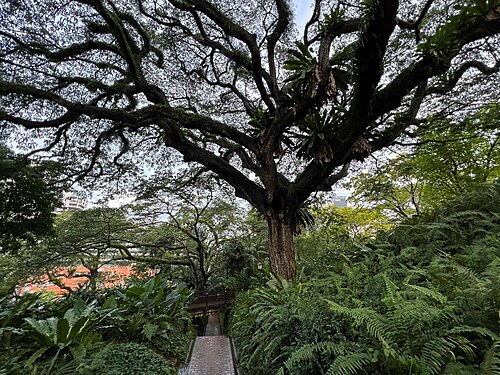
This rain tree spreads its umbrella-shaped canopy directly over a public stairway that carries walkers out of Fort Canning Park onto Hill Street, so almost everyone who takes those steps passes und...
Photo: Wzhkevin (CC BY-SA 4.0)
Singapore, Singapore
Fort Canning Hill was the seat of the ancient Kingdom of Singapura before it was a British fort or a public park, and the five heritage trees mapped on it now sit on ground that has been fought over, planted over and walked over for seven centuries.
A rain tree spreads its canopy directly above the public stairway that carries walkers out onto Hill Street, so most people pass beneath it without looking up. A Madras thorn beside the Service Reservoir is the largest of its species on Singapore's whole heritage register, its girth measured twice, eleven years apart, and grown wider both times. A tamalan on Fort Green is one of the last survivors of an ornamental planting scheme laid out across the hill in the early 1900s, when the old fort grounds became a colonial pleasure garden; NParks' own register notes that few of its neighbours from that planting are still alive. A terap nasi grows beside the hill's 14th Century Walk of History with plank buttresses broad enough to make its age feel physical rather than just recorded. And an earpod tree, named in both English and Spanish for seed pods coiled like a human ear, stands between the old fort wall and the hotel that now shares the hill with it. All five are NParks-registered heritage trees, free to see, on park ground open around the clock.
This rain tree spreads its umbrella-shaped canopy directly over a public stairway that carries walkers out of Fort Canning Park onto Hill Street, so almost everyone who takes those steps passes und...
Photo: Wzhkevin (CC BY-SA 4.0)
This tamalan is one of the last survivors of an ornamental planting scheme that once covered much of Fort Canning Hill in the early 1900s, when the old fort grounds were being turned into a colonia...
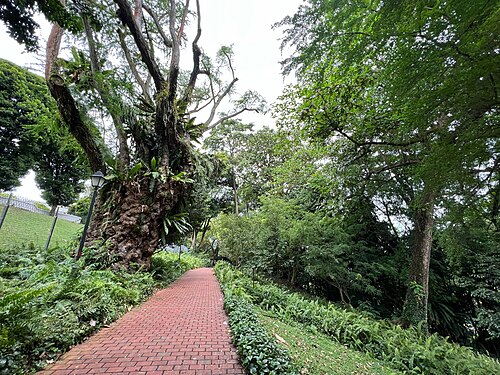
NParks records this as the largest Madras thorn on Singapore's heritage register, an 8.5 metre girth today, up from 7.4 metres when it was first measured for the scheme in 2001.
Photo: Wzhkevin (CC BY-SA 4.0)
This terap grows beside Fort Canning's 14th Century Walk of History, a path named for the hill's role as the seat of the ancient Kingdom of Singapura, and it carries plank buttresses at its base br...
The seed pods explain the name: dark, flat, coiled into a near-perfect circle and close enough to a human ear that the tree is called after one in both Spanish and English.
Opening times and visitor information: National Parks Board (NParks).
More parks worth the walk: every park we map. Or explore by city: Prague · Brussels · Porto · Brisbane · Munich · Cambridge