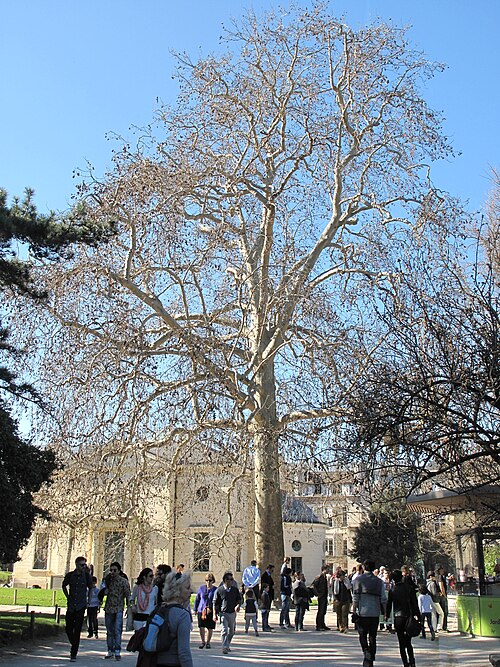
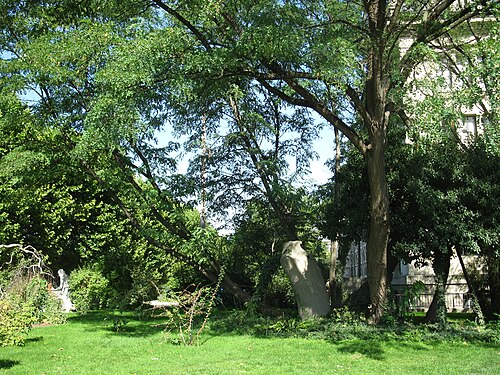
This pistachio helped prove that plants have sexes. In the early 1700s Sébastien Vaillant, a botanist at the royal garden that became the Jardin des Plantes, had a pistachio that flowered every year and never set fruit. The story told about it is that he took pollen from this one and shook it over a second pistachio, which then fruited, and in 1717 he set out in a public lecture that flowers have male and female parts. The tree he worked with is still alive, in a corner of the Jardin alpin. Its date depends on who you read. The description on its best-known photograph says it was planted in 1702; the Muséum's own head of botanical gardens has dated its sowing to 1704. Either way it is about 320 years old, and the oldest pistachio we know of in Paris. A reader on r/paris sent us here calling it a living witness of the history of science, which is exactly what it is. It does not look like much at first: a tree of modest size, with leathery leaves in threes and fives. The Jardin alpin is the sunken rock garden of the Jardin des Plantes, free to enter; the pin is where a photographer stood beside the tree, so look for the pistachio leaves there.
From people who stood here
No notes yet
Did you visit the tree? Leave a note for the next visitor.
Getting there
Jardin alpin, Jardin des Plantes, 57 Rue Cuvier, 75005 Paris
You can recognise it by its leaves, leathery and grey-green in groups of three to five leaflets, on a tree of modest size in the Jardin alpin, at the pin.
Free. The Jardin alpin is the sunken rock garden inside the Jardin des Plantes and keeps the garden's hours (until 20:00 in summer); it can close in winter, so check the Muséum's site before a special trip.
Gare d'Austerlitz (Metro 5 and 10, RER C) or Jussieu (Metro 7 and 10), a few minutes on foot.
Sources
Where the facts on this page come from. The story was written with AI from these sources, and readers who know the tree correct it.