Palma's six trees range from a town square icon to a forest oddity. S'Olivera de Cort, an olive five to six centuries old, was lifted from a Pollenca estate and replanted before the Ajuntament in 1989. Two giant Moreton Bay figs, in a cultural centre's garden and the municipal cemetery, rank among the largest in the Balearics. On the seafront by the Gothic Llotja, a Norfolk Island hibiscus stands beside a fig a reader found, hung with aerial roots. Out at Castell de Bellver, an ordinary shrub has spent a century growing into a tree.
0 of 6 visited in Palma de Mallorca
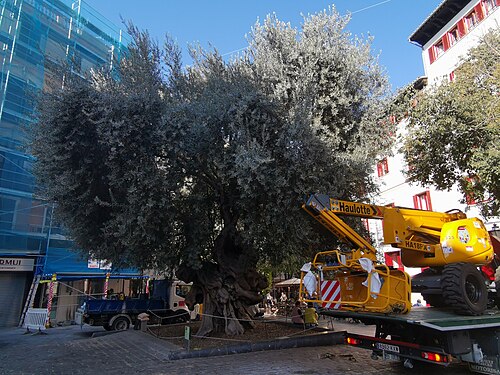
Olive (Olea europaea) · 500-600 years · Old town, Palma
This olive is older than the square it stands in, and it has only been standing there since 1989. It grew for centuries at Pedruixella Petit, an estate near Pollenca with about two thousand olive trees, until a city gardener and the head of public works came to its owner, the hotelier Jaime Batle, and asked to buy it for the town hall square. Batle refused to sell. When he learned where it would go, he gave it away instead.
On 3 May 1989 the tree was lifted whole and replanted in Placa de Cort, directly opposite Palma's Ajuntament. Its trunk measures about seven metres round and two and a half tall before the first of four thick primary branches, on a tree only six metres high in total, the classic shape of an olive that has spent five or six centuries getting wider rather than taller.
The city promised Batle a plaque with his name on it. Four mayors came and went before it was finally installed, thirty years after the gift. By then the tree needed no introduction: it had become one of the most photographed things in Palma, a six-hundred-year-old symbol of peace and rootedness parked in front of the seat of city government, exactly where a gardener once thought it belonged.
Photo: Z thomas (CC BY-SA 4.0)
Moreton Bay Fig (Ficus macrophylla) · 150-200 years · Old town, Palma
Local naturalist writers call this without qualification the biggest tree in Palma, and the numbers back the claim: a trunk over two metres across, more than twenty metres tall, and a crown reported at around thirty five metres, planted around 1827 when the old General Hospital laid out a botanical garden here. The building it grows beside, the Casa de la Misericordia, took in Palma's poor from 1565 onward; it is a cultural centre run by the Consell de Mallorca now, with free entry to its two courtyards and this garden.
The tree has outgrown its bed in more than one direction. When the city dug up the nearby Rambla for works, it found the fig's roots running under the street, well beyond the garden wall that was supposed to contain them. At the base, a ring of decorative stones from the original nineteenth century planter still survives, now half swallowed by the trunk that has spent two centuries thickening around it.
Along with a second giant fig in Palma's municipal cemetery, planted at roughly the same time, this is one of the two largest Ficus macrophylla in the Balearic Islands, and by most measurements the larger of the pair.
Norfolk Island Hibiscus (Lagunaria patersonii) · Old town seafront, Palma
Locals call it pica-pica, and the name is a warning rather than an insult. Lagunaria patersonii comes from a single small island in the Tasman Sea, Norfolk Island, and packs its seed pods with fine glass-like hairs that itch for hours if the pod is opened carelessly. English speakers call the species the itchy bomb tree for the same reason. In summer it flowers in pale pink cups that pass for a small hibiscus, which is where the polite half of its name comes from.
This specimen grows on the Passeig de Sagrera, the seafront promenade, directly in front of La Llotja, the fifteenth century Gothic merchants' exchange that is one of Palma's best known medieval buildings. At 2.6 metres round and 18 metres tall it is a substantial specimen of a species usually kept smaller as a street or garden tree, catalogued by the Balearic government among the island's singular trees for exactly that reason.
It is the most street level and sociable entry on this page: no garden wall, no ticket, just a big tree doing its work of shade and ornament on a promenade full of people, across from a building that has been central to Mallorcan trade since before Columbus sailed.
Moreton Bay Fig (Ficus macrophylla) · 150-200 years · Nord, Palma
Palma's other giant fig, planted around the same decades as the one at the Misericordia garden, grows inside the city's municipal cemetery, where it has had a century and a half to spread five massive branches out from a neck seven metres and ten centimetres round, measured at chest height in 2011. It is not as tall as its cousin across town, about fifteen metres against twenty, but what it lacks in height it makes up in reach: surface roots run out from the trunk in every direction, thick enough to break paving and shoulder headstones aside.
A cemetery might seem an odd place to send someone looking for a remarkable tree, but Palma's is landscaped rather than merely functional, and this fig is one of two enormous Ficus macrophylla shading its older section, giving what could be a bleak place genuine, peaceful shade. Together with the Misericordia fig, it ranks among the largest specimens of its kind anywhere in the Balearic Islands.
The cemetery is open to visitors daily, no ticket required, and asks only the ordinary courtesy any burial ground does.
Mastic Tree (Pistacia lentiscus) · 80-120 years · Bellver, Palma
Pistacia lentiscus is a shrub almost everywhere it grows, a low, dense presence in Mediterranean scrubland that most walkers step past without a glance. Left alone for a century, on the right ground, it can do something else entirely: this specimen, growing just south of the outer wall of Castell de Bellver, has pushed up four vertical trunks and taken on the size and shape of a proper tree, which is exactly why the Balearic government catalogued it among the islands' singular specimens.
It stands in the Parc Forestal de Bellver, the pine forest that wraps around the fourteenth century circular castle on its hill above the city. The castle itself keeps a ticket booth and opening hours; the forest around it, waymarked with walking trails, does not, so the mata is free to visit whether or not you go inside the walls.
There is nothing dramatic in its numbers, no record height or girth. Its interest is entirely in the exception it represents: the ordinary Mediterranean shrub that had the ground and the time to become something else.
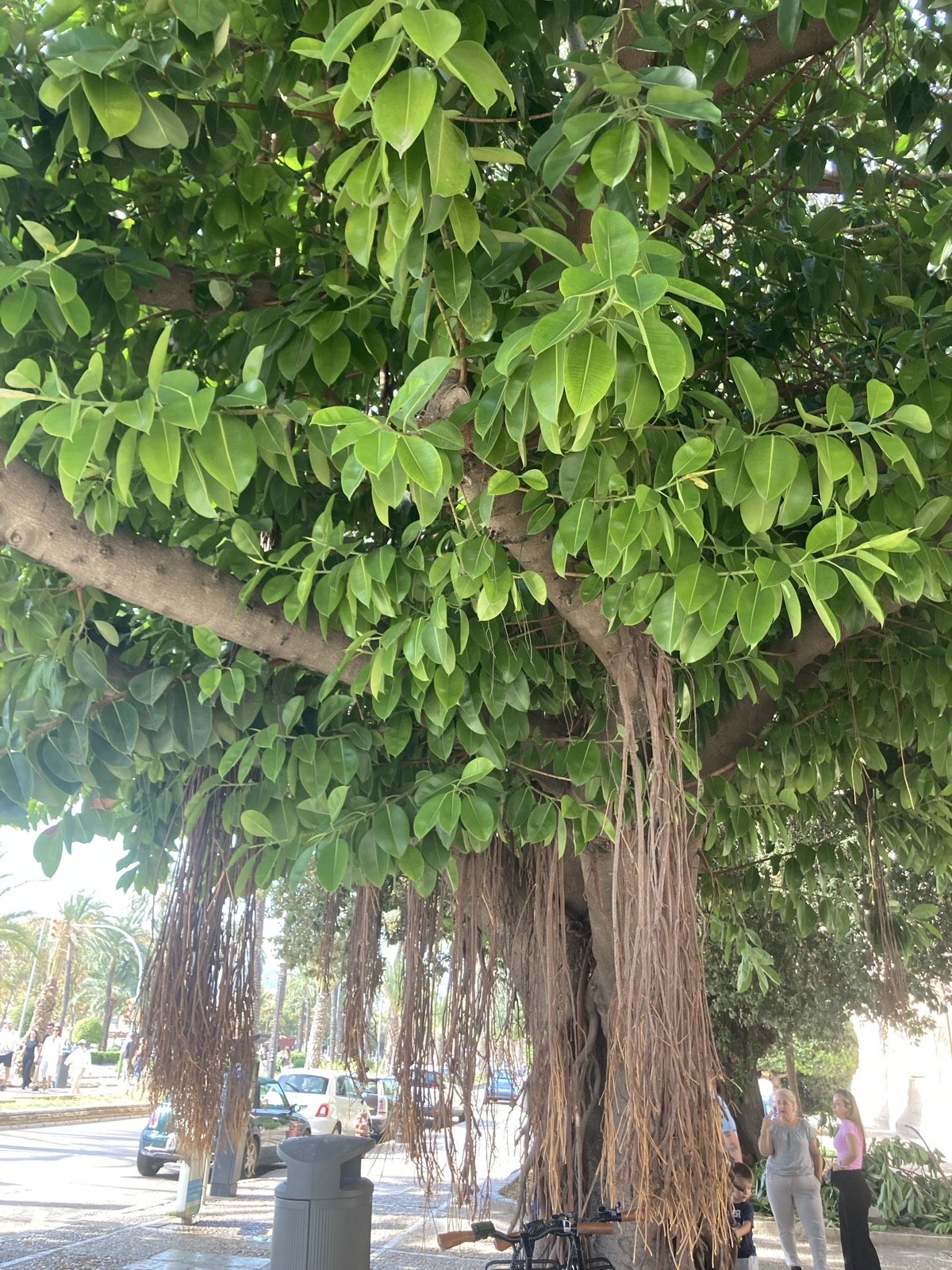
Fig (Ficus sp.) · Old town seafront, Palma
A reader sent us this one, and it is a better find than anything on our list for this stretch of the seafront. A fig stands on the Passeig de Sagrera beside La Llotja, Palma's fifteenth century Gothic merchants' exchange, and lets down curtains of aerial roots from its branches toward the pavement, the way figs do when the air is warm and damp enough for them to try.
Its neighbour in front of La Llotja is the largest lagunària in the Balearics, a protected tree with a register entry and a measured trunk. The fig has none of that. No catalogue we know of names it, so we cannot yet say which fig it is, how old it is or who planted it.
If you know, tell us: the species, a girth from a tape measure, an old photograph or a story about it. That is how this page gets longer.