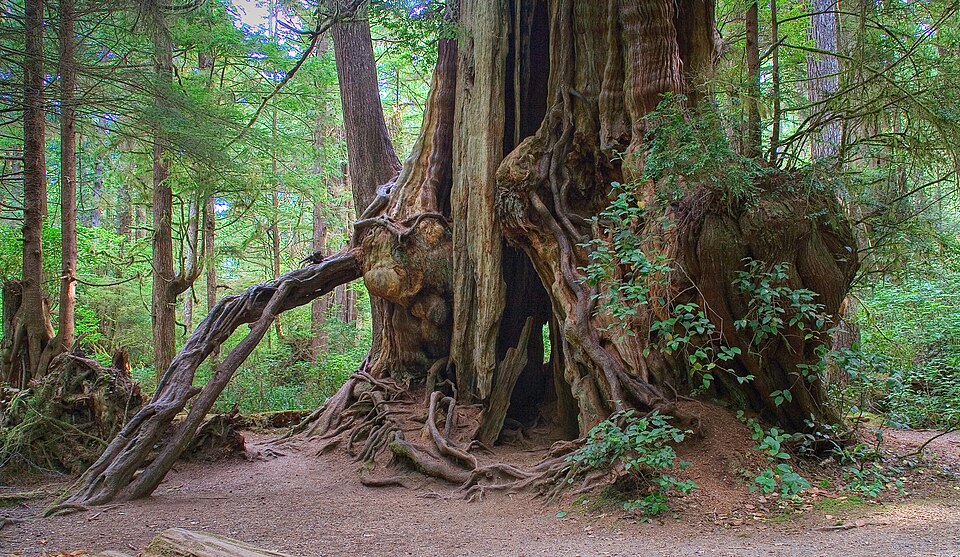
The Duncan Cedar
The largest known western red cedar in the world is mostly dead wood, and it is still alive. A strip of living bark runs up one trunk and keeps the whole thing going, and a red cedar's resistance to rot means it can hold on like that for a very long time. One forestry expert has said it may manage centuries more if nothing knocks it down. The Duncan Cedar is also the largest tree of any species in Washington state: about 5.9 metres through, 54 metres tall, and more than a thousand years old by the usual estimate. Loggers found it in 1975, and it survives because local people argued for it to be left standing. One thing to know before you drive out. It does not stand in Olympic National Park. It is on Washington State Department of Natural Resources land just outside the boundary, which is why a state Discover Pass is needed to park, and why it is grouped with the park only by geography and habit. The road in is about four miles of unpaved logging track off Highway 101, south of Forks, ending at a small pull-off marked by little more than a tree-shaped sign. A short boardwalk does the rest. Visitors report green growth still coming. Pair it with the Kalaloch Redcedar, a short drive down the coast inside the park, for two very different ways a cedar refuses to die.
Off US Route 101, about 15 miles south of Forks, Washington, near the Olympic National Park boundary You can recognise it by a trunk nearly six metres through that is mostly dead wood, with one strip of living bark carrying green growth. It stands at the end of a short boardwalk from a pull-off marked by a tree-shaped sign.
Discover Pass required ($10 day / $45 annual) as it stands on Washington State DNR land, not inside the national park itself. Reached via a short boardwalk from a small, poorly marked roadside pull-off after about 4 miles of unpaved logging road.
No public transit; about 15 miles south of Forks, WA, off US-101. Roadside/trailhead parking, unpaved final approach.