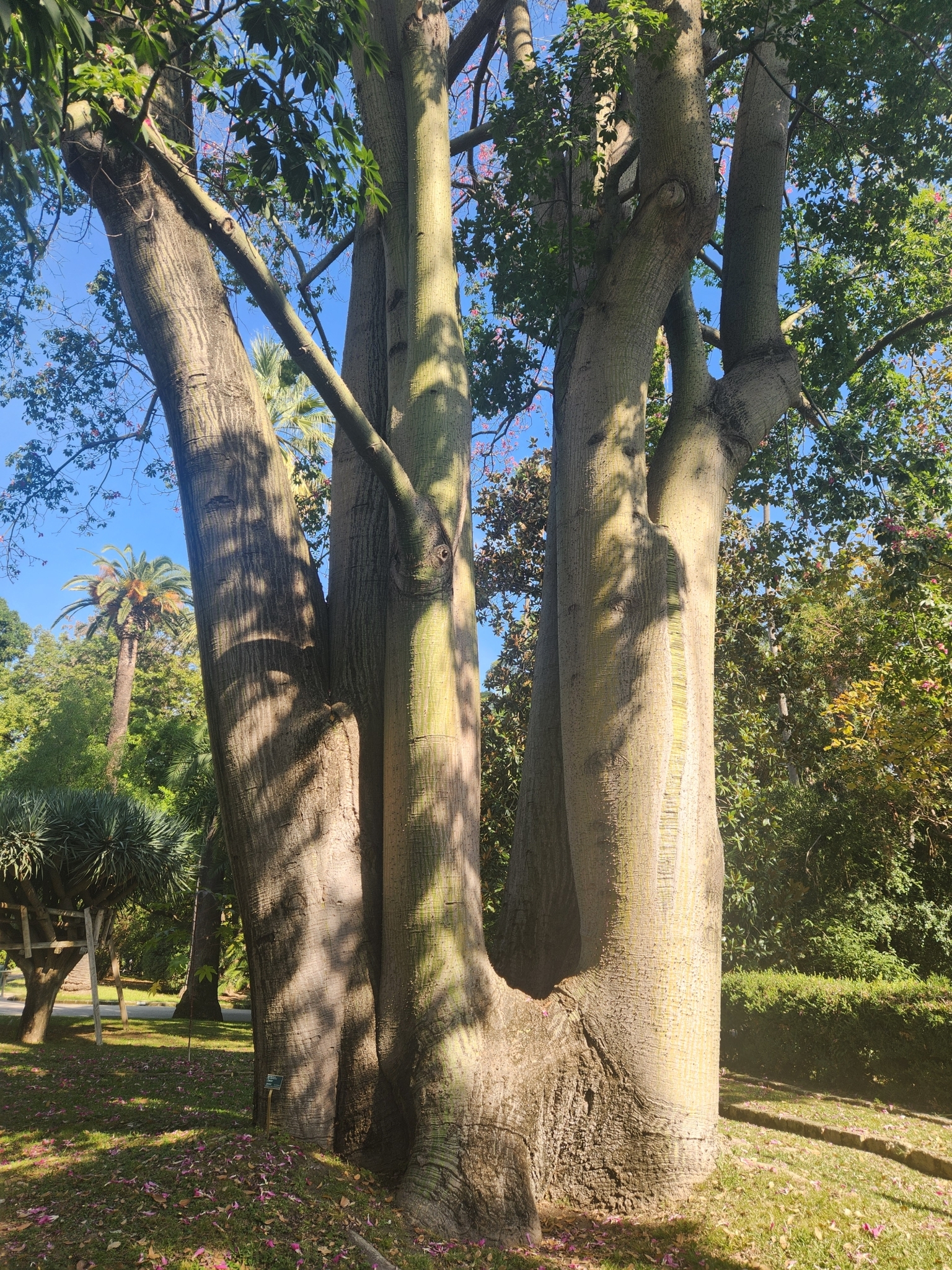
The Elephant's Foot of the Botanical Garden
Italy's national register calls this one Nolina longifolia. Campania's own regional register, surveying the same trunk at the same coordinate, calls it Nolina recurvata. They are not describing two different plants: both names have since been folded into the genus Beaucarnea, and Neapolitan gardeners have always called both by the same nickname anyway, pianta mangiafumo, the smoke-eater, for a diet of city pollution nobody has ever actually proven. What the two registers agree on, to the centimetre, is the trunk itself: 560 cm around at the base, swollen into a grey succulent foot that tapers to a modest four metres of height. That makes it the second widest trunk anywhere in the botanical garden, behind only the silk floss tree nearby, and the strangest shape in it. Nolina and its close relative Beaucarnea store water the way a baobab does, in a barrel-shaped base that narrows into a crown of long strappy leaves, an adaptation built for the dry highland scrub of Mexico rather than a Neapolitan summer. Which of the two closely related species actually stands here has never been settled in print: the garden's own published lists of its desert and arboretum collections do not mention it at all, so there is no third source to break the tie, and nobody has recorded when it was planted. If you can read the label at its base, or the garden can tell you which of the two it planted, tell us.
Real Orto Botanico di Napoli, Via Foria 223, 80139 NapoliYou can recognise it by a barrel-shaped grey succulent base, the second widest trunk in the garden after the silk floss tree, tapering up to a crown of long strappy leaves. It stands in the Real Orto Botanico di Napoli.
Free, no booking. Open weekdays only: Mon, Wed, Fri 9:00-14:00, Tue and Thu 9:00-16:00, closed Saturday and Sunday
10 min walk from Cavour or Museo metro, or bus along Via Foria
Sources
Where the facts on this page come from.
- In the official register: Alberi monumentali della Campania (Regione Campania)
- masaf.gov.it
- agricoltura.regione.campania.it