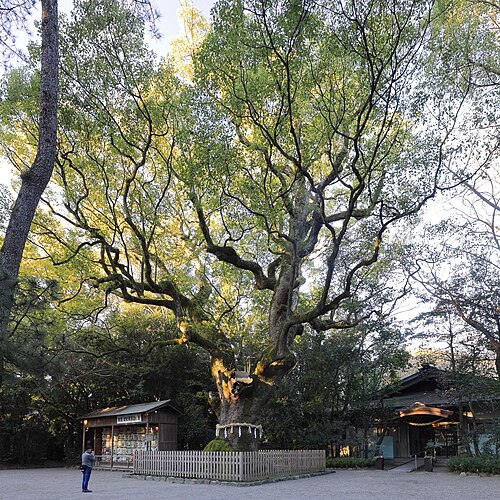
From the terrace this tree stands on you look out over a steelworks. Kannonji, the eleventh station of the Owari thirty-three Kannon pilgrimage, sits on high ground at Arao, and everything below it toward the water is heavy industry built on reclaimed shallows, while the old houses keep to the land that was always land. The camphor is at the top of the stone steps up to the Kannon hall, on the left. The Environment Agency records it at 9.6 metres round and 23 metres tall, which makes it the largest tree on this page, though the source that photographed it notes honestly that it did not look that thick from either above or below, since the slope and the scrub at its foot make the base hard to see. Tokai city made it a Natural Monument in December 1968 under the bare name Great Camphor, which identifies nothing, so it goes by the temple's. The tradition is 700 years. What is not in doubt is the view: this tree has stood on the same ledge watching a bay turn into a factory floor.
The line is our estimate of how much there is to see, not a measurement. Typical for this species where this tree stands; exact weeks shift with the year.
Kannonji, Bukuden, Arao-cho, Tokai 476-0001You can recognise it by its base, hard to see beneath the slope and scrub, at the top of the stone steps. It stands to the left of the steps up to the Kannon hall at Kannonji, overlooking the steelworks below.
Free, temple grounds open in daylight
Meitetsu Tokoname line to Shin-Nittetsu-mae, about 500 m northeast
Sources
Where the facts on this page come from.