The Great Camphor of Ota
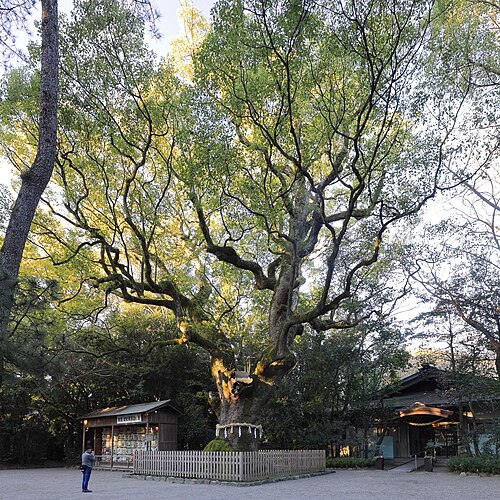
Twelve metres tall and thirty-two metres across. That ratio is the whole tree: the great camphor of Ota went sideways instead of up, and the crown it carries is nearly three times as wide as the trunk is high. It stands just inside the stone torii of Omiya Shrine, on the right bank of the Ota river, a few hundred metres west of the Tokai city offices. The centre of the trunk has gone, and what holds the thing up is the ring of stems rising round the gap, which between them measure 9.5 metres. It is in good health. The shrine ground is also a public park, and the board there says the park was made as a green place for townspeople to rest in, which is a polite way of saying the park exists because the tree does. Tokai made it a Natural Monument in June 1968. The thousand years posted on the board is a tradition, without a method attached, and thousand-year claims on Japanese camphors do not usually survive a close look at the trunk. What survives inspection here is the shape.
The line is our estimate of how much there is to see, not a measurement. Typical for this species where this tree stands; exact weeks shift with the year.
Omiya Shrine, Kamihamada, Ota-cho, Tokai 477-0031You can recognise it by the shape, a crown 32 metres across over a tree only 12 tall, and by the hollow centre with a ring of stems round the gap. It stands just inside the stone torii.
Free, shrine ground which is also a public park
Meitetsu to Otagawa, then about 500 m west of the Tokai city offices
Sources
Where the facts on this page come from.