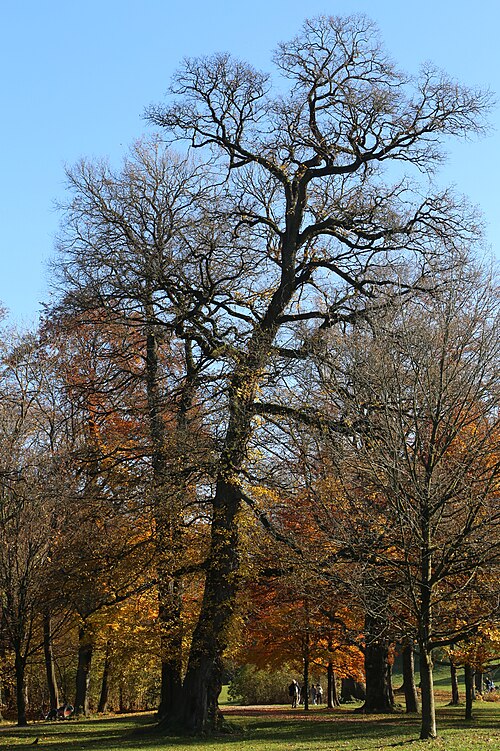
The Amur Cork Tree of the Luitpoldpark
You can press a thumb into this tree and the bark gives. The Amur cork tree carries a thick, soft, deeply ridged corky layer that dents under a hand and springs back, which is exactly why Munich's 2021 natural monument ordinance protects it for an interesting bark pattern and calls the species extremely rare in the city. Phellodendron amurense comes from the Amur river country on the Russian and Chinese border, and from Korea and northern Japan, which is a continental climate with harder winters than Bavaria has ever managed. Under the cork the inner bark is a startling sulphur yellow, and it is one of the fundamental herbs of Chinese medicine. The leaves are pinnate, like an ash, and turn clear yellow in autumn; the berries are black and smell of turpentine when crushed. In the northeastern United States the same tree seeds itself so aggressively into hardwood forest that several states have banned its sale. In a Schwabing park it just stands there being unusual. The ground it stands on is the Luitpoldpark, laid out in 1911 and dominated by a hill made from the rubble of the bombed city. A Mediterranean hackberry, protected under the same ordinance for the same rarity, grows about 200 metres east. The ordinance lists reasons and carries no dates or measurements, so the tree's age is unknown.
Luitpoldpark, 80804 MünchenYou can recognise it by thick, deeply ridged corky bark that dents under a thumb and springs back, its inner bark a startling sulphur yellow beneath. It stands in the Luitpoldpark, about 200 metres from the park's protected hackberry.
Free, public land, no restrictions
3 min walk from the Ackermannstraße tram stop
Sources
Where the facts on this page come from.
- In the official register: Naturdenkmal (Bayern LfU), no. ND-07189
- Munich Naturdenkmalverordnung 2021, Schwabing-West 2
- lfu.bayern.de