Tenerife is an island, and this is not a walk. Four trees at three stops, with a car between them. Two record-holding Canary pines stand 150 metres apart at a free roadside viewpoint above Vilaflor de Chasna, 1,400 metres up. The dragon tree most visitors come for, El Drago Milenario, is some 25 kilometres north in Icod de los Vinos, and a fig with a colonnade of aerial roots grows about 20 kilometres east of that, in the botanical garden at Puerto de la Cruz. One day covers all four.
0 of 4 visited in Tenerife
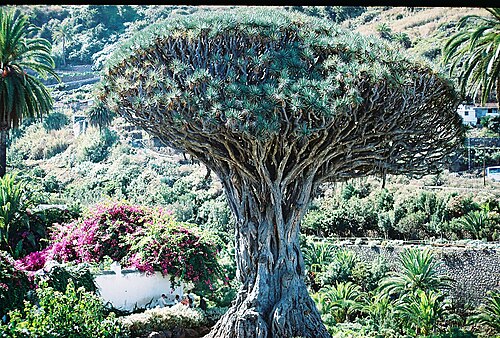
Dragon Tree (Dracaena draco) · 550-1000 years · Icod de los Vinos
Nobody can date this tree, and nobody is going to. Dracaena draco lays down no annual growth rings, so the standard method of reading a trunk fails on it completely, and the estimates fill the vacuum accordingly: current scientific work puts El Drago Milenario near 700 years with a margin of a century or more either way, while tradition, the tourist literature and the tree's own name insist on a thousand or more. The name is a claim, not a measurement. What can actually be measured is everything else. The base is about 20 metres around, the tree stands 18 to 21 metres tall depending on who did the measuring, and the crown spreads roughly 20 metres across on more than 300 primary branches, which together make it the largest and oldest known living specimen of its species anywhere. Spain declared it a national monument in 1917. It has needed help since: conservators opened it up in 1985 to install internal ventilation against fungal rot, and in 1993 the road that ran past it was moved to spare it exhaust fumes and passing hands. The sap runs red when the bark is cut, the dragon's blood that Europe once bottled as dye and medicine. It stands in Icod de los Vinos, in a park built around it in 1996, partly visible from the street and properly visible only from inside.
Photo: Андрей Колычев (CC BY 3.0)
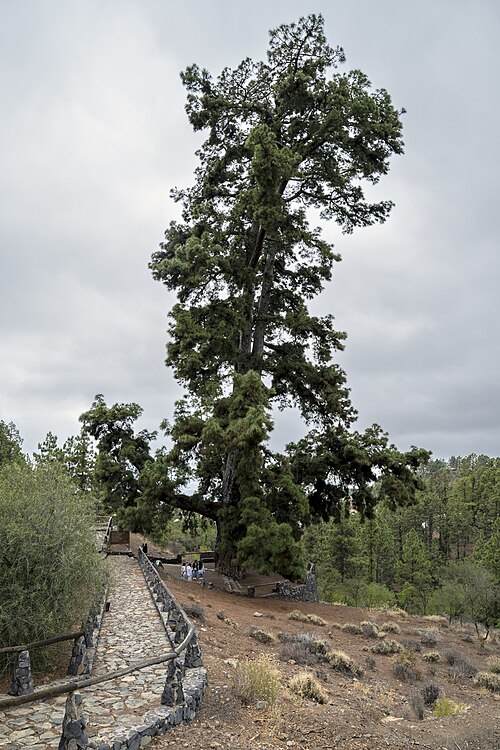
Canary Pine (Pinus canariensis) · 700-800 years · Vilaflor de Chasna
Vilaflor de Chasna put this tree on the town's coat of arms, which is a fair indication of how the place rates it against everything else it owns. Pino Gordo is a Canary pine with a trunk 9.36 metres around, the thickest native tree in Spain and widely called the most voluminous pine in Europe. It is also over 45 metres tall, which almost anywhere else would be the headline and here is not even the record at this viewpoint: the tree 150 metres up the trail is eleven metres taller. Estimates put it at roughly 700 to 800 years, meaning it was already a substantial pine when Castile finished taking the island in 1496, and a seedling several centuries before that. The bark carries fire scars. Canary pine is one of the few pines able to resprout straight from a scorched trunk, which is how a tree can spend seven centuries on a dry volcanic slope that burns and keep its crown. It grows at over 1,400 metres in the Corona Forestal, the pine belt that rings Teide, and reaching it costs nothing: a signed parking area off the TF-21 toward the Parador, then a marked trail of 150 to 200 metres, with benches and information panels at the tree.
Photo: Cayambe (CC BY 4.0)
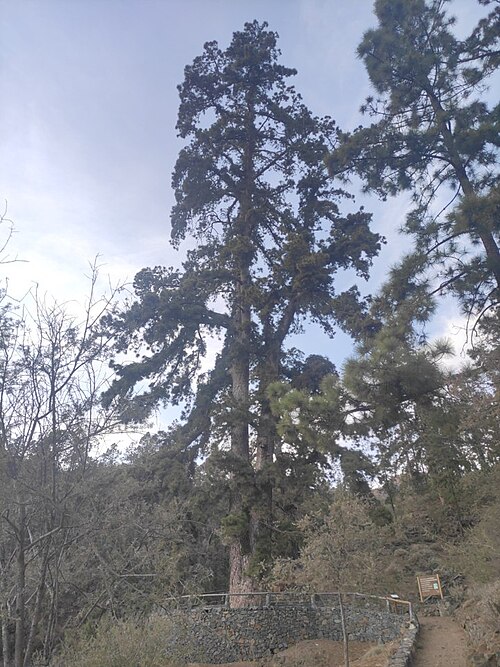
Canary Pine (Pinus canariensis) · 500-600 years · Vilaflor de Chasna
At 56 metres this is the tallest native tree in Spain, and it stands 150 metres from the thickest one. Pino de las Dos Pernadas is the taller and slimmer half of the pair above Vilaflor de Chasna: about eight metres around against Pino Gordo's 9.36, and roughly 500 to 600 years old against its neighbour's 700 to 800. The name is a description rather than a story. At around ten metres up, the trunk divides into two limbs of near-identical thickness that carry on skyward side by side, two legs, dos pernadas, and the split is the first thing you notice from the bench below. On the age estimates it germinated somewhere around the Castilian conquest of the island in the 1490s, and it has spent the centuries since on a slope that burns periodically; like every Canary pine here its bark is thick enough to survive fire that would kill most conifers outright. The setting is the Corona Forestal at over 1,400 metres, looking out over the pine belt below Teide. It is free, on the same short marked trail from the same parking area on the TF-21, which is what makes these two a genuine pair rather than two entries that happen to share a road.
Photo: Fry72 (CC BY-SA 4.0)
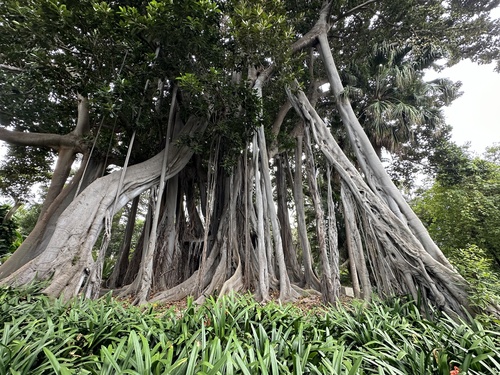
Moreton Bay Fig (Ficus macrophylla) · 150 years · El Botanico, Puerto de la Cruz
This tree keeps adding trunks. El Gran Ficus drops aerial roots from its branches, and the ones that reach the ground thicken, stiffen and set as columns, so what began as a single Moreton Bay fig is now a colonnade about 30 metres high that visitors walk into rather than around. It is the youngest tree on this list by centuries. The garden's Swiss head gardener Hermann Wildpret, in post from 1860 to 1893, planted it in the 1870s, which makes it roughly 150 years old; one guide puts it at about 200 without naming a planting date, and the documented planting is the better bet. The garden itself is far older, founded by royal order of Carlos III in 1788 and inaugurated in 1792 to acclimatise tropical plants to a European climate, so the fig is a latecomer to its own address by a century. Sources disagree on the fine print of what it is, some naming the Lord Howe Island form of the species rather than the mainland Australian one; nobody has settled it, and if you know, tell us. The garden is compact, about two hectares, and charges a few euros, but this is not a specimen you have to hunt for once you are through the gate.
Photo: Scott Shanks (CC BY)