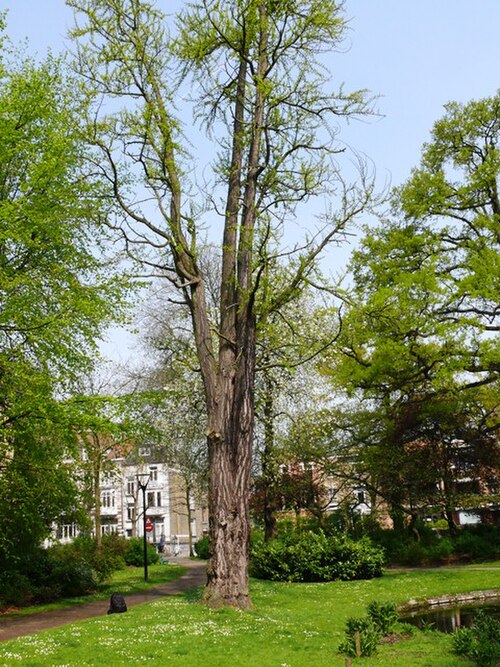
The Tree of Heaven of the Michael Lustig Monument
The memorial beside this tree is a drawing of its shadow. The tree went in first, planted in 1988 on the park strip along the Lindenlei; the monument followed ten years later, inaugurated on 8 May 1998, and its floor is black granite laid out in the shape the tree casts on the ground. Daniel Dutrieux designed it. Set into and around that shadow are a copper dreidel two metres across, a Star of David, granite blocks carrying the names of Jews deported from Ghent, and a Hebrew inscription taken from the first chapter of Lamentations. It is named for Michael Lustig, a rabbi arrested near this spot in 1943 together with his wife and their two children, and deported. Every November since 1999 the city and Ghent's Jewish community have gathered here to mark Kristallnacht. None of that makes the tree old, and it is not on this list pretending to be. A hemelboom planted in 1988 is young, and Ailanthus altissima is not a species anyone plants for permanence: it grows fast, seeds itself into gutters and railway embankments across Europe, and is usually cut down long before it amounts to anything. This one was left alone, grew, and a sculptor took the shape it throws on the pavement and cut it in stone.
The line is our estimate of how much there is to see, not a measurement. Typical for this species where this tree stands; exact weeks shift with the year.
Lindenlei, GentThe tree standing in the black granite floor of the monument, on the green strip along the Lindenlei canal. The two-metre copper dreidel is at its foot.
Free, public park strip along the Lindenlei canal, open at all times
Central Ghent, within the historic centre; roughly 10-15 minutes' walk from Gent-Sint-Pieters via the centre, or a short ride on any De Lijn line serving Korenmarkt
Sources
Where the facts on this page come from.