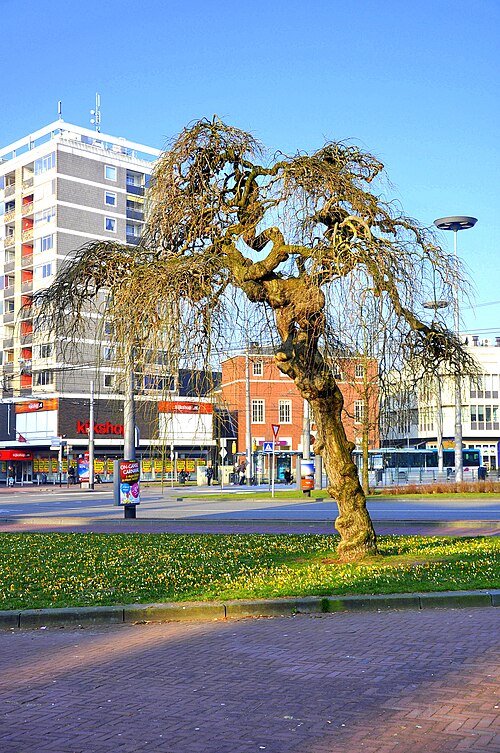
Nineteen designers entered a public competition in 1880 for what to do with a canal the city had just filled in, and Leonard Springer's plan, entered under the motto Natura, Ars et Technica, beat all of them. The park he built over the old Jansgracht became the Velperplein plantsoen, and this scarlet oak is one of its survivors, a North American species with no obvious business looking so at home in a Dutch civic square. Scarlet oak earns its planting for one trick, a canopy that turns a genuinely deep red most European oaks cannot manage, which is presumably why someone chose it here. The municipal monumental tree register dates its planting to somewhere around 1900 to 1910, a generation or two after Springer's own scheme went in rather than part of it, though the register's own file admits an earlier date is possible too. Either way it has stood through the plein's complete rebuilding between 1995 and 2005, when new roads, cycle paths, a bus station and a parking garage entrance were dug in around it. It grows in the park's southeast corner, a few steps from Musis Sacrum's front doors, unfenced and unticketed. If you know its planting date more precisely than the council does, tell us.
Autumn colour
October into November, when the canopy turns a deep, genuine scarlet
Velperpleinpark, near the corner with Van Muijwijkstraat, ArnhemYou can recognise it by a canopy that turns a deeper red in autumn than the oaks native to Europe. It stands in Velperpleinpark, near the corner with Van Muijwijkstraat.
Free, public park, open daily
Velperplein, city centre; about a 15 minute walk from Arnhem Centraal station
Sources
Where the facts on this page come from.
- In the official register: Landelijk Register Monumentale Bomen (Bomenstichting), no. 1687159
- Landelijk Register Monumentale Bomen v2024 (LRMB), Bomenstichting (nr 1687159)
- nl.wikipedia.org
- geo1.arnhem.nl
- services-eu1.arcgis.com