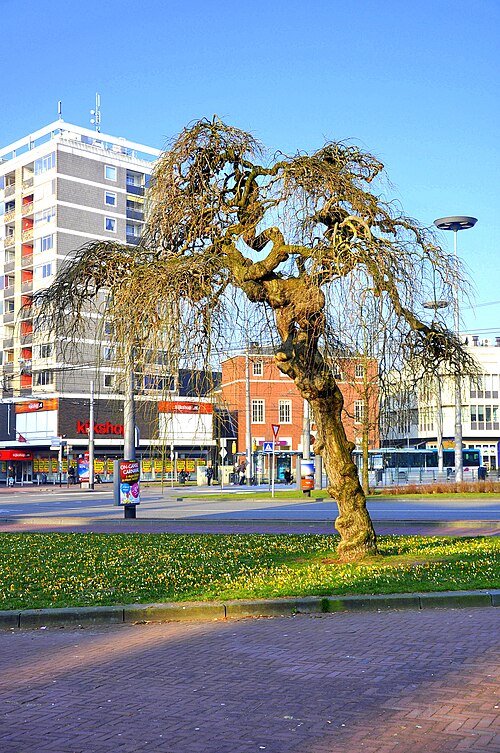
Every few years since 2006, whoever surveys Arnhem's monumental trees has come back to this black walnut and written down bad news: a conspicuous wound low on the trunk, a crown that had visibly thinned since the 1990s, deadwood spotted in 2014. In 2024 the surveyor found something new growing in the trunk cavity, a resin-varnish fungus, though likely a young colony rather than an advanced infection. And yet the same notes say that in recent years the tree has stood full and healthy in leaf, which reads either as a genuine recovery or as a walnut simply refusing to follow its own file. It grows in the strip of park on the northwest side of Velperplein, planted, the city's register guesses, around the same time as Leonard Springer's 1880 design for the square, though the tree's own dated band puts it a generation later, 1900 to 1910. Black walnut is an American import, grown here for its wood and its nuts rather than any native pedigree, and this one has outlived the plein's late 1990s and early 2000s rebuild, the new roads, cycle paths, bus station and a parking garage tunnel dug in around it. It still stands, free to see, on a corner of green between a 19th-century concert hall and a theatre.
The line is our estimate of how much there is to see, not a measurement. Typical for this species where this tree stands; exact weeks shift with the year.
Velperplein, green strip northwest of Musis Sacrum, ArnhemYou can recognise it by the conspicuous wound low on the trunk and the cavity above it, on a black walnut whose crown has thinned since the 1990s. It stands in the green strip on the northwest side of Velperplein.
Free, public park, open daily
Velperplein, city centre; about a 15 minute walk from Arnhem Centraal station
Sources
Where the facts on this page come from.
- In the official register: Landelijk Register Monumentale Bomen (Bomenstichting), no. 1687157
- Landelijk Register Monumentale Bomen v2024 (LRMB), Bomenstichting (nr 1687157)
- services-eu1.arcgis.com