Twenty-one monumental trees stand across seven parts of Alicante, fifteen of them figs. Ten cluster in the city centre around Plaza Gabriel Miró and Parque de Canalejas, where a pair of Australian silky oaks bookends the fig alignment. Two more wait a kilometre south in Benalúa. Plaza de Calvo Sotelo holds a Norfolk Island pine and an uncatalogued fig. In San Antón, a monkey puzzle and a group of nineteenth-century elms share the fenced Panteón de Quijano garden, and a Cook pine towers over three centenary olives in Plaza de Galicia.
0 of 21 visited in Alicante
Moreton Bay Fig (Ficus macrophylla) · 120 years · City centre, the square between the Ayuntamiento and Parque de Canalejas
Local press calls this the largest ficus in Spain's catalogue. The canopy is what earns the claim: 40.5 metres across on the Valencian register's own figures, thrown over a city square, on a trunk 10.65 metres round and a tree 25.3 metres tall. It is the thickest of the four Moreton Bay figs on Plaza Gabriel Miró and the widest of them by some margin.
Its age is the part nobody has settled. Todoalicante puts it at about 120 years, a figure the paper ties to that measured canopy. A rounder 170 also circulates, with no measurement behind it and no particular one of these four trees attached to it, so 120 is the number this page uses.
Ficus macrophylla comes from the east coast of Australia, and at this size it stops behaving like a street tree. Aerial roots come down from the limbs, thicken where they reach soil and fuse into the base, which is why the city has fenced the root plates of the figs on this square. That, and the fact that people climb them to be photographed.
The square has had a hard recent year. In September 2025 a centenarian elm broke and came down at the San Fernando corner of it, and the city ordered a review of every monumental tree on its books.
Moreton Bay Fig (Ficus macrophylla) · 90-140 years · City centre, the square between the Ayuntamiento and Parque de Canalejas
Twenty-six metres is tall for a fig. This is the tallest of the four Moreton Bay figs on Plaza Gabriel Miró, 26.6 metres on the Valencian register, with a trunk 10.32 metres round, and it stands on its own at the southern end of the square, about forty metres from the other three.
Nobody has dated it. What exists instead is the square. El Español puts the present layout at 1918, when the sculpture known as La Aguadora was installed, and treats that as roughly when these figs went into the ground. That is a reading of the setting rather than a record of a planting, so the honest figure is over a century, not a year.
The species is Australian, from the wet coastal forests of Queensland and New South Wales, where it germinates high in the crown of another tree and lets its roots down the host's trunk to the soil. In a Spanish square it has to start at ground level like everything else, and it compensates from above: limbs that run out horizontally, aerial roots dropping from them, props thickening into a second and third trunk.
El Español rates the Gabriel Miró group as probably the most notable ficus specimens in the country, with canopies over twenty-five metres. This one covers 31.5 metres of pavement.
Moreton Bay Fig (Ficus macrophylla) · 90-140 years · City centre, the square between the Ayuntamiento and Parque de Canalejas
The register calls this one number I, which turns out to be a filing decision rather than a ranking: of the four figs on the square it has the third-thickest trunk. Seven and a half metres round, 23 metres tall, a crown of 33 metres. In most European cities that is the biggest tree in town. Here it is the middle of the group.
No source dates it. The square took its present shape in 1918 and its figs are described together as over a century old, which is as close as the record comes to a number for this one.
What it does have is the ground under it. A mature Ficus macrophylla lifts its roots into buttresses and lets more down from the branches, so the base is a low tangle of grey props rather than a trunk with a clean edge to put a tape around. The 7.6 metres is a measurement of that tangle, taken where it is tightest.
Alicante has decided these trees are worth explaining. The city has fenced their root plates, because visitors climb them for photographs, and installed plaques beside them, making this square one of five signposted stops on a route through its monumental ficus.
Moreton Bay Fig (Ficus macrophylla) · 90-140 years · City centre, the square between the Ayuntamiento and Parque de Canalejas
The slimmest trunk on the square carries the second-widest crown on it. The Valencian register puts this fig at 6.4 metres round, the least of the four, and 19 metres tall, also the least, and then gives it a canopy 35 metres across. The other three went up. This one went sideways.
That is worth standing under. A low, wide Moreton Bay fig brings its horizontal limbs within a few metres of your head, and the aerial roots it drops from them hang in the space you are walking through. Where one reaches soil it thickens, takes weight, and in time stops being a root at all and becomes part of the trunk.
The Valencian catalogue treats each of these four figs as a monument in its own right, with its own entry and its own measurements rather than one line for the group. That reflects what a visitor actually finds on the square: four large trees of one species, none of them a copy of the others, one tall and narrow, one enormous in every direction, one middling and one that spread out at head height.
No planting date survives for this one. The four are described together as over a century old, and that is the honest range.
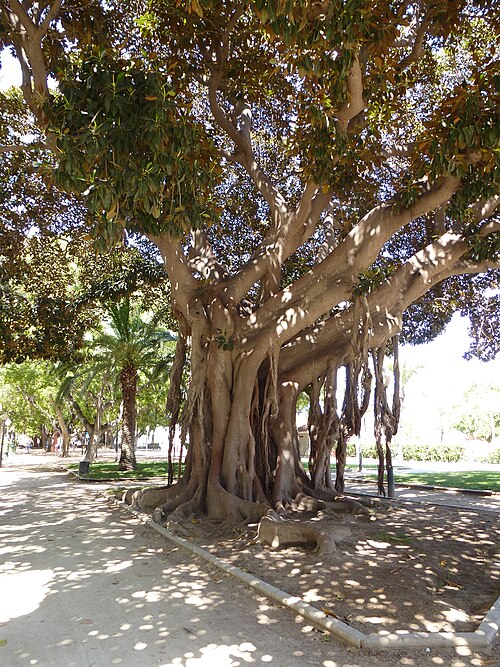
Moreton Bay Fig (Ficus macrophylla) · City centre, between the Explanada de España and the sports marina
Eleven and a half metres round the base, and nothing else on this walk comes close. The Ficus del Passeig de Canalejas is one of the few trees in the Valencian catalogue carrying a name of its own instead of a number, and the measurements back it up: 11.59 metres of girth, 20.8 metres of height, a crown 38.7 metres across the paseo.
The park around it was laid out in 1886 to a design by the architect González Altés, on the strip between the Explanada de España and what is now the sports marina. The Gabriel Miró square a few minutes north took its present shape in 1918; this ground was drawn thirty years earlier, and its figs have had the time to show it. Trunks that twist and fold, aerial roots let down from the limbs and grown thick enough to stand as second and third trunks, surface roots running out in slabs between the benches. One local account puts it plainly: these trees have accompanied several generations of Alicante residents.
Nobody has dated this one individually. The register measures rather than dates, and the park's Moreton Bay figs are described collectively as over a hundred years old. By El Español's count six of them stand here, alongside eleven Ficus nitida, which is reason enough to walk the paseo slowly.
Photo: Wikimedia Commons (panoramio) (CC BY 3.0)
Moreton Bay Fig (Ficus macrophylla) · City centre, between the Explanada de España and the sports marina
Seven metres of trunk holding up thirteen metres of tree. That ratio is the reason to stop here: the Valencian catalogue measures this fig at 7.05 metres round and only 13 metres tall, with a crown of 16, so from the path it reads as a wide grey mass at ground level with a fairly modest tree on top of it.
On a Moreton Bay fig the trunk is not really one stem. Aerial roots come down from the limbs, meet the soil, thicken, take load and fuse into the column, so a girth figure on this species measures the result of a process rather than a single stem that grew outwards. Seven metres of it is a lot of process.
The register lists this tree without a name, as a monumental tree of local interest, one of four standing within about twenty-five metres of each other. Nobody has dated it. What it has is the age the park has: Parque de Canalejas was laid out in 1886 and its Moreton Bay figs are described as more than a century old, which is a range rather than a birthday.
The park is free, open and a couple of minutes' walk from the four big figs on Plaza Gabriel Miró.
Moreton Bay Fig (Ficus macrophylla) · City centre, between the Explanada de España and the sports marina
Two registered figs stand about twenty metres apart here and they are visibly not the same tree. This is the taller one, 19 metres against its neighbour's 13, on the slimmer trunk, 6.35 metres round against 7.05, and it carries the wider crown at 21 metres. Same species, same park, same century, opposite habits: one built downwards into bulk, this one went up.
Both are listed in the Valencian catalogue as monumental trees of local interest, and neither is given a name there. So this one is identified the way a visitor identifies it, by where it stands and what it looks like, and no source anywhere puts a date on it. Parque de Canalejas was laid out in 1886 and its Moreton Bay figs are described as over a hundred years old, which is the range that honestly applies.
What the species offers at this size is the underside. Horizontal limbs, aerial roots hanging free of the ground with others already thick enough to carry weight, and surface roots running out across the soil in low ridges. It is an evergreen from the Australian east coast doing in a Mediterranean park what it does in a subtropical forest, minus the host tree it would normally have started in.
Moreton Bay Fig (Ficus macrophylla) · 150 years · Benalúa
The oldest fig in Alicante grew from a sapling taken before 1860 from the city's Agricultural Research plot, ground that is now the Jardín Botánico. It was replanted in the garden of a private house, the Chalet de Grau, and never moved again, even as everything around it did: the chalet became a shelter for minors, the shelter closed and was demolished in 1998, and the plot sat empty for years before the city decided to build a health centre on it.
The first plans put a car park under its crown. Neighbours in Benalúa organised against it, and the city moved the twenty-four parking spaces to the far side of the building instead, folding the tree into a small garden by the entrance. It was the tree's second rescue. An earlier mayor had once proposed lifting it whole to Plaza de Navarro Rodrigo, a few streets away, a transplant residents fought off as too risky for a tree already past its first century.
The city's own figure for the trunk is a startling 23.7 metres round, measured over the fused apron of aerial roots that a Ficus macrophylla grows once it settles in for a century. The regional government's monumental tree register, which measures the clean trunk beneath the roots, gives 14.69 metres instead, still the widest on any Alicante page. Either way, at over 150 years old, it is the oldest and thickest fig the city has.
Indian Laurel Fig (Ficus microcarpa) · Benalúa
Plaza de Navarro Rodrigo is one of Benalúa's oldest squares, laid out on land the Marqués de Benalúa donated to the city and named for the nineteenth-century politician and writer who represented Alicante in parliament. A fountain, a children's playground and a kiosk share the square with this one Indian laurel fig, its canopy wide enough, 27 metres across, that it shades most of the gardens on its own.
The tree is one of six sites across Alicante where the city has put up an information panel on its ficus population, alongside Plaza Gabriel Miró and Parque de Canalejas, warning against climbing the aerial roots or damaging the bark. Unlike the two celebrity figs a kilometre away, this one carries no recorded age at all. The Valencian government's register lists its measurements and its protected status and nothing else.
It nearly had company. A former mayor once proposed moving the giant Ficus de Benalúa here from its garden on Calle San Agatángelo, a transplant Benalúa's own residents fought off as too dangerous for a tree already past its first century. The plan died, the Benalúa fig never left its garden, and Navarro Rodrigo kept its one fig standing quietly among the flower beds instead.
Moreton Bay Fig (Ficus macrophylla) · Ensanche, beside Alicante's main railway station
Alicante's monumental-fig register carries a category most of its other trees do not: generic protection rather than the individually named local-interest status the city centre's figs hold. Read alone that could suggest an afterthought, but three independent sources put it plainly, this fig grows on the public forecourt outside the main entrance of Alicante's principal railway station, one of six sites the city itself chose for an information panel on its monumental figs. At 6.9 metres round and 28 metres tall, it is the largest of three planted together at the station facade, thick enough that most visitors stepping off a train would notice it without knowing to look. A 2026 report on the neighbouring Plaza de la Estrella redevelopment, the future entrance to a planned 2.1 kilometre green corridor through the city, calls the fig population here century old and says the trees will be kept as the new plaza's anchor rather than removed for it. No source dates this specific tree, so that stays a fact about the intersection rather than a number for the page. It stands close enough to Benalúa's two figs to fold into the same southern outing, a few minutes further down the same stretch of the city.
Indian Laurel Fig (Ficus microcarpa) · 80 years · Sant Roc, facing the Postiguet beach
A fig here has a crown 27 metres across, wide enough that its neighbour, growing nineteen metres away, is usually mistaken for the same tree. Alicante's regional tree register counts them as two separate Indian laurel figs, Ficus microcarpa, 2.67 and 2.85 metres round, 13 and 16 metres tall, and treats their shared plot in Paseito de Ramiro, facing Postiguet beach, as one small park rather than two addresses.
The city's own printed walking route through the old town is the only source that puts an age on them at all: about 80 years, tucked into an itinerary that also notes a 56-metre stretch of 16th-century city wall running through the same park. The ground has an older history than the figs do. It was once the medina's own souk, and in the early 20th century became one of Spain's first outdoor schools, named for the historian Rafael Altamira. Neither fact dates the trees themselves, only the plot they grew up in.
The park sits on the city's official Red de Senderos Urbanos walking route, a few minutes from the beach, free and open with no gate.
Moreton Bay Fig (Ficus macrophylla) · City centre, between the Explanada de España and the sports marina
Four Moreton Bay figs from the same nineteenth-century planting stand within forty metres of each other at Plaza Portal de Elche, and the trunks do not agree on how to grow. This one is the slender member of the group: 3.9 metres round against six to seven metres on its three neighbours, though at 14 metres tall with a 19 metre crown it holds its own overhead.
The plaza takes its name from a gate that once stood in the city wall here, on the road out toward Elche, torn down with the rest of Alicante's fortifications in the nineteenth century. What replaced the gate was greenery: this grove of figs has been pruned and maintained by the council for well over a century, including a heavy 2014 to 2015 pruning that made the local press under the headline "the elegant resurgence of the Portal de Elche figs."
Alicante's regional catalogue lists it as a monumental tree of local interest, unnamed beyond its register number. Nobody has dated the individual tree; the park itself opened in 1886, and its figs are generally put at more than a century old, which is the honest range rather than a birthday.
Free, public, about ten minutes on foot from the Luceros tram stop.
Moreton Bay Fig (Ficus macrophylla) · City centre, between the Explanada de España and the sports marina
The fourth and southernmost fig in this small grove stands nearest the point where a city gate, the Portal de Elche, once stood before Alicante pulled its walls down in the nineteenth century. It is a close match for its heaviest neighbour seven metres north: both run thirteen metres tall with a sixteen metre crown, and only the trunks properly disagree, 6.43 metres round against 7.05.
A 2015 piece on the council's own pruning of this grove names exactly four ficus at the Portal de Elche, distinguished by where they stand rather than by any individual history, which fits a planting laid down together from the same nursery stock. This one greets you first if you walk in from the Rambla de Mendez Nunez side.
Alicante's regional catalogue lists it as a monumental tree of local interest, without a name beyond its register number. No age survives for it specifically; the park opened in 1886 and its Moreton Bay figs are generally put at more than a century old, honestly a range rather than a date.
Free, public, about ten minutes on foot from the Luceros tram stop.
Indian Laurel Fig (Ficus microcarpa) · Carolinas Bajas
This ficus is one of thirteen Ficus microcarpa the city catalogues as monumental, named in a 2025 council press release that also describes the maintenance regime behind the health of these trees: root plates wrapped in coconut fibre and checked on a quarterly rotation, protection against the compaction of the busy plazas most of them stand in. It shares its own square, a small pedestrian plaza called Plaza de la Pipa in the Carolinas Bajas district, with a bronze sculpture by Eduardo Lastres, and faces what was once the city's tobacco factory, now the Las Cigarreras cultural centre.
At 2.12 metres around, the trunk is modest next to Alicante's giant Moreton Bay figs downtown, but the Valencian register gives it a higher individual protection category than most of the city's monumental ficus carry. The canopy explains why: Wikipedia's account of the plaza calls it simply gran copa, a big one, spread wide on a trunk that never had to compete for light.
Nobody has recorded when it was planted. If you know, tell us.
Norfolk Island Pine (Araucaria heterophylla) · a century · City centre, between Avenida Doctor Gadea and Avenida Federico Soto
A Norfolk Island Pine is neither a pine nor from anywhere near Spain. The species grows wild on one small island in the South Pacific, about eight kilometres end to end, and nineteenth-century gardeners carried it to every warm coast they could reach because it does something no Mediterranean native does. It builds itself in flat horizontal tiers, one stacked above the next, and it holds that shape in salt wind.
Alicante's grows on Plaza de Calvo Sotelo, the square everyone here calls the Plaza de las Palomas after its pigeons. Local historians describe it as centenaria, over a hundred years old, and that is as precise as anybody has been willing to be. There is no planting record and nobody has put a tape around the trunk. If you know either figure, tell us.
The city's own walking route through the old centre stops on this square and names three trees: an elm, a plane and this one. The araucaria is the only conifer of the three and the easiest to pick out from across the plaza, a dark green spire in a place otherwise built for shade. The square is one of Alicante's social and festival grounds, which means the tree has spent its entire life standing over crowds. It is free, unfenced and open at every hour, five minutes on foot from the trams at Luceros.
Fig (Ficus sp.) · a century · City centre, between Avenida Doctor Gadea and Avenida Federico Soto
Every June, the neighbourhood association wraps this fig in fireproof tarps before setting fire to the plaza around it. Plaza de Calvo Sotelo hosts one of Alicante's Fogueres bonfires, the city's answer to Valencia's Fallas, and the fig stands close enough to the pyre that its crown has been scorched more than once. In 2026 the flames got through anyway and burned back part of the canopy, prompting residents to ask the city for better protection. The bonfire commission's own history describes shielding the tree every year since around 2013, which makes it a fixture of the festival rather than a bystander to it.
It shares the square with the Araucaria already on this page, but it never made the city's list of protected monumental ficus, the same catalogue that covers the six-tree cluster in Parque de Canalejas and the grove at Portal de Elche. No plaque names it, no register measures it, and neither source willing to call it centenario says which fig it actually is. Alicante's other monumental specimens are mostly Ficus macrophylla, so that is the reasonable guess, but nobody has confirmed it. If you can tell one fig from another, we would like to know.
Free and unfenced, on the same corner where the barrio burns its monument each June and plants a new one straight after.
Monkey Puzzle (Araucaria araucana) · 100-125 years · San Antón
A small grove of monkey puzzle trees once filled the centre of this fenced nineteenth-century garden. Only one is left; its neighbours were removed over the years and replaced with younger stock that never caught up, leaving Araucaria araucana standing alone among the obelisk and monument of the Panteón de Quijano.
At around thirty metres and past its first century, it still wears the reptilian, tightly overlapping leaf scales that gave the species its English name and once armoured it against browsing dinosaurs on the volcanic slopes of central Chile, long before Alicante existed. The city's own tree catalogue puts it at 95 years; the contractor who now maintains the garden says closer to 100. Neither figure is precise enough to argue with the other.
It is one of three separate Araucaria species scattered across Alicante's public squares, alongside the Norfolk Island pine of Plaza de Calvo Sotelo and a far taller Cook pine over Plaza de Galicia. None of the three shares a square with either of the others, which says something about how whoever planted this city's gardens liked to spread a good conifer around.
The garden is fenced but not locked: an iron railing, a short staircase, open daily.
Cook Pine (Araucaria columnaris) · ~50 years · Ensanche Diputación, at the seaward end of Parque de Canalejas
Alicante's own walking route for its notable trees calls this the tallest on it: fifty metres, by the city's tree catalogue and by the contractor who maintains it, both citing the same figure independently. That number is worth a raised eyebrow rather than blind repetition: mature Cook pines rarely clear sixty to sixty five metres even in their native New Caledonia, and a cultivated specimen approaching fifty would be exceptional almost anywhere on Earth. It is what the city says, recorded as the city says it.
Planted by municipal gardeners sometime in the 1970s, though the two sources disagree by five years on exactly when. Araucaria columnaris grows as a single arrow-straight spire, its lower branches long since shed and replaced by short awl-shaped shoots pressed close against the trunk. Captain Cook noted the species on his third voyage and guessed, wrongly, that trunks this straight would make fine ship masts; New Caledonian Cook pine wood turns out to be too brittle for the job.
Plaza de Galicia opened as a public square in 1969, at the seaward end of Parque de Canalejas, on ground that had been a gas works. No gate, no closing hour. A few steps from the tree's base stands a small grove of three centenary olives, sharing the same open plaza.
Olive (Olea europaea) · 100-200 years · Ensanche Diputación, at the seaward end of Parque de Canalejas
Three olives stand close enough together in Plaza de Galicia to read as one small grove: the thickest just over three metres round, the other two a little more than half that. A 2013 newspaper survey of the city's biggest and oldest trees called all three centenary and left it there, no year count attached to any of them, which is the honest state of the record.
Olea europaea resists being dated by girth alone. The species survives fire, drought and heavy pruning by suckering back from its own base, so an old grove often turns out to be one tree that slowly became several, or several planted close enough to eventually read as one. Groves like this were common around Spanish towns and country estates for the better part of a century before anyone thought to write down when they went in.
The regional monumental-tree register lists all three individually, with their own girths, and no planting date, the same silence that covers most of Alicante's monumental figs: a register built to measure a tree rather than to date it.
Plaza de Galicia opened as a public square in 1969, on the site of a former gas works, at the seaward end of Parque de Canalejas. Free, unfenced, no closing hour. A soaring Cook pine, one of the tallest trees on the city's own singular-trees route, stands a few steps away.
Field Elm (Ulmus minor) · 100-200 years · San Antón
Dutch elm disease took most of Europe's elms and never arrived here. A 2013 Diario Información survey of Alicante's biggest and oldest trees lists the elms of Plaza de Santa Teresa among the specimens that have dodged the diseases, and says the fungus that cleared elms out of country after country never reached the city.
What nearly finished them was rot from the inside. Andrés Medrano, then running the municipal gardening workshop school, described the emergency surgery these trunks needed in 1990: the wood was rotten and the crews worked in masks. The trees came through it, and he was still pointing at them twenty-three years later.
The same survey places them in the nineteenth century and calls them typical of the romantic gardens of that era, planted as a group rather than as showpieces, which is how they still read. Nobody has published a count of them, nobody has taped a trunk, and they carry no register entry of their own. If you know how many stand here, tell us.
Their garden is the Panteón de Quijano, a memorial built between 1855 and 1857, with an obelisk at the centre and the last monkey puzzle in the city standing beside it. Iron railing, a staircase up from the plaza, open through the day.
Silky Oak (Grevillea robusta) · 100-150 years · City centre, between the Explanada de España and the sports marina, a few dozen metres from the Ficus del Passeig de Canalejas (ali_005)
Two trees standing eleven metres apart agree on their height to within a metre and disagree on their waistline by a factor of three. The Generalitat's monumental-tree catalogue registers them separately: one 19 metres tall with a trunk 1.05 metres round, the other 18 metres tall with a trunk of 3.75. Diario Información's 2013 survey of the city's tallest and oldest treats them as a matched pair at either end of the Canalejas fig alignment, around 19 metres, both of them over a century old. Nothing in the record explains the gap between those two trunks, so it stays a gap.
Neither of them is an oak. Grevillea robusta comes from the subtropical forests of eastern Australia, a relative of the banksia and the macadamia, and the Spanish name it goes by here, roble australiano, describes a leaf and nothing else. It also grows fast, which makes a trunk a poor clock: the century these two are credited with comes from the newspaper, not from a tape measure round the base.
The promenade itself was laid out to an 1886 design by the municipal architect José González Altés. No source records when the two silky oaks went in. They have spent their catalogued lives as the bookends of somebody else's avenue: the Moreton Bay figs between them are the trees people stop for, one of them nearly twelve metres round at the base. The pair stands at the ends of the row, easy to walk past a hundred times.