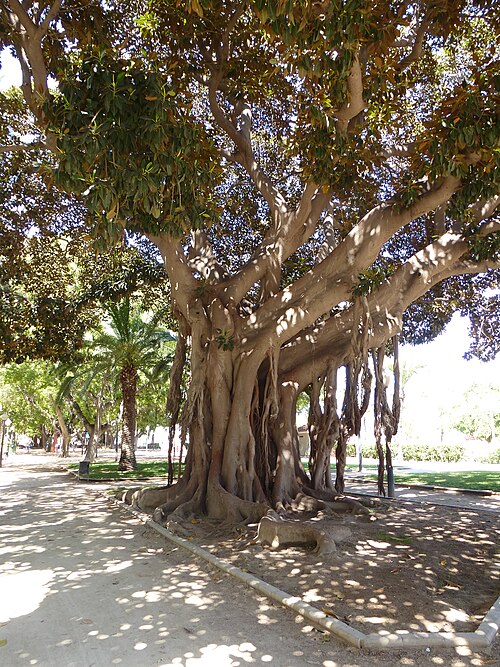
The Centenary Olives of Plaza de Galicia
Three olives stand close enough together in Plaza de Galicia to read as one small grove: the thickest just over three metres round, the other two a little more than half that. A 2013 newspaper survey of the city's biggest and oldest trees called all three centenary and left it there, no year count attached to any of them, which is the honest state of the record. Olea europaea resists being dated by girth alone. The species survives fire, drought and heavy pruning by suckering back from its own base, so an old grove often turns out to be one tree that slowly became several, or several planted close enough to eventually read as one. Groves like this were common around Spanish towns and country estates for the better part of a century before anyone thought to write down when they went in. The regional monumental-tree register lists all three individually, with their own girths, and no planting date, the same silence that covers most of Alicante's monumental figs: a register built to measure a tree rather than to date it. Plaza de Galicia opened as a public square in 1969, on the site of a former gas works, at the seaward end of Parque de Canalejas. Free, unfenced, no closing hour. A soaring Cook pine, one of the tallest trees on the city's own singular-trees route, stands a few steps away.
From people who stood here
No notes yet
Did you visit the tree? Leave a note for the next visitor.
Getting there
Plaza de Galicia, Alicante
A small grove of three registered olives standing together, within about fifteen metres of each other, in the same plaza as the tall araucaria (ali_018); the thickest of the three has a trunk just over three metres round.
Free, open public plaza (Plaza de Galicia), part of the 'El Parque' urbanization at the seaward end of Parque de Canalejas, no gate or opening hours
About 12-15 minutes on foot from TRAM Luceros (lines L1-L4); a continuation of the same waterfront walk as the Araucaria of Plaza de Galicia (ali_018), standing a few steps from it
In fruit
September to November: the harvest: the whole grove is netted and the fruit comes down, and the tree turns from green to black as it goes
The line is our estimate of how much there is to see, not a measurement. Typical for this species where this tree stands; exact weeks shift with the year.
Sources
Where the facts on this page come from. The story was written with AI from these sources, and readers who know the tree correct it.
- In the official register: Catálogo de Árboles Monumentales y Singulares de la Comunitat Valenciana (Generalitat Valenciana), no. 3085
- web.archive.org
- Generalitat Valenciana catálogo de árboles monumentales y singulares register (register_ids 3085, 3086, 3087; three individually registered Olea eu…
- es.wikipedia.org