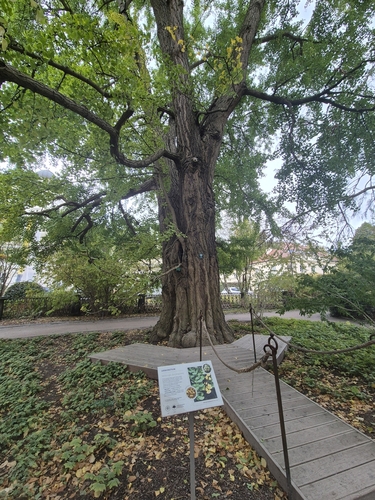
For almost two centuries, two pedunculate oaks have grown side by side in the Romantic Garden of Lazienki Krolewskie, the park Poland's last king built for himself in the 18th century. The palace museum's own page on the park's oldest trees states it plainly: both oaks measure 450 centimetres round and 28 metres tall, and both hold protected natural-monument status. That girth on a pedunculate oak points to real age, roughly two hundred years, old enough that the pair were already substantial trees when Poland was partitioned off the map of Europe entirely, decades before the country existed again to protect them. Lazienki is the most visited royal park in the country, its lake, palace and open-air theatre drawing crowds who mostly walk past two more oaks without a glance. These stand near the New Orangery, on the western side of the path called Chinska Droga, close enough together that a visitor can take in both in one stop. The garden itself is free every day, no ticket needed beyond the museum buildings and the odd ticketed pavilion, making this the easiest stop on the whole Warsaw list to fold into an ordinary afternoon in the park.
In fruit
September to October: acorns drop, and a good mast year buries the ground in them
The line is our estimate of how much there is to see, not a measurement. Typical for this species where this tree stands; exact weeks shift with the year.
Lazienki Krolewskie park, near the New Orangery, west side of the Chinska Droga path, SrodmiescieYou can recognise the pair by their matching girths, 4.5 metres round each, growing side by side. They stand in the Romantic Garden of Lazienki, near the New Orangery on the Chinska Droga path.
Free, the park gardens are open daily to the public at no charge (only some buildings/museum interiors are ticketed)
Bus or tram to Lazienki Krolewskie, short walk within the park to the New Orangery area
Sources
Where the facts on this page come from.