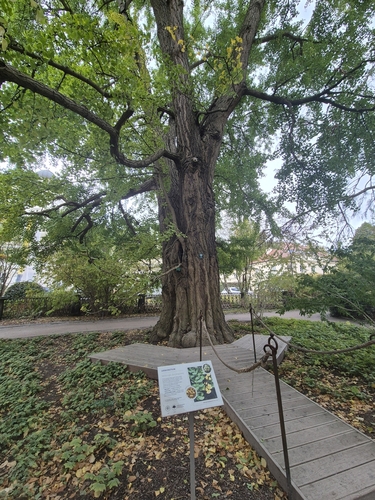
The Columnar Oaks of the Observatory Entrance
You need a ticket to see this treePaid entry to the Botanical Garden of the University of Warsaw: 24 zl full, 12 zl reduced; 12 zl for everyone on Mondays from March to October. Open 10:00 to 18:00 in March and April, 10:00 to 20:00 May to August, 10:00 to 18:00 in September, 10:00 to 17:00 in October; the ticket office closes an hour earlier. The garden's page gives no outdoor hours for November to February (greenhouses closed), so check before a winter visit.
Two columnar oaks stand either side of the entrance nearest the garden's astronomical observatory, upright and narrow in a way ordinary pedunculate oaks never grow on their own: Quercus robur 'Fastigiata' is a cultivated form, bred to stay compact rather than spread the wide crown the species is known for. Warsaw designated the pair as protected natural monuments only in October 2024, one of the university garden's newest additions to a collection that also protects trees three centuries older. The two are individually measured rather than treated as a single unit: one stands 19 metres tall with a trunk 335 centimetres round, the other 20 metres and 345 centimetres, close enough in size to read as a matched pair from the path but genuinely two different trees with two different numbers. They stand about fifty metres from the garden's celebrated 1824 ginkgo, the same stop on the same visit, though a Warsaw institution's habit of taking its oldest trees seriously by cataloguing its youngest as well is the more unusual thing about them.
Ogrod Botaniczny Uniwersytetu Warszawskiego, observatory entrance, Aleje Ujazdowskie 4You can recognise them by their narrow, upright columnar shape, unlike an ordinary oak's wide crown. They stand either side of the entrance nearest the garden's observatory.
Tram or bus to Plac Na Rozdrozu, right by the garden gate on Aleje Ujazdowskie; also walkable from Metro Politechnika (M1 line)
Sources
Where the facts on this page come from.