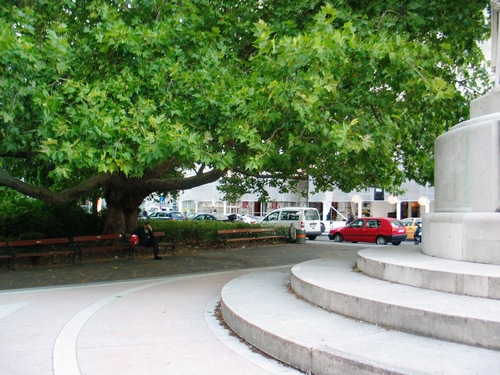
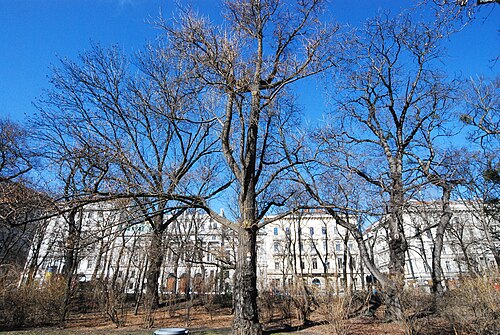
This tree has been quietly absorbing a piece of iron fence for two and a half centuries. The plane in the Fähnrichhof, a courtyard just off Singerstraße in Vienna's old town, grew directly through part of the railing that once enclosed St Stephen's Cathedral's own graveyard, closed to burials in the 1730s. The fence is no longer visible today. Vienna's own natural monument record notes it as sealed inside the trunk by decades of callus growth, the tree's version of scar tissue closing over a wound. A 1987 expert assessment measured the trunk at two and a half metres around, the crown at ten metres across, and put the tree's age at more than 250 years even then, which makes it well past 280 today. It stands in a courtyard once attached to the Domherrenhof, the residence of St Stephen's cathedral canons, reachable on foot through a passage from Blutgasse that locals call a Durchhaus, one of the old town's many semi-hidden pedestrian shortcuts between streets. The glass door at the Blutgasse end is usually left open during the day. Almost nobody outside the neighbourhood knows this tree exists, let alone that it is quietly digesting a piece of ecclesiastical ironwork nobody has seen in living memory.
The line is our estimate of how much there is to see, not a measurement. Typical for this species where this tree stands; exact weeks shift with the year.
Fähnrichhof courtyard, off Singerstraße 11 / Blutgasse 3, 1010 WienYou can recognise it by the trunk, two and a half metres round when it was measured in 1987, under a crown ten metres across. It stands alone in the Fähnrichhof courtyard, through the passage from Blutgasse 3.
Free, via the public Blutgasse-Fähnrichhof passage; the glass door is usually open during the day but can occasionally be locked
3 min walk from Stephansplatz U-Bahn station (U1/U3), via the Blutgasse passage
Sources
Where the facts on this page come from.
- In the official register: Naturdenkmale (Stadt Wien, MA 22), no. 3257855
- de.wikipedia.org
- geschichtewiki.wien.gv.at