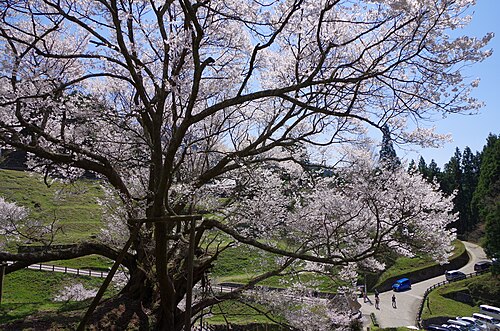
Yatsufusa means eight clusters, and the sources cannot agree that there are eight. Nara's prefectural tourism board counts eight trunks and puts nine metres around the base. Japanese Wikipedia counts six, one of them thrown down by a typhoon in 1979 and still alive on the ground, and arrives at 13.5 metres of girth by adding each trunk separately, from 1.2 metres up to 8.4, rather than running a tape around the foot of the whole thing. Two counts, two ways of measuring, and no way to reconcile them from a desk, so here are both. What everyone agrees on is the shape. The trunks are fused at the base and twist around each other on the way up, roughly 20 metres of them, a form the Japanese describe as a reclining dragon. That oddity is precisely why the botanist Miyoshi Sakuichi had it listed as a National Natural Monument on 25 April 1932, for academic value rather than for looks. It stands beside the shrine building at Sakurami Shrine and has been held up since the 1970s on steel cables anchored in concrete, the cost split between the state, the prefecture, the city and the shrine, and harder to raise every year as the village around it empties. Nobody has established an age. The only date anyone offers is a legend about Emperor Jinmu. If you know better, tell us.
Sakurami Shrine, Utano-Sakura, Uda City, Nara PrefectureYou can recognise it by its trunks fused at the base and twisting upward together, a shape called the reclining dragon, held up on steel cables since the 1970s. It stands beside the Sakurami Shrine building in Uda.
Free, on the grounds of Sakurami Shrine (public shrine precinct, open ground, no fee or gate mentioned by any source).
Kintetsu Osaka Line to Haibara Station, then a bus toward the Utano area followed by roughly a 60-minute walk; or by car via National Routes 369/166 and Nara Prefectural Road 31 from the Hari interchange of the Nara Expressway.
Sources
Where the facts on this page come from.