Three protected trees across three districts of Uda City, Nara Prefecture: Matabei-zakura, a weeping cherry lit after dark each April and used in the opening titles of an NHK drama, the Sen'nen-zakura, a hybrid cherry over 900 years old at Butsuryuji temple, and the Yatsufusa Sugi, a cluster of fused cedar trunks whose count of six or eight nobody has settled. All are National or Prefectural Natural Monuments.
0 of 3 visited in Uda
Weeping Cherry (Prunus itosakura 'Pendula') · 300 years · Ouda, Uda City
The cherry is named after a general who ended up on the losing side. Goto Matabei fought for the Toyotomi, and after that clan fell he is said to have settled here in Ouda. The tree stands on the ground where his family's residence used to be.
Locals also call it Taki-zakura, the waterfall cherry, which is the better description of what it does. Thirteen metres tall, the trunk over three metres round, and the branches of a weeping cherry falling in a curtain to the ground. In the first half of April it is lit after dark and the village runs a festival around it.
The rest of the country met it in 2000, when NHK used it in the opening titles of the taiga drama Aoi: Tokugawa Sandai. That is the year a village tree became a national one.
Its age is put at about 300 years. Both sources hedge that carefully, saying it is what people say rather than what anyone has measured, and the hedge stays where they put it. Nara Prefecture lists it as a protected tree.
Nothing is gated and there is no entry fee. During the bloom you pay about 500 yen to park, and you will not have it to yourself.
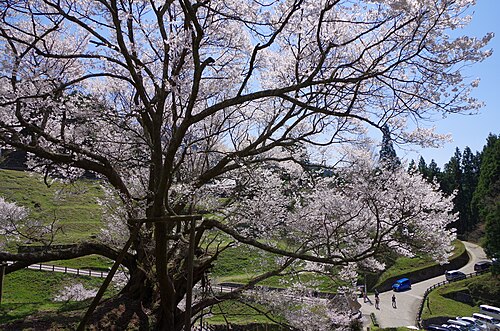
Cherry (Prunus sp.) · 900 years · Haibara, Uda City
Most cherry trees are finished inside a century. This one is reckoned to be over 900 years old.
The Sen'nen-zakura stands beside the stone steps climbing to Butsuryuji, in the Haibara district of Uda City, and Nara Prefecture calls it the largest and oldest cherry in the prefecture. The trunk is 7.7 metres round. About two metres up it breaks into eleven limbs, large and small, and the whole tree reaches 16 metres. It is a Mochizuki-zakura, a local hybrid of the mountain cherry and the Edohigan, and Edohigan is the parent behind Japan's famously long-lived cherries, which is the reason a figure like 900 is arguable at all.
Take that figure as inherited rather than measured. It is the prefecture's own claim, repeated by every source we found, with nothing contradicting it and nobody showing their working. The popular name goes further: sen'nen means a thousand years, and the tree gets called a thousand-year cherry on the strength of the nickname alone. Over 900 is what the register says, so over 900 is what we print.
Bloom is early to middle April, lit until nine at night. The grounds cost 200 yen, another 300 if you want the main hall, and there is a 100 yen box for the cherry's own upkeep, which at this age is not a formality.
Photo: Nankou Oronain (as36… (CC BY-SA 3.0)
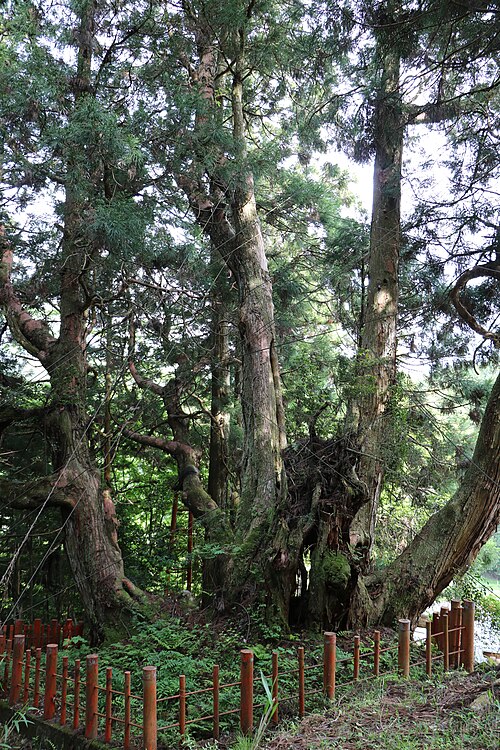
Japanese Cedar (Cryptomeria japonica) · Utano, Uda City
Yatsufusa means eight clusters, and the sources cannot agree that there are eight.
Nara's prefectural tourism board counts eight trunks and puts nine metres around the base. Japanese Wikipedia counts six, one of them thrown down by a typhoon in 1979 and still alive on the ground, and arrives at 13.5 metres of girth by adding each trunk separately, from 1.2 metres up to 8.4, rather than running a tape around the foot of the whole thing. Two counts, two ways of measuring, and no way to reconcile them from a desk, so here are both.
What everyone agrees on is the shape. The trunks are fused at the base and twist around each other on the way up, roughly 20 metres of them, a form the Japanese describe as a reclining dragon. That oddity is precisely why the botanist Miyoshi Sakuichi had it listed as a National Natural Monument on 25 April 1932, for academic value rather than for looks.
It stands beside the shrine building at Sakurami Shrine and has been held up since the 1970s on steel cables anchored in concrete, the cost split between the state, the prefecture, the city and the shrine, and harder to raise every year as the village around it empties.
Nobody has established an age. The only date anyone offers is a legend about Emperor Jinmu. If you know better, tell us.
Photo: さかおり (CC BY-SA 4.0)