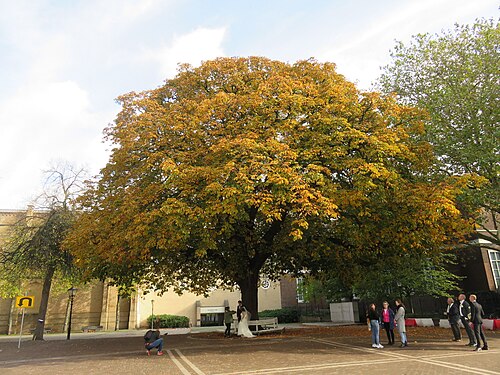
The Oak of the Scheveningseweg Jewish Cemetery
NetherlandsThe HagueZorgvliet
This oak was planted in a burial ground that had already been in use for a century and a half. The Jewish cemeteries on the Scheveningseweg date from the 1690s, opened outside the built up city because that was where the Jewish community of The Hague was permitted to bury its dead, on ground either side of the straight road Constantijn Huygens had laid out three decades earlier to link the city with the sea. The register dates the oak to the 1840s, which puts it a little under two centuries old. Jewish burial custom leaves a cemetery undisturbed once the graves are in place, so ground like this is often the least altered land in an old European city, and trees on it grow up without the pruning, digging and replanting that shapes a park. What came later is not the tree's story, but it is the ground's. The Jewish population of The Hague numbered around seventeen thousand before the war and most of them did not come back. The cemeteries survived. The oak stands inside the wall, in a quiet place that is not open every day, so check the hours before you make the trip.
In fruit
September to October: acorns drop, and a good mast year buries the ground in them
The line is our estimate of how much there is to see, not a measurement. Typical for this species where this tree stands; exact weeks shift with the year.
Joodse begraafplaats, Scheveningseweg, Den HaagYou can recognise it as the oak standing inside the wall of the Jewish cemetery. It stands on the Scheveningseweg; check opening hours, as the burial ground is not open every day.
In the Jewish cemetery on the Scheveningseweg, an enclosed burial ground that is not open every day; check the opening hours before travelling
Tram along the Scheveningseweg, about 15 minutes from Den Haag Centraal
Sources
Where the facts on this page come from.
- In the official register: Landelijk Register Monumentale Bomen (Bomenstichting), no. 1689457
- Landelijk Register Monumentale Bomen v2024 (Bomenstichting), register nr 1689457: Zomereik, Joodse begraafplaats, Scheveningseweg, Den Haag, planti…
- Bomenstichting Den Haag, 2026-08-18: the local branch pointed us at the national register as the source for The Hague's monumental trees; register…
- services-eu1.arcgis.com