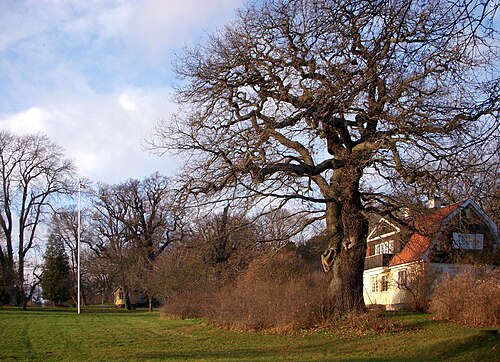
Karl XI:s ek (Fiskartorpseken)
This oak has grown into the wall of a royal fishing cottage rather than around it. The cottage, Karl XI:s fiskarstuga, was built in the 1680s as a retreat for King Charles XI beside Husarviken bay, inside what was then an enclosed royal hunting ground reserved for the crown's own use, and the oak beside it began growing at roughly the same time, which puts it at 330 to 350 years old. The trunk now presses directly against the cottage's yellow wall and roofline, the two grown together into one another over three centuries. It was already hollow enough by the late 1950s that the trunk was filled with concrete to hold what remained, a repair recorded on top of Rutger Sernander's 1930s measurement of 6.1 metres round. In 1835 the Scottish geologist Charles Lyell used this oak and a second one nearby, on Norra Djurgarden, as fixed points to measure how far Stockholm's shoreline had risen out of the sea since earlier surveys, fieldwork that fed directly into the theory of postglacial rebound Charles Darwin later drew on. The other oak, Lyell's own reference tree half a kilometre away, is already on this list. Every oak inside the Royal National City Park is protected from felling by the park's own statute, this one included, still standing exactly where a king once fished.
Beside Karl XI:s fiskarstuga, Fiskartorpet, Norra Djurgarden, Stockholm You can recognise it by the trunk pressed into the cottage's yellow wall, grown into the building rather than beside it, 6.1 metres round. It stands at Karl XI's fishing cottage, Fiskartorpet.
Free, inside the Royal National City Park (Kungliga nationalstadsparken) on Norra Djurgarden, open year round. The oak grows against the outer wall of a protected historic building not open to enter, but the tree itself is on the surrounding public park ground and fully viewable and reachable from the path.
Bus toward Fiskartorpet/Uggleviksvagen, then a short walk; nearest metro is Universitetet, about 20-25 minutes on foot.