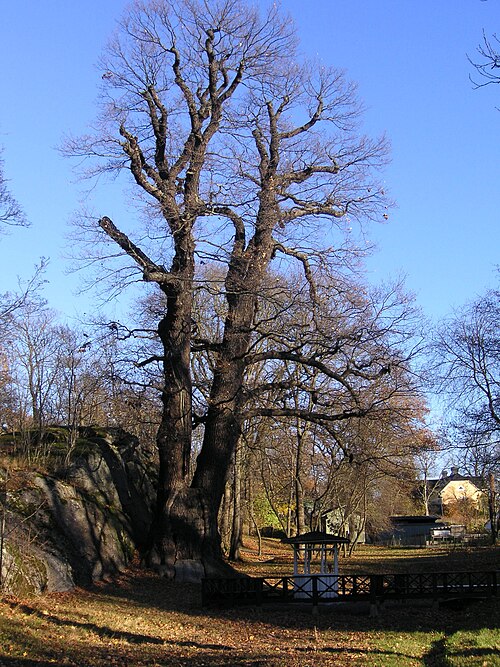
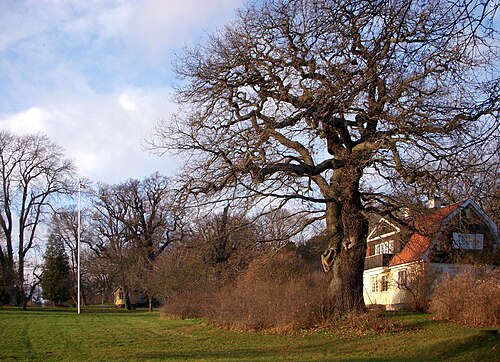
Somebody cut this tree open trying to steal a signature. Tradition holds that the poet Carl Michael Bellman carved his name into the bark after sitting beneath it improvising songs on his mandolin, the setting for one of his Fredman's Epistles; an English autograph hunter later cut the carved name clean out of the trunk to keep as a souvenir, and the oak began rotting from that wound inward. By about 1890 the crown was failing badly enough that nearly every branch was sawn off. What was left, hollow and unstable, got filled with cement and bound in iron bands to hold it together, the standard nineteenth-century repair for a tree nobody wanted to lose but didn't know how to save. The botanist Rutger Sernander inspected the result in 1926 and called the pruning completely thoughtless and brutally ignorant. By 1969 the writer Gunnar Brusewitz described what remained as a deplorable remnant. It is still alive, its crown still putting out new growth every year, standing outside the Hasselbacken restaurant beside a statue of the poet it is named for, on the same stretch of Djurgarden where King Gustav III reportedly came incognito to watch ordinary Stockholmers at leisure. Nobody has established its age since the concrete went in; if you know it, tell us.
Outside Hasselbacken, Djurgardsslatten, Sodra Djurgarden, Stockholm You can recognise it by the cement fill and iron bands holding its hollow trunk together, beside a statue of the poet Carl Michael Bellman. It stands outside the Hasselbacken restaurant on Djurgardsslatten.
Free. Stands on open public ground outside the Hasselbacken restaurant on Sodra Djurgarden, right beside the Bellman statue; reachable at any time.
Tram 7 or bus 69 to Grona Lund/Liljevalchs, then about 5 minutes on foot.