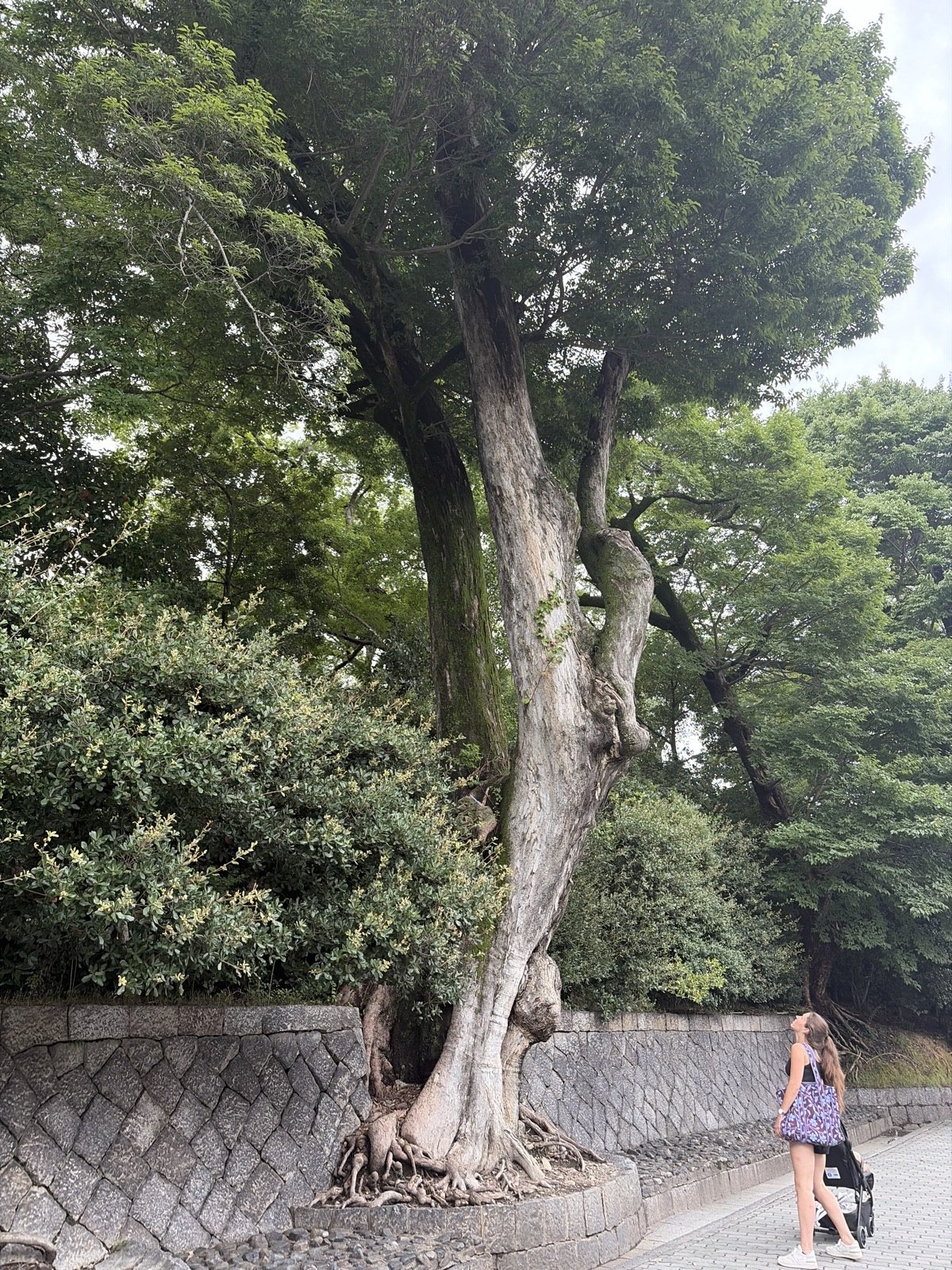
Go looking for the old chinkapin at the Omiya gate and this is the tree that catches your eye.
Aphananthe aspera
Muku is a tree most of Japan has walked past without learning its name. We map 3 of them, in 2 cities.
Its leaves dry rough enough that woodworkers once used them to sand wood, horn and lacquer, and in autumn it drops small dark fruit that birds strip and people once ate straight off the ground. It seeds easily and grows fast on undisturbed soil, which is why it turns up old on shrine land: nobody there had a reason to cut it. Two stand on hamlet shrine ground north of Hiroshima, at Kirihata and Furosaki, each measured once by a government survey and never written about since. The third, at Kyoto's Omiya Gate in Kyoto Gyoen, has not even been formally identified: its bark and leaves suggest muku, but nobody has taped its girth or entered it on a register.
Go looking for the old chinkapin at the Omiya gate and this is the tree that catches your eye.
The famous tree at Kirihata Shrine is not this one.
There is a bus stop called Furosaki Jinja-mae, meaning in front of Furosaki Shrine, and it puts you on the doorstep.
Explore by city: Kyoto · Hiroshima · Prague · Brussels · Seville · Munich · Porto · Brisbane · every city · or browse all species.