In Dutch this tree is the doodsbeenderenboom, the dead men's bones tree.
Kentucky Coffeetree
Gymnocladus dioica
The genus this tree belongs to has exactly two species in the world, this one and a Chinese cousin, and it survives mostly because people kept planting it. We map 5 of them, in 5 cities.
The Kentucky coffeetree takes its English name from settlers who roasted and ground its seeds as a coffee substitute, a recipe not worth reviving since the raw seeds and pods are toxic. What gives it away is timing: it leafs out later than almost anything nearby, often not before late May, then drops early and spends the rest of the year as bare, blunt grey branches, so stark that the Dutch call it the dead men's bones tree and the French call it chicot, stump. Bordeaux's, over 130 years old, is fenced and pruned around cavities in its trunk. Ottawa's went in near Queen Elizabeth Driveway around the turn of the twentieth century, and Idaho's largest stands in Boise's Julia Davis Park.
Brussels
Berlin
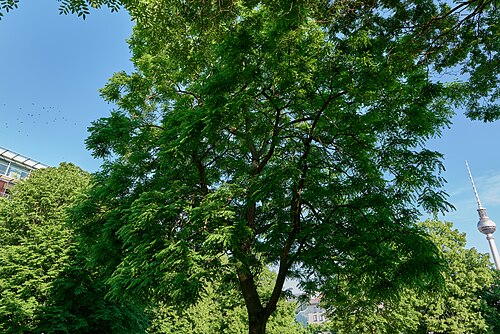
In German this tree is called the Geweihbaum, the antler tree, and in winter you can see why.
Boise
The largest Kentucky coffeetree in Idaho grows in a city park that also holds an art museum and a zoo.
Bordeaux
The French call this tree chicot, meaning stump, because its winter silhouette is so bare and so sparsely branched that people assume it has died.
Ottawa
The name is literal.
Explore by city: Brussels · Berlin · Boise · Bordeaux · Ottawa · Prague · Seville · Munich · every city · or browse all species.