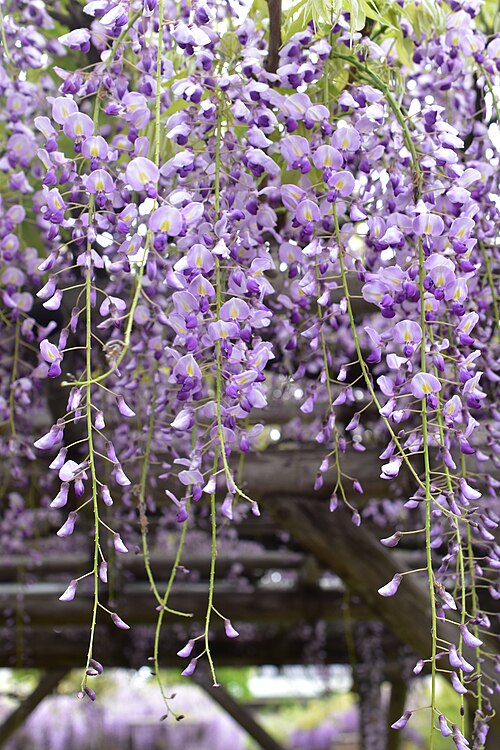
Claude Monet may owe part of his water lily garden to this shrine, according to art historians who trace a line from Hiroshige's woodblock prints to Giverny.
Photo: Fred Cherrygarden (CC BY-SA 4.0)
Wisteria floribunda
Japanese wisteria is a vine, and it can outlive almost any tree around it. We map 6 of them, in 6 cities.
The Great Wisteria of Ushijima, near Kasukabe, is put at roughly 1,200 years, four metres round at the base and trained across a trellis of 600 to 700 square metres; it is the only wisteria Japan protects as a Special Natural Monument, and the garden around it opens for about three weeks a year. At Yama-jinja, near Mount Fuji, two vines seeded themselves and climbed unassisted, granted national monument status in 1928. Ichinohe's vine, several hundred years old by local account, is untrained too. Tokyo's Kameido Tenjin wisteria has a claim stranger than its age: art historians trace a line from Hiroshige's 1856 print of it, arched drum bridge and all, to the wisteria Monet later planted at Giverny.
Claude Monet may owe part of his water lily garden to this shrine, according to art historians who trace a line from Hiroshige's woodblock prints to Giverny.
Photo: Fred Cherrygarden (CC BY-SA 4.0)
Two wild wisteria vines grow in the grounds of a shrine named for them: Yama-jinja, whose fuller name, Yamanokami no Fuji, means the wisteria of the mountain god.
Seven wisteria and one other vine have ever been given Japan's National Natural Monument status, the country's highest tier of tree protection, and this is the northernmost of them.
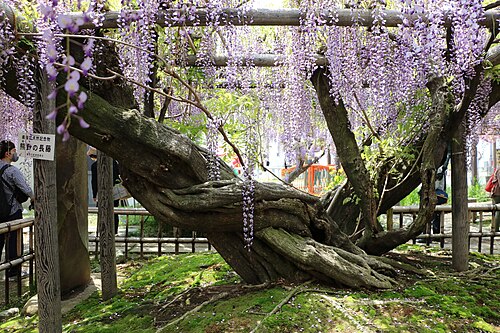
The kanji in this wisteria's name is usually read Kumano.
Photo: さかおり (CC BY-SA 4.0)
Japan protects exactly one wisteria at its highest heritage rank, and this is it.
The longest flower chain recorded on this wisteria measured 180 centimetres.
Explore by city: Tokyo · Fujikawaguchiko · Prague · Brussels · Seville · Munich · Porto · Brisbane · every city · or browse all species.